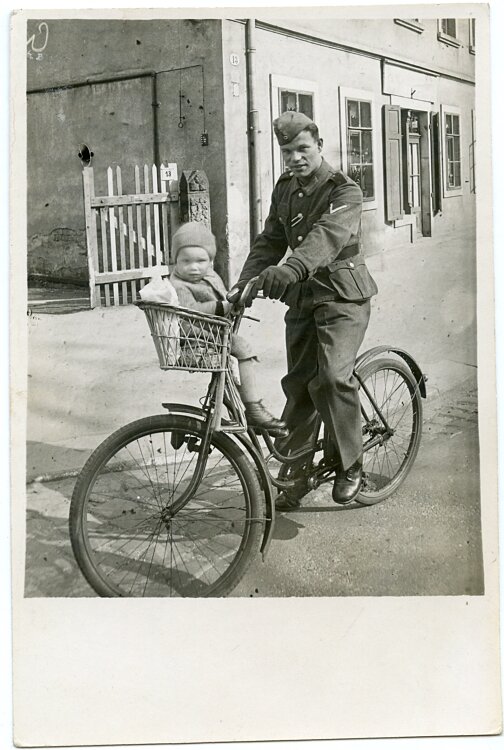
Photograph, Gefreiter of the Wehrmacht on a Bicycle
This object is a postcard-sized photograph showing a Gefreiter (lance corporal) of the Wehrmacht on a bicycle. Such images were widespread during World War II (1939-1945) and document an important but often overlooked aspect of German warfare: the significance of the bicycle as a military means of transport.
The Wehrmacht employed bicycles extensively, particularly in infantry divisions. As early as the 1930s, the German Army High Command recognized the advantages of bicycle troops. Bicycles offered mobility without fuel consumption, required minimal maintenance, and enabled faster movement than foot marches. Infantry divisions particularly had their own bicycle companies, and some units were fully organized as bicycle battalions.
The rank of Gefreiter was the first enlisted rank above the simple soldier. A Gefreiter had already completed some service time and possessed basic knowledge and experience. Promotion to Gefreiter typically occurred after approximately six months of service, depending on performance and conduct. Gefreiters wore a single chevron on the left upper arm of their uniforms.
Photographs in postcard size were the standard format for private soldier photographs. These pictures were frequently taken by professional photographers in barracks or at the front, but could also be made by comrades with private cameras. Soldiers sent these photos to their families or kept them as mementos. The postcard format (approximately 9 x 14 cm or 10 x 15 cm) was practical as it was easy to send and store.
The military use of bicycles by the Wehrmacht reached its peak during the Western Campaign of 1940 and Operation Barbarossa in 1941. During the invasion of France and the Benelux countries, numerous infantry units moved on bicycles, which enabled them to keep pace with motorized formations. In the Russian campaign, bicycles proved particularly useful in the first months, although poor road conditions and the coming winter severely limited their usability.
The Wehrmacht's bicycle equipment was standardized. The most commonly used models came from German manufacturers such as Brennabor, Diamant, Dürkopp, and Opel. Military bicycles were robustly constructed, with reinforced frames and resistant tires. They often featured special mountings for military baggage, rifles, and equipment. The characteristic field-grey paint corresponded to the Wehrmacht's general camouflage philosophy.
Such photographs possess significant documentary value today. They show not only the technical aspects of military equipment but also the human side of war. Soldiers often posed proudly for such photographs, which underscores the propagandistic dimension of these images. Simultaneously, they offer authentic insights into uniforms, equipment, and the daily life of ordinary soldiers.
The condition grade 2 indicates a well-preserved photograph with possibly slight signs of use. According to common collector categories, this means the photo is complete and clearly recognizable but may show slight signs of aging such as edge creases, minimal discoloration, or light wear marks.
From a historical perspective, such everyday documents are valuable for understanding Wehrmacht organization and the lived reality of soldiers. They supplement official documentation and propaganda material through their personal dimension and help historians reconstruct a more complete picture of military history. These seemingly simple photographs serve as important primary sources for researchers studying the social history of the Wehrmacht, military technology, and the experience of ordinary soldiers during the Second World War.