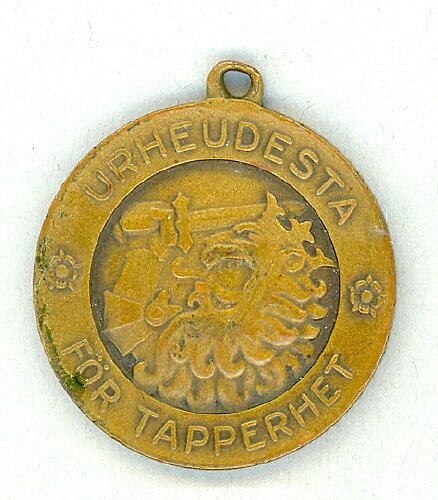
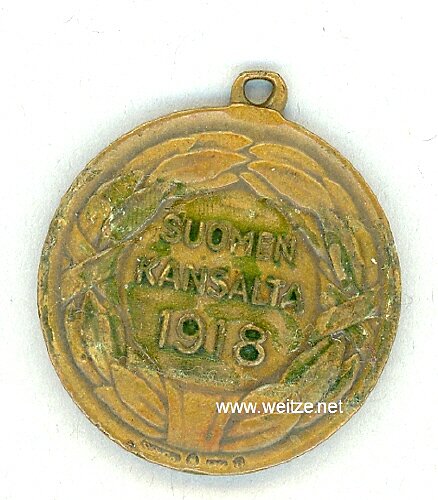
Finland Liberty Medal in Bronze 1918
The Finnish Freedom Medal (Finnish: Vapaudenristi, Swedish: Frihetskorset) represents one of the most significant decorations in Finnish history, symbolizing the struggle for national independence during the Finnish Civil War of 1918. This medal was instituted immediately after the bloody conflict that shook the young nation, which had only gained independence in December 1917.
The medal was established on May 4, 1918, by the Commander-in-Chief of the White Guards, General Carl Gustaf Emil Mannerheim. The Finnish Civil War, which lasted from January 27 to May 15, 1918, was a devastating conflict between the bourgeois “White” Guards and the socialist “Red” Guards. The Whites fought for a democratic republic independent from Bolshevik Russia, while the Reds sought to establish a socialist revolution.
The bronze version of the Freedom Medal constituted the third class of this decoration. The medal was awarded in four classes: the Freedom Cross 1st to 4th Class, with the first two classes typically made of silver and adorned with swords, while the 3rd Class (bronze with swords) and 4th Class (bronze without swords) were designated for common soldiers and supporters of the White cause. The bronze version described here belongs to the more numerous awards.
The medal's design features a characteristic Latin cross with widened ends on the obverse, surrounded by a laurel wreath. At the center of the cross, there is typically the Finnish coat of arms or another national symbol. The reverse usually bears the year 1918 and inscriptions in both Finnish and Swedish, Finland's two official languages.
In total, approximately 78,000 Freedom Medals were awarded during and immediately after the Civil War, reflecting the massive mobilization of the Finnish population in this existential conflict. The bronze versions comprised the largest proportion, as they were given to common fighters, militiamen, and civilian supporters of the White movement.
The historical significance of this decoration is ambivalent. For the victors of the Civil War, it symbolized the successful defense of Finnish independence against the Bolshevik threat. For the losers and their descendants, however, it remained for a long time a painful symbol of national division. Approximately 37,000 people lost their lives in this civil war, many of them dying in prison camps from starvation and disease.
The absence of the ribbon, as mentioned in the description, is not uncommon with historical specimens. The original ribbon was designed in the Finnish national colors of blue and white, with different classes of the medal having slightly different ribbon configurations. The ribbon was attached to the medal through a ring suspension.
After World War II, the 1918 Freedom Medal partially lost its official significance as Finland sought to heal the deep wounds of the Civil War and promote national reconciliation. Nevertheless, it remains an important historical document and a sought-after collectible that documents the turbulent founding phase of the Finnish Republic.
For collectors of military antiques, the bronze Freedom Medal represents an authentic testimony from a decisive phase of European history. Bronze versions are more commonly found on the collector's market than the higher silver classes, making them accessible to those beginning to collect Finnish militaria. When authenticating, attention should be paid to the quality of the striking, the material, and the characteristic features of different manufacturers.
Today, the Finnish Freedom Medal stands as a poignant reminder of a nation's struggle for independence and the tragic divisions that can accompany revolutionary periods. It remains an important artifact for understanding early 20th-century Finnish history and the broader context of European political upheaval following World War I.