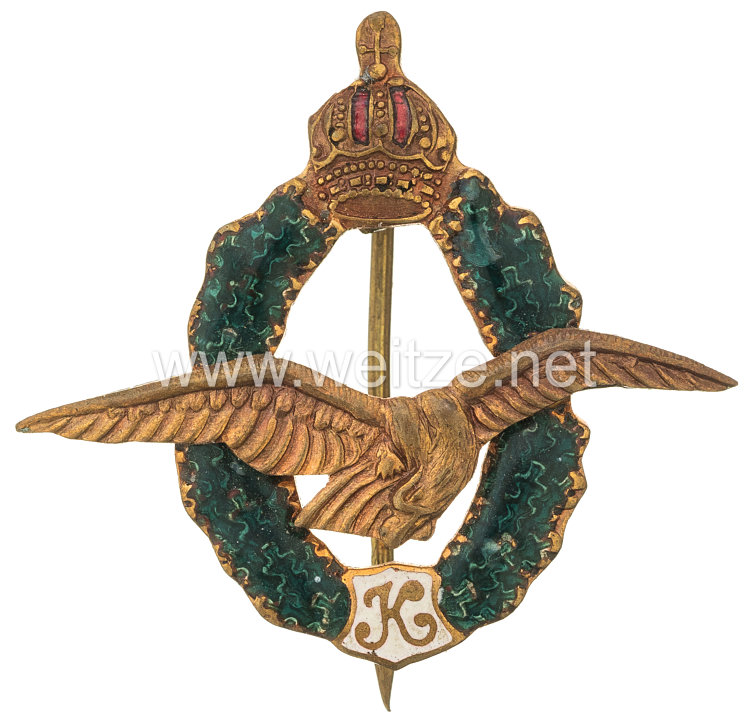
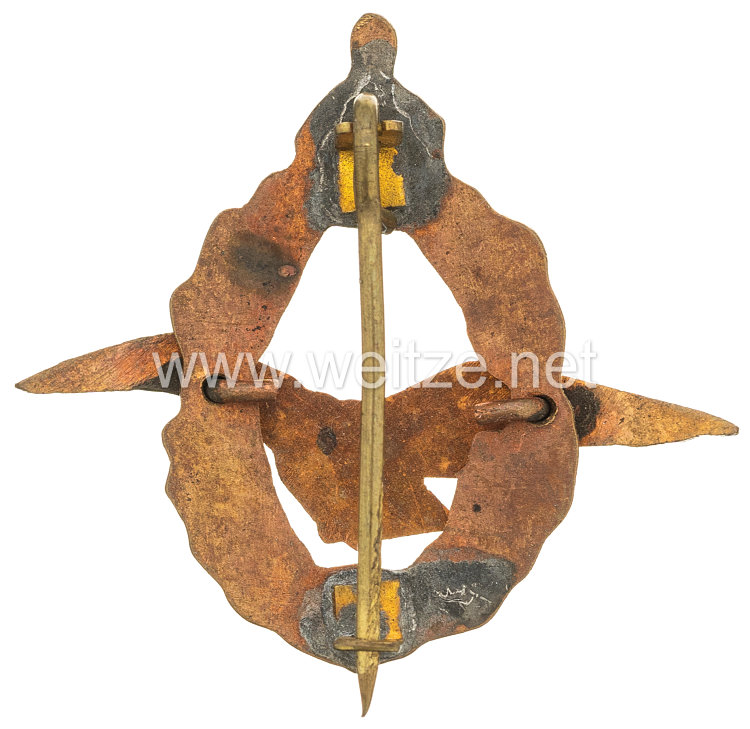
Austria K.u.K. Monarchy World War I Field Pilot Badge 2nd Model 1916/17 - Miniature

27 mm, the wreath finely enameled, 2nd model still with only 1 crown, with coat of arms shield “K” for Emperor Karl.
448480
350,00

Austria K.u.K. Monarchy World War I Field Pilot Badge 2nd Model 1916/17 - Miniature

The Austro-Hungarian Field Pilot's Badge represents one of the most significant military decorations of the k.u.k. Monarchy during World War I. This miniature version of the second model from 1916/17 is a remarkable example of the Habsburg Empire's military award culture during the late war period.

The Field Pilot's Badge was instituted on February 21, 1913 by Emperor Franz Joseph I and was originally intended for military pilots who had completed their aviation training. With the outbreak of World War I in 1914, this decoration gained considerable importance as aviation rapidly developed into a decisive military factor.

The first model of the badge featured the characteristic laurel wreath with two crowns – the Austrian Imperial Crown and the Hungarian Crown of St. Stephen – symbolizing the Dual Monarchy. Following Emperor Franz Joseph's death on November 21, 1916, and the accession of his grandnephew Emperor Karl I, the badge was modified.

The second model presented here is historically significant as it features only one crown and bears the coat of arms shield “K” for Emperor Karl. This change reflects the political and dynastic transformations during the final phase of the k.u.k. Monarchy. The use of the monogram “K” instead of the traditional “FJ” for Franz Joseph marks a clear break in Habsburg military decoration iconography.

The miniature version measuring 27 mm in diameter was intended for wearing on civilian clothing or full dress uniforms. While the regular-sized badge was worn on field uniforms, miniatures allowed wearers to discreetly display their decoration on less formal occasions. The fine enameling of the wreath testifies to the high craftsmanship quality of Austrian decoration manufacturers such as Rothe in Vienna or Schneider in Prague.

The technical execution of this miniature with enameled laurel wreath demonstrates the continuation of the Viennese enameling tradition even under the difficult wartime conditions. The enameling process required specialized craftsmen and multiple firings at high temperatures, making production elaborate and costly.

The laurel wreath as a classical symbol of military honor and valor had a long history in Habsburg tradition. Its combination with the crown and imperial monogram emphasized the direct connection between the pilot and the monarch as supreme war lord.

During Emperor Karl I's reign from 1916 to 1918, relatively few pilots were awarded this badge, as training capacities were limited by material shortages and increasing military strain. This makes examples of the second model particularly rare and historically valuable today.

The k.u.k. Aviation Troops played a remarkable role in World War I despite material inferiority compared to the Allies. Pilots such as Godwin Brumowski, the most successful Austro-Hungarian fighter ace with 35 confirmed victories, contributed to the legend of Habsburg military aviation.

The end of the Dual Monarchy in November 1918 also meant the end of this award tradition. The successor states – Austria, Hungary, Czechoslovakia, and Yugoslavia – developed their own systems of military honors. Nevertheless, the k.u.k. pilot badges remained in memory as symbols of a vanished era.

Today, such miniatures are important testimonies of Austro-Hungarian military history and are equally valued by collectors and museums. They document not only the technical development of aviation but also the political upheavals during the final years of the Habsburg Monarchy.