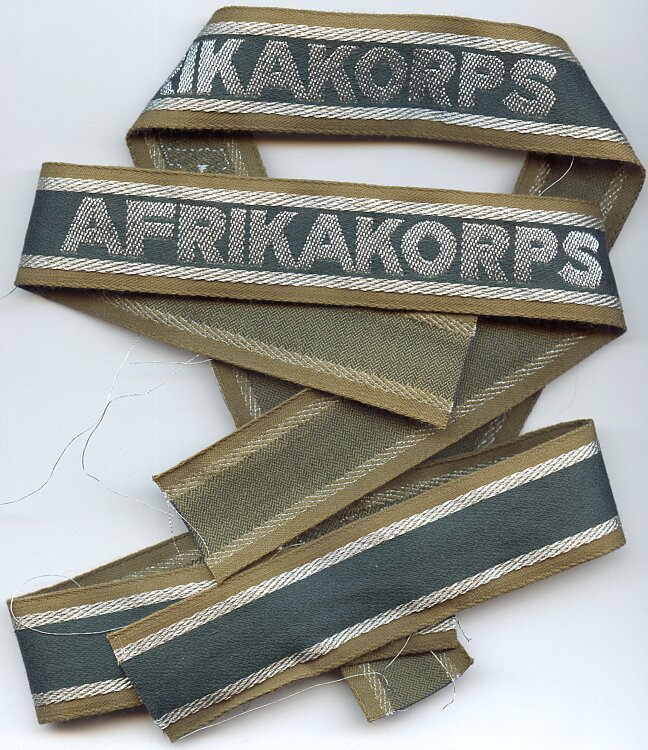
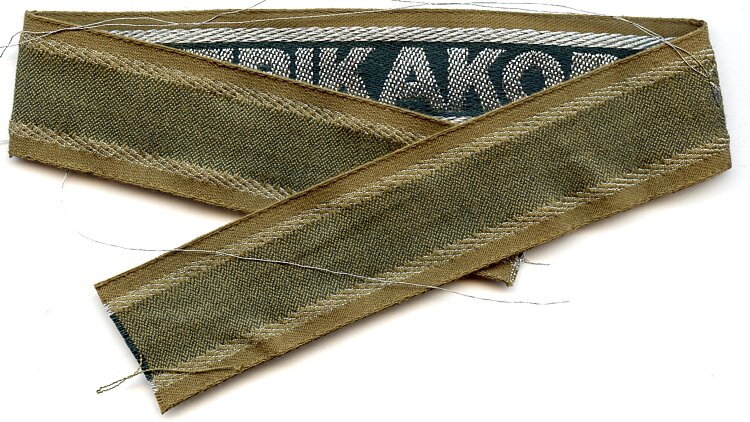
Museum Reproduction - Wehrmacht Cuff Title "Afrikakorps"
The Afrika Korps cuff title ranks among the most recognized and sought-after insignia of the German Wehrmacht during World War II. The present object is a museum reproduction from around 1980, replicating the historical originals from the period between 1941 and 1943.
The Deutsches Afrikakorps (DAK) was established in February 1941 under the command of Lieutenant General Erwin Rommel to support Italian forces in North Africa. The cuff title was instituted on July 18, 1941, by decree of the Wehrmacht High Command and served as special recognition for soldiers who had served at least six months in the North African theater of operations or were wounded there.
The original cuff title consisted of a sand-colored or silver-gray fabric strip bearing the inscription “AFRIKAKORPS” in Latin block letters. It was worn on the right upper arm of the uniform, approximately two centimeters below the shoulder seam. The design was deliberately simple, yet distinctly different from other Wehrmacht cuff titles through its characteristic coloring, which reflected the desert environment.
The award criteria were clearly defined in the Heeresverordnungsblatt (Army Regulations Gazette): Eligible were all members of the Wehrmacht and Waffen-SS who were deployed within the command area of Panzergruppe Afrika (later German-Italian Panzer Army). Personnel from the Luftwaffe and Kriegsmarine directly involved in operations could also receive the award.
The North African campaign lasted from 1941 until the capitulation of German-Italian forces in Tunisia in May 1943. During this period, the Afrika Korps developed into a legendary unit whose reputation was highly regarded by both friend and foe. The extreme climatic conditions, the vastness of the desert, and the intense combat left lasting impressions on the soldiers.
After the war, a significant collectors’ market developed for military memorabilia, including cuff titles. Due to high demand and limited supply of originals, numerous reproductions and museum copies emerged from the 1960s onward. These reproductions serve legitimate purposes such as museum exhibitions, historical reenactments, or collections when properly identified as such.
The present museum reproduction from circa 1980 represents this category of historical reproductions. It was manufactured during a period when scientific and museum interest in World War II increased and professional standards for historical replicas were being developed. Such objects possess independent cultural-historical value as documents of memory culture and the ways subsequent generations have engaged with military history.
For collectors and historians, distinguishing between originals and reproductions is crucially important. Original cuff titles display specific characteristics: the type of weaving technique, the materials used (which varied due to wartime conditions), signs of aging, and often wear patina. Museum reproductions, however, typically show more modern manufacturing techniques and materials.
The study of such objects today serves primarily historical education and documentation of military equipment. They enable museums and educational institutions to present history in a tangible way without having to rely on expensive and rare originals.
Understanding the context of both original insignia and their reproductions contributes to a comprehensive historical understanding of the period and the subsequent development of historical consciousness and collecting culture.