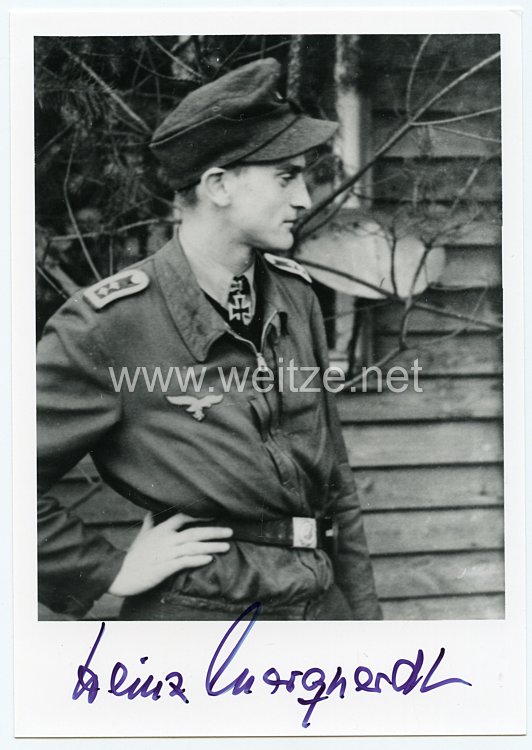
Luftwaffe - Postwar Signature of Knight's Cross Recipient Heinz Marquardt

on a photograph, dimensions: 10.4 x 14.2 cm, condition 1
446180
20,00

Luftwaffe - Postwar Signature of Knight's Cross Recipient Heinz Marquardt

Post-War Signature of Knight's Cross Recipient Heinz Marquardt - Historical Context

This object represents a fascinating testimony to German military history of World War II and the post-war period: a post-war signature of Knight's Cross recipient Heinz Marquardt on a photograph. Such documents form an important category of military-historical collectibles and shed light on the complex memorial culture of the post-war era.

Heinz Marquardt was a German fighter pilot of the Luftwaffe during World War II. Born on May 11, 1922, in Stettin (now Szczecin, Poland), he joined the Luftwaffe and was trained as a successful fighter pilot. Marquardt primarily flew the Messerschmitt Bf 109 and the Focke-Wulf Fw 190. During his military career, he achieved numerous aerial victories, primarily on the Eastern Front, which earned him various military decorations.

On March 12, 1945, Marquardt was awarded the Knight's Cross of the Iron Cross, one of the highest military decorations of the Third Reich. This honor was bestowed for exceptional bravery in combat or outstanding military leadership. At the time of the award, Marquardt had achieved approximately 121 confirmed aerial victories. He served in various fighter wing units, including JG 52, one of the most successful fighter wings of the Luftwaffe.

After the war's end, Marquardt survived the conflict and returned to civilian life. Like many former military personnel of the Wehrmacht and Luftwaffe, he became part of a veteran community that existed in Germany and internationally during the post-war decades. These communities organized meetings, maintained camaraderie, and kept alive the memory of their fallen comrades - a phenomenon that was controversially discussed in post-war German society.

The practice of giving autographs and signatures on photographs developed in the post-war period into a widespread phenomenon among collectors of military-historical memorabilia. Veterans, particularly bearers of high decorations such as the Knight's Cross, were often asked for their signatures at meetings, by mail, or during private encounters. These signed photographs served multiple purposes: they were souvenirs, collector's items, and documented the authentic connection between the historical event and the living person.

In the context of military-historical collecting, such post-war autographs gained particular significance from the 1970s and 1980s onwards. With increasing temporal distance from the war and the advancing age of veterans, a growing interest in authentic, personalized memorabilia emerged. Collectors and historians valued these objects both for their documentary worth and as personal connections to history.

The photograph itself, on which the signature was placed, likely shows Marquardt in his Luftwaffe uniform or in another military representation from the war period. Such photographs were often taken from official propaganda images, personal archives, or subsequently reproduced from historical sources. The dimensions of 10.4 x 14.2 cm correspond to a common postcard format frequently used for autograph purposes.

The legal and ethical aspects of collecting Nazi militaria are complex in Germany and internationally. While collecting historical objects for educational and documentation purposes is generally legal, trade in certain symbols and insignia is subject to strict regulations. The German Criminal Code (§ 86a) prohibits the use of unconstitutional symbols, but makes exceptions for historical, scientific, and educational purposes. Post-war signatures themselves do not fall under these prohibitions, as they do not propagate forbidden symbolism but represent historical documents.

The condition of the present signature is indicated as “Condition 1,” which in collector's nomenclature typically denotes the best possible state of preservation - without damage, creases, or discoloration. This significantly increases both the historical and monetary value of the object.

In modern military-historical research, such autographs serve as primary sources for biographical studies and as tools for authenticating other documents. They enable researchers to trace the post-war activities of veterans and to study the development of memorial culture. At the same time, they call for critical engagement with German military history and the question of how societies deal with their past.

Heinz Marquardt passed away in 2003, meaning that his post-war signatures are no longer available and existing specimens form a closed corpus of historical documents. This lends such objects additional historical significance as irretrievable testimonies of a bygone era.