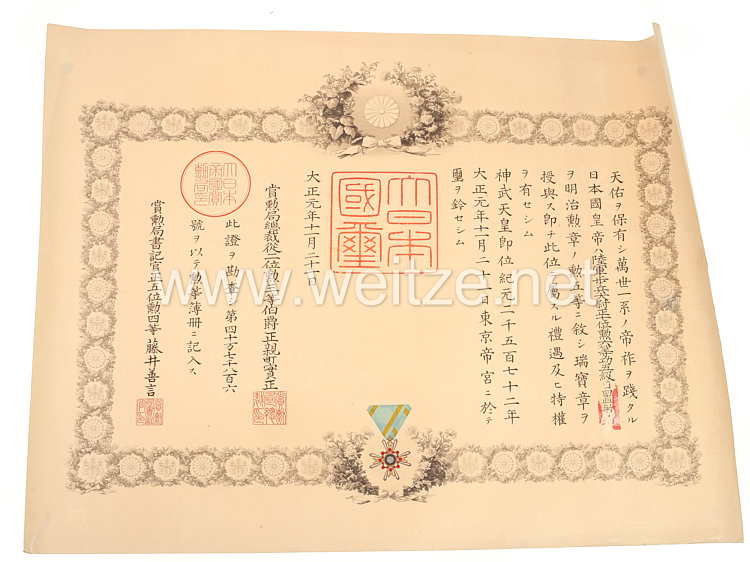
Japan, Award Certificate - Order of the Holy Treasure 5th Class

Dimensions approx. 59 x 45 cm, Taisho 1 (1912), rolled up, document is slightly damaged, condition 2.
377380
110,00

Japan, Award Certificate - Order of the Sacred Treasure 5th Class

This award certificate for the Order of the Sacred Treasure, 5th Class from the first year of the Taishō Era (1912) represents a significant document from a transitional period in Japanese history. This specimen dates from the year when Emperor Yoshihito ascended the Chrysanthemum Throne, inaugurating a new era that would last until 1926.

The Order of the Sacred Treasure (Japanese: Zuihō-shō) was originally established on January 4, 1888, by Emperor Meiji and belonged to the most important decorations of the Japanese Empire. The designation “Sacred Treasure” refers to the legendary imperial regalia of Japan - the sword, mirror, and jewel - known as Sanshu no Jingi, which symbolize the divine legitimacy of imperial rule.

The order was divided into eight classes, with the first class representing the highest decoration. The 5th Class, to which this certificate belongs, was a middle rank and was typically awarded to officials, mid-ranking officers, teachers, local dignitaries, and meritorious citizens. This class recognized significant, though not exceptional, services to the Japanese state.

The year Taishō 1 (1912) was of great political significance. Emperor Meiji, under whose reign Japan had transformed from a feudal state into a modern industrial nation and military power, died on July 30, 1912. His son Yoshihito ascended the throne as Emperor Taishō, and the new era officially began. The continuity of order conferrals during this transition underscores the stability of Japanese state institutions.

The award certificates themselves were elaborate documents produced with great care. They typically measured approximately 59 x 45 cm and were made on high-quality Japanese paper (washi). They contained the imperial text in classical Japanese, often featuring ornate calligraphy, as well as the imperial seal (Goshin'ei). The certificates were traditionally stored rolled, following the Japanese tradition of scroll art.

The design followed strict regulations of the Imperial Household Agency (Kunaichō). The text of the certificate was composed in formal, reverential language and stated the recipient's name, the reason for the award (if specified), and the date. The imperial seal conferred official authority and authenticity to the document.

The Order of the Sacred Treasure differed from the Order of the Rising Sun (Kyokujitsu-shō) in that it was primarily awarded for specific merits in civil service, while the Order of the Rising Sun honored military and exceptional civilian achievements. The 5th Class of the Sacred Treasure was particularly common among local administrative officials, teachers with long service records, and individuals who had served their communities with distinction.

During the Taishō Period (1912-1926), often referred to as the era of “Taishō Democracy,” Japan experienced a phase of relative liberalization. Despite these social changes, the order system remained an important element of state recognition and social hierarchy. The conferral of an order was not only a personal honor but also a sign of social prestige for the entire family.

The physical condition of the certificate - rolled and with minor damage - is typical for documents over a century old. The rolled form was the traditional Japanese method of storing important documents and allowed for space-saving storage. Minor damage is not unusual for documents from this period and minimally affects their historical value.

After World War II, the Japanese order system was fundamentally reformed. The Order of the Sacred Treasure was restructured in 1955 and is still called Zuihō-shō today, but is awarded according to different criteria. Pre-war certificates like this one from 1912 are now sought-after collector's items and important historical documents that provide insight into the social and administrative structure of imperial Japan.

Such certificates are of interest not only to collectors of military and civil decorations but also to genealogists, Japanologists, and historians studying the Meiji and Taishō periods. They document the names of individuals who held some significance in Japanese society of their time and help reconstruct social networks and career paths.

The 5th Class order itself typically consisted of a silver medal with a suspended ribbon in the order's distinctive colors. The design featured stylized representations of sacred objects and mirror patterns, executed with the fine craftsmanship for which Japanese metalwork was renowned. Recipients would wear the decoration on formal occasions, and possession of such an honor carried both social prestige and certain privileges within the hierarchical structure of Japanese society.

r