Indian Land Pattern Socket Bayonet, Modified

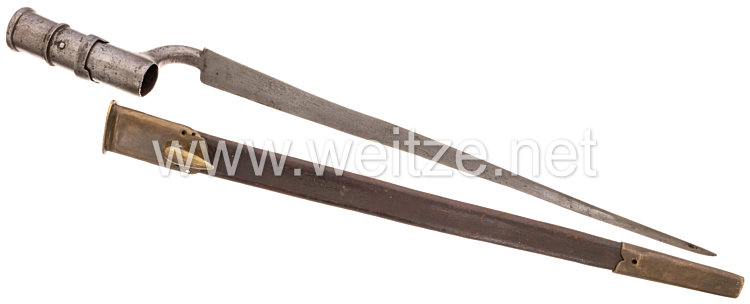
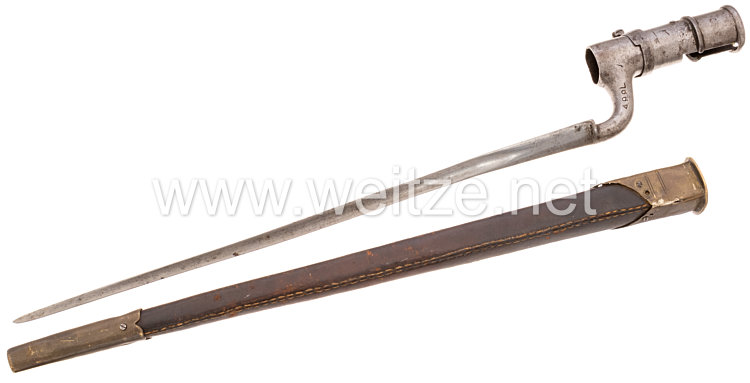
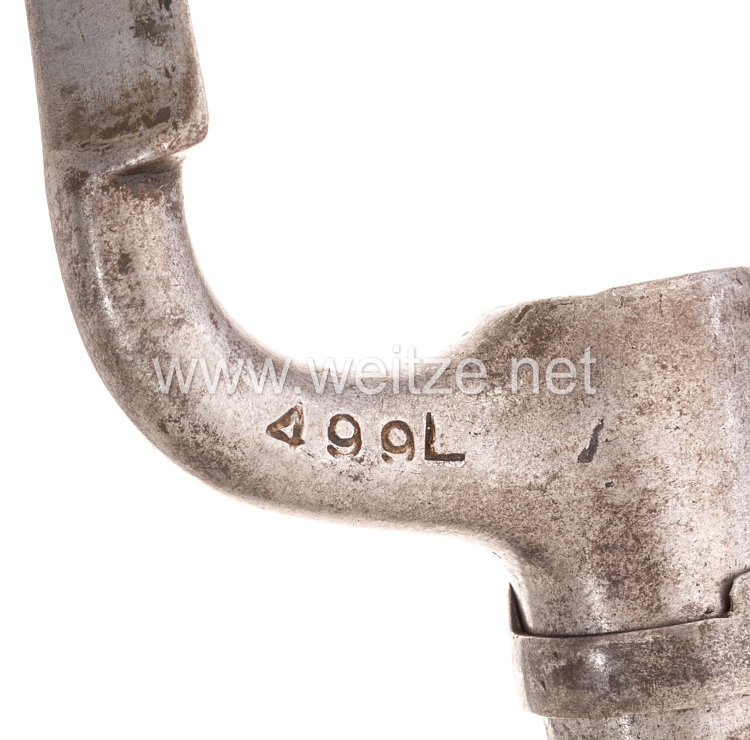
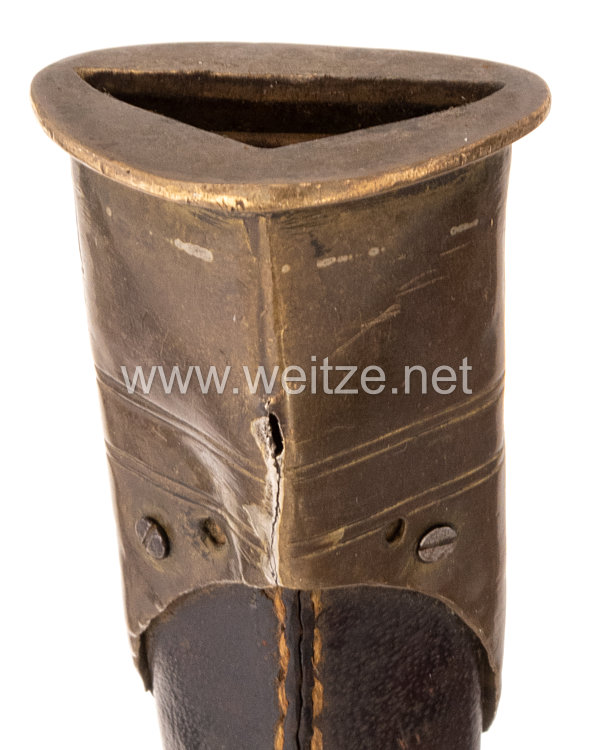
Triangular blade with hollow ground flutes, heavily worn and therefore tapered considerably toward the point, approximately 370 mm long, socket with reinforcing ring, Z-shaped mounting slot and locking ring, approximately 100 mm long, barely identifiable Indian script markings, dark brown leather scabbard with brass fittings, these newly screwed, heavily worn and no longer in best condition, but difficult to find with scabbard nonetheless. Condition 2-3
439180
180,00

Indian Land Pattern Socket Bayonet, Modified

This Indian socket bayonet represents a fascinating example of the complex weapons history of the British Colonial Empire. It is a modified version of the Land Pattern bayonet, originally developed for British forces and later transferred into service with Indian troops.

The Land Pattern bayonet was introduced in the 18th century as standard equipment for the Brown Bess musket, which served as the main weapon of British infantry from approximately 1722 until the 1840s. The characteristic triangular blade with hollow grinding was specifically designed for close combat and intended to cause severe, difficult-to-heal wounds. The triangular shape also prevented the blade from becoming stuck in an opponent's body and facilitated quick withdrawal of the weapon.

Following the gradual assumption of direct administration of India by the British Crown after the Sepoy Mutiny of 1857, large quantities of British military equipment were transferred to India. The British Indian Army, which emerged from this reorganization, received both new and older British weapons. Many of these weapons were locally modified and adapted to the specific needs and circumstances of Indian troops.

The visible Indian script characters on the socket indicate such local adaptation. These markings were likely applied in one of the numerous British-Indian arsenals that existed in cities such as Calcutta, Madras, or Ishapore. These markings served to identify the unit, regimental affiliation, or simply as inventory numbers.

The Z-shaped mounting slot with locking ring is typical of British bayonets from the 18th and early 19th centuries. This system enabled secure attachment to the gun barrel, with the bayonet being locked by a twisting motion. The socket with its collar provided additional stability and prevented the bayonet from being pushed too far onto the barrel.

The leather scabbard with brass fittings is an interesting addition, as original Land Pattern bayonets were often carried without scabbards – they were transported directly attached to the rifle. The existence of this scabbard suggests that the bayonet was also used as an independent close-combat weapon or tool, which was quite common in Indian practice. The fact that the brass fittings have been newly screwed on demonstrates continued practical use over an extended period.

The considerable wear on the blade, which is “much carried and thus already very slender toward the point,” indicates intensive and long-term use. This was typical for weapons in Indian service, which were often employed under harsher climatic conditions and with less regular maintenance than in Europe. The wear from repeated sharpening and corrosion in tropical climate led to this characteristic tapering toward the point.

Such modified and locally marked bayonets are today rare witnesses to the complex military history of colonial India. They represent the fusion of British military technology with Indian adaptation and usage. The British Indian Army was one of the largest volunteer armies in world history and played significant roles in both World Wars as well as in numerous colonial conflicts.

Particularly noteworthy is that such a bayonet is still preserved with its original scabbard. Most scabbards were lost over the decades or rotted in the tropical conditions of India. The preservation of both components, albeit in used condition, makes this ensemble a valuable historical artifact.

The condition rating of 2-3 reflects the authentic used condition, which is often more valuable to collectors and historians than perfectly preserved, possibly never-deployed pieces. The signs of use tell the story of an object that actually served and possibly participated in historical events.

This type of bayonet serves as a tangible connection to the era of British colonial rule in India, a period that fundamentally shaped both British and Indian history. It represents not just military technology, but also the complex relationships of power, adaptation, and cultural exchange that characterized the colonial period.