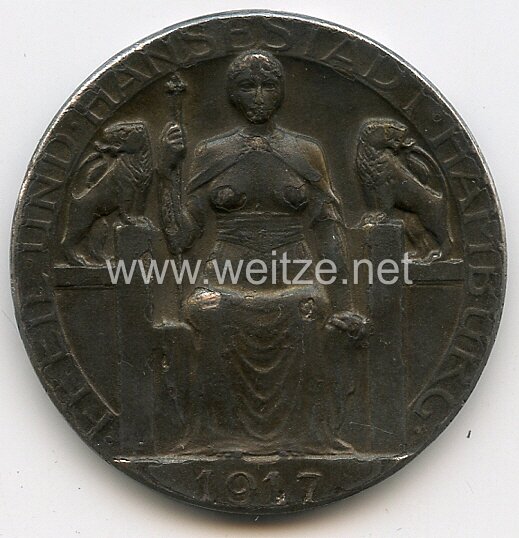
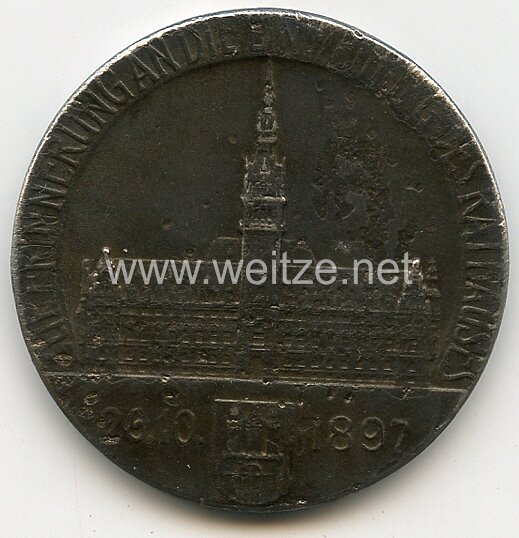
Hamburg Non-Portable Medal βIn Commemoration of the Inauguration of the Kaihaus October 26, 1897 - Free and Hanseatic City of Hamburg 1917β
The Hamburg non-wearable medal commemorating the inauguration of the Kaispeicherhaus on October 26, 1897 represents a fascinating chapter in the maritime and economic history of the Free and Hanseatic City of Hamburg. This iron medal, measuring 42 mm in diameter, connects the memory of a significant infrastructural event with Hamburg's historical development as one of Europe's most important port cities.
The year 1897 marked a turning point in Hamburg's harbor architecture. The inauguration of the Kaispeicherhaus was part of the comprehensive modernization of Hamburg's port, which was driven forward in the final decades of the 19th century. Following Hamburg's incorporation into the German customs union in 1888, the Speicherstadt (Warehouse District) was created, a monumental warehouse complex that today is a UNESCO World Heritage Site. The warehouses served to store goods such as coffee, tea, spices, carpets, and other trade commodities that passed through the port.
However, the striking of this medal occurred only in 1917, as the inscription clearly indicates. This was a year of profound hardship for Germany and Hamburg. The First World War had been raging for three years, and the British naval blockade had virtually paralyzed Hamburg's port. The choice of iron as the material for this medal is particularly significant in this context. During World War I, precious metals such as gold and silver were needed for war financing and armaments production. The use of iron for medals and other civilian objects was a direct consequence of material scarcity and corresponded to the general resource policy of the German Empire.
The classification as a non-wearable medal is an important technical aspect. Unlike wearable orders and decorations that were equipped with ribbons and suspension loops and worn on uniforms, non-wearable medals served exclusively representative and commemorative purposes. They were kept as table medals or presented in collections. Such pieces were frequently issued at significant state, municipal, or economic occasions and distributed to participants, dignitaries, or deserving individuals.
The dual dating of this medal β 1897 for the commemorated event and 1917 for the striking β raises interesting questions. It was not uncommon for anniversary medals to be issued with a time delay, especially when round anniversaries were celebrated. The year 1917 marked the 20th anniversary of the Kaispeicherhaus inauguration. The issuance of such commemorative medals during wartime could also be interpreted as an attempt to strengthen civic pride and local identity during a time of national crisis.
The Free and Hanseatic City of Hamburg maintained a long tradition of self-governance and preserved its special status even after the founding of the German Empire in 1871. The city regularly issued its own medals and decorations that underscored its independence and its significant role in German commerce. Hamburg medals were often characterized by high craftsmanship and historical-symbolic design.
The Speicherstadt and its individual buildings such as the Kaispeicherhaus were architectural masterpieces of Neo-Gothic and Historicism styles. Designed by architects including Franz Andreas Meyer and his successors, these monumental brick buildings on oak piles were constructed between 1883 and 1927 in the former Brookinsel area. They symbolized Hamburg's rise to Germany's leading port city and its central role in world trade.
Medals like this are important historical documents today. They document not only specific events but also the material culture, economic conditions, and collective memory politics of their time of origin. The condition, indicated here as condition 2, suggests a well-preserved specimen with minor signs of use, which is particularly noteworthy for iron medals due to the material's susceptibility to corrosion.
For collectors and historians, such pieces offer insights into local history, the development of port infrastructure, and Hamburg's economic significance. They are material witnesses to an era characterized by economic prosperity, technological progress, and ultimately the catastrophes of World War I.