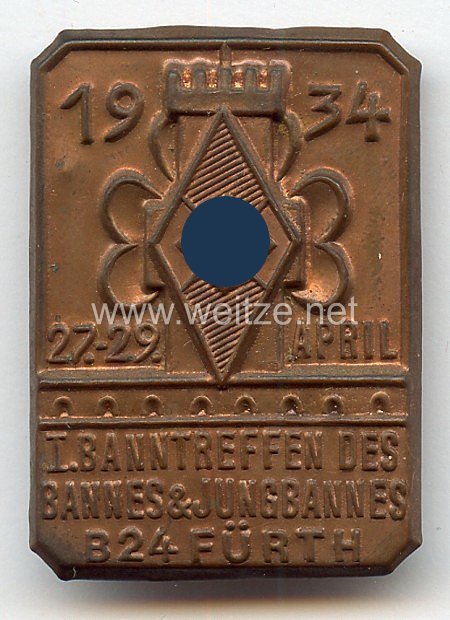
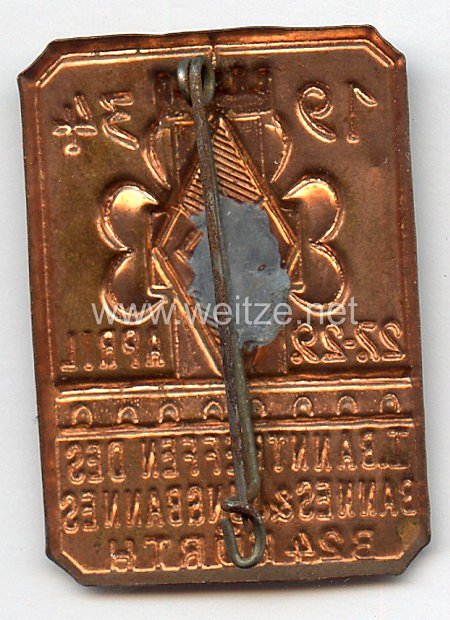
HJ - 1st Bann Rally of Bann & Jungbann B24 Fürth April 27-29, 1934
This tin badge documents the First Bann Meeting of Bann and Jungbann B24 Fürth, which took place from April 27-29, 1934. Such event badges formed an important component of the organizational culture of the Hitler Youth (Hitler-Jugend, HJ) during the early phase of the National Socialist regime.
The Hitler Youth was founded in 1926 and developed after the seizure of power in 1933 into the sole state youth organization of the German Reich. The territorial structure of the HJ followed a hierarchical system: The Gebiet (region) represented the highest organizational level, followed by Obergaue, Banne, Stämme, Gefolgschaften, Scharen, and finally Kameradschaften as the smallest unit. A Bann typically encompassed several thousand members and corresponded roughly to an urban or rural district.
Bann 24 Fürth belonged to the organizational structure of the HJ in Gau Franconia, one of the most active areas of the National Socialist movement under the leadership of Gauleiter Julius Streicher. Fürth, as a significant industrial city in Middle Franconia with approximately 70,000 inhabitants at the time, played an important role in the regional HJ organization. The Jungbann designated the subdivision for younger members, corresponding to the German Young People (Deutsches Jungvolk, DJ), which included boys aged 10 to 14.
The year 1934 marked a significant consolidation phase for the Hitler Youth. While the “Law concerning the Hitler Youth” would not be enacted until December 1, 1936, competing youth associations were already being systematically dissolved or brought into line in 1934. The Reich Youth Leadership under Baldur von Schirach intensified the registration and mobilization of German youth during this year. Bann meetings served several purposes: they strengthened camaraderie, demonstrated the organization's strength, and served ideological training.
Event badges like the present example were typical elements of Nazi organizational culture. They were manufactured from various materials, with tin badges being particularly preferred for larger events due to their cost-effective production. The badges were attached to uniforms or civilian clothing by means of a pin and served as a visible sign of participation. For the wearers, they represented souvenirs symbolizing unity and shared experiences.
The design of such badges frequently followed certain iconographic patterns: they typically contained the Imperial Eagle, the swastika, the Siegrune (victory rune) of the HJ, as well as information about the location, date, and occasion of the event. The color scheme often oriented itself toward the official colors of the organization – black, white, and red – as well as regional references.
A three-day Bann meeting at the end of April 1934 typically included various program points: field exercises and sporting events, marches and roll calls, cultural performances with songs and choral speaking, as well as ideological training. Such events also served to demonstrate discipline and order to the public and were intended to recruit new members.
The condition 2 rating of the badge indicates good preservation with light signs of use, which is remarkable for an object nearly 90 years old. Many of these badges were destroyed after 1945 or were lost over the decades, making preserved examples significant as historical documents today.
From a scholarly perspective, such objects provide insights into the everyday history of National Socialism and the mechanisms of mass mobilization. They document how the regime systematically registered and ideologically shaped youth from an early age. The local level – here Bann Fürth – demonstrates how National Socialist rule was organized down to the smallest administrative units.
For historical research, such event badges are important sources for reconstructing HJ activities at the local level. They supplement written records and help to understand the density and frequency of events. The date at the end of April 1934 falls into a phase when the National Socialists were consolidating their power, before the events of the so-called “Röhm Putsch” at the end of June 1934.
Today, such objects belong in the context of critical historical examination. They serve as tangible evidence of how a totalitarian system penetrated all areas of life and organized even leisure time and youth education according to its ideological goals. The badge from Fürth thus represents not only a local event but also exemplifies the comprehensive control mechanisms of the Nazi dictatorship.