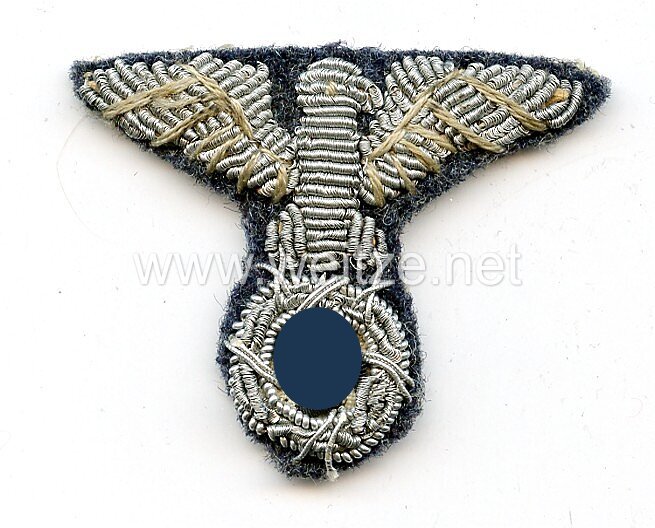
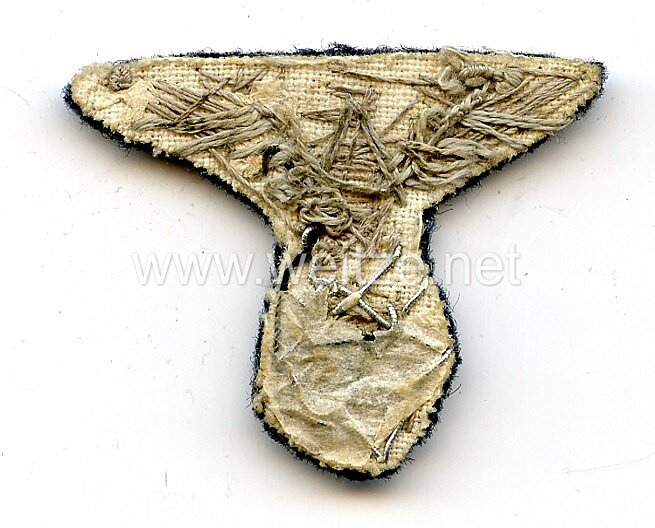
DLV Deutscher Luftsportverband Visor Cap Eagle for Leader

Metal thread hand-embroidered version on Luftwaffe cloth. Condition 2.
457780
185,00

DLV Deutscher Luftsportverband Visor Cap Eagle for Leader

DLV German Air Sports Association Visor Cap Eagle for Leaders – A Symbol of German Aviation History

The visor cap eagle of the Deutscher Luftsportverband (DLV) presented here, in hand-embroidered metallic thread execution for leaders, represents a significant testimony to German aviation history during the interwar period. This type of insignia was worn by DLV leadership personnel between 1933 and 1937 and represents a crucial period in the development of German aviation.

The German Air Sports Association – Origins and Significance

The Deutscher Luftsportverband (DLV) was founded on March 25, 1933, and officially served to promote civilian air sports in Germany. Under the leadership of Hermann Göring, however, the organization fulfilled a far more significant function: it provided cover for the secret buildup of the German air force, which was only officially revealed on March 1, 1935. The Treaty of Versailles of 1919 had prohibited Germany from any military aviation, which is why the training of pilots and technical personnel had to take place under the guise of civilian air sports.

The DLV organized more than 50,000 members in local groups and regional associations. The organization operated flight schools, gliding clubs, and model aircraft groups, where future Luftwaffe personnel were systematically trained. With the official founding of the Luftwaffe in 1935, the DLV gradually lost its importance and was finally transferred to the National Socialist Flying Corps (NSFK) in 1937.

Rank Structure and Uniforms

The DLV developed its own rank structure, which was modeled on military precedents. The leadership ranks comprised various levels from simple Führer to Korpsführer. The uniform included a characteristic blue service dress with specific insignia and effects that indicated the wearer's rank and function.

The visor cap eagle was an essential element of headgear for all ranks. While simple members wore machine-woven or stamped versions, high-quality hand-embroidered metallic thread executions were designated for leadership personnel. These were manufactured on Luftwaffe cloth (LW-Tuch), a special blue-gray base material that was also later used in the Luftwaffe.

Manufacturing and Quality Characteristics

The hand-embroidered metallic thread eagles were produced by specialized craft businesses and insignia factories. Renowned manufacturers such as Assmann, BeVo, or regional embroidery workshops produced these insignia according to specified guidelines. The embroidery technique required considerable craftsmanship: aluminum or silver threads were applied to the base fabric to create the characteristic form of the left-facing eagle with spread wings and talons grasping a wreath containing a swastika.

The quality of these embroideries varied depending on the manufacturer and price range. High-quality examples are characterized by fine, even stitches, three-dimensional design of the feathers, and precise detail work. The metallic thread material used was generally made of aluminum, with particularly high-quality versions using genuine silver wire.

Iconography and Symbolism

The eagle as a sovereign symbol has a long tradition in German history, dating back to the Holy Roman Empire. During the Nazi era, the eagle was combined with the swastika and became the central state symbol. The DLV eagle followed this pattern but differed in details from later Luftwaffe versions. The wing position, feather design, and proportions show characteristic features that enable attribution to the DLV period.

Collector Value and Historical Significance

DLV insignia are today sought-after collectibles in military and aviation history. Their relative rarity – due to the organization's short existence of only four years – makes them desirable objects. Hand-embroidered leader eagles are particularly valuable, as they were produced in smaller quantities than the simpler enlisted versions.

The condition is usually assessed on a scale from 1 (mint) to 5 (heavily damaged). Condition 2 designates a well-preserved example with slight signs of wear but without significant damage. Such pieces document not only craftsmanship but also a significant chapter in aviation history, in which the foundations for the later Luftwaffe were laid under a civilian facade.

Historical Context

The DLV visor cap eagle stands as an example of the concealment of military rearmament in the early Nazi period. It represents a transitional phase between treaty-enforced disarmament and the open remilitarization of Germany. As a material testimony to this era, it possesses both aviation-historical and political-historical relevance and provides insights into the organizational, uniform, and symbolic history of the 1930s.

r