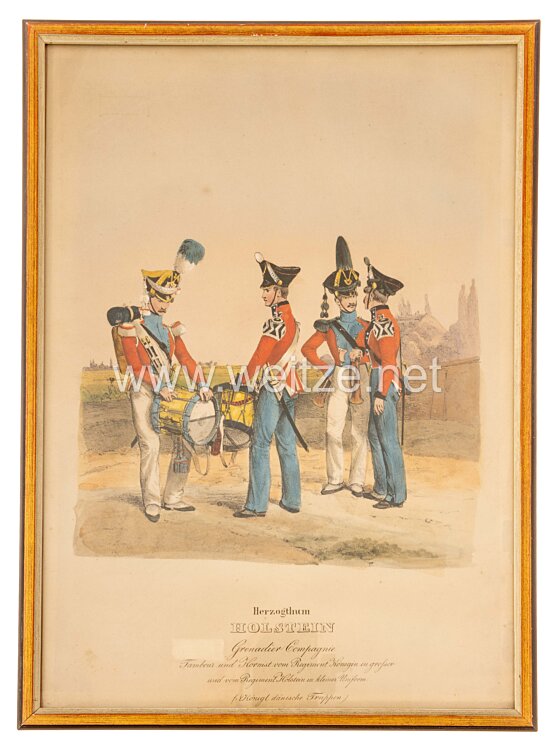
Duchy of Holstein Framed Hand-Colored Lithograph “Grenadier Compagnie”

Lithograph by Eckert/Monten, circa 1840. In wooden frame. 26.7 x 36.9 cm. Condition 2.
453979
65,00

Duchy of Holstein Framed Hand-Colored Lithograph “Grenadier Compagnie”

This hand-colored lithograph depicts a grenadier of the Grenadier Company of the Duchy of Holstein and dates from around 1840. It was created by the renowned military artists Eckert and Monten, who were known for their detailed representations of uniforms and military units of the German states in the 19th century.

The Duchy of Holstein, together with the Duchy of Schleswig, formed a significant part of the Danish composite monarchy, even though Holstein was simultaneously a member of the German Confederation. This complex constitutional situation would later lead to considerable political tensions, culminating in the Schleswig-Holstein Wars of 1848-1851 and 1864.

Grenadiers traditionally represented the elite of the infantry. Originally developed in the 17th century as specialized units for throwing hand grenades, by the 19th century they had long since lost this original function and served as selected shock troops. Soldiers of the grenadier companies were chosen according to strict criteria: they had to be taller and stronger than average, display special military abilities, and distinguish themselves through bravery and reliability.

Around 1840, the Duchy of Holstein maintained several infantry regiments that were part of the Danish army. Each regiment typically had one or more grenadier companies, which were positioned on the flanks of the battle formation. The uniform of the Holstein grenadiers of this period largely followed continental European standard patterns, but showed specific peculiarities of the Danish army.

The technique of hand-colored lithography was a widespread method for reproducing military depictions in the 1840s. After the lithographic printing process, developed by Alois Senefelder around 1798, the prints were carefully painted with watercolors by specialized colorists. This enabled relatively cost-effective mass production of colored images while maintaining high artistic quality.

The artists Eckert and Monten belonged to a group of military painters who systematically documented the uniforms of various German states and their allies. Their works served not only aesthetic purposes but also as practical reference works for uniform matters and as historical documentation. Such lithographs were often published in series and acquired by officers, military administrations, and collectors.

The framing of such lithographs in wooden frames was typical of the period and was intended to protect the valuable prints and make them presentable. Many of these framed military depictions decorated officers' messes, regimental offices, or private collections of militarily interested citizens.

The political situation of the Duchy of Holstein in the 1840s was characterized by growing tensions. The increasing German national movement collided with the interests of the Danish Crown, which wanted to preserve its rule over the duchies. The Holstein troops found themselves in a conflict of loyalty between their affiliation with the Danish army and their cultural connection with Germany.

This lithograph is thus not only an art-historical document but also a testimony to a complex political epoch. It shows the military organization of a state that stood on the brink of fundamental upheavals. After the wars of the 1860s, Holstein would lose its political independence and eventually become part of Prussia.

For collectors and historians, such contemporary depictions represent invaluable sources, as they provide authentic details about uniforms, equipment, and military organizational structures. The quality and attention to detail in the works of Eckert and Monten make them particularly valuable for military-historical research.

r