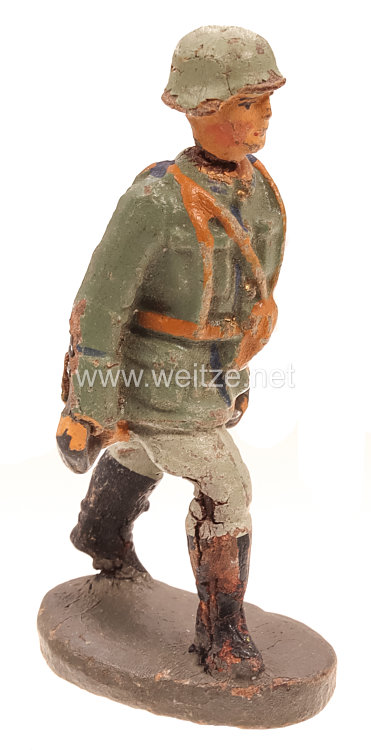
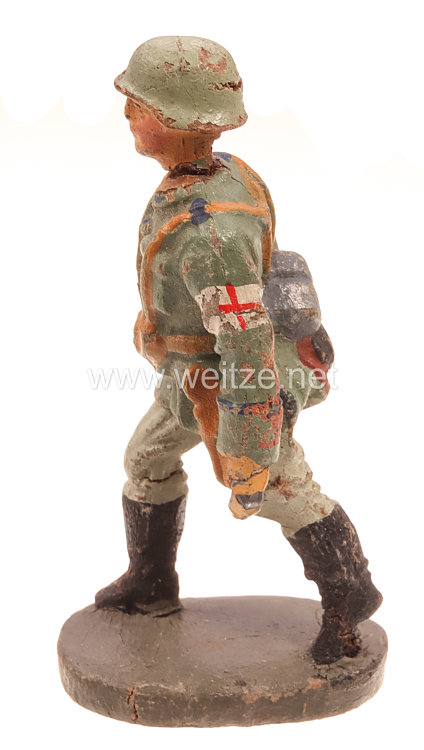
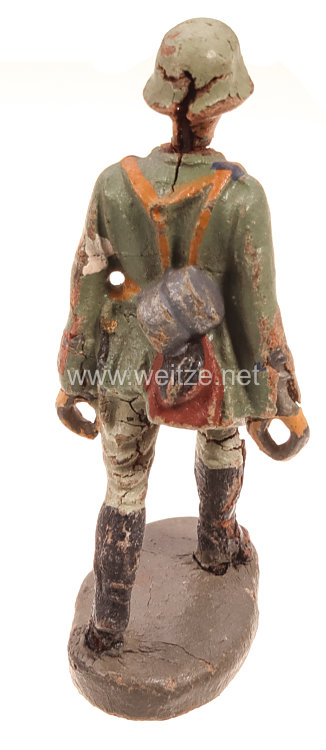
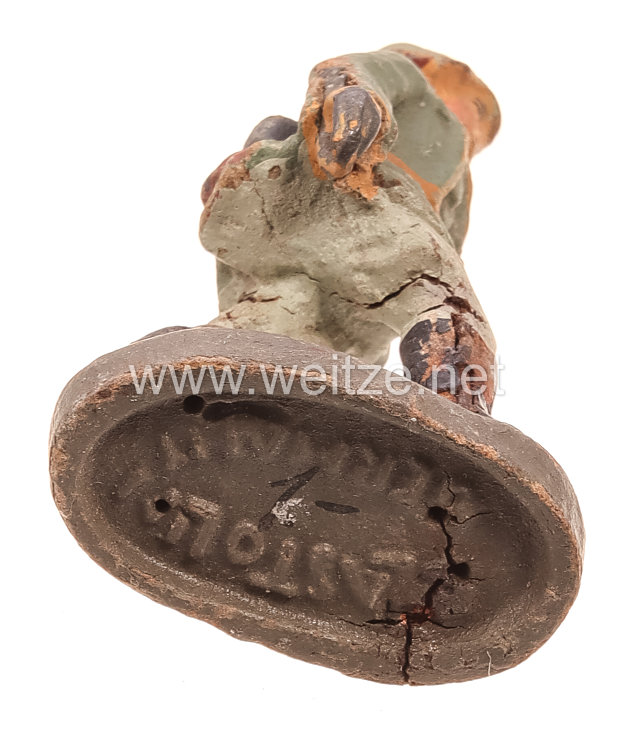
Elastolin - Army Medical Corpsman as Stretcher Bearer with Steel Helmet

7.5 cm, Condition 2
445179
25,00

Elastolin - Army Medical Corpsman as Stretcher Bearer with Steel Helmet

The Elastolin figure of a medical orderly serving as a stretcher bearer with steel helmet represents a significant collector's item from the period between the 1930s and 1940s. This 7.5 cm figure belongs to the extensive product range of the company O. & M. Hausser, which became world-famous under the brand name Elastolin.

The Hausser company was founded in 1904 in Ludwigsburg and developed into one of Germany's leading manufacturers of toy soldiers. The distinctive feature of Elastolin figures was their material: a compound of casein, chalk, glycerin, and linseed oil applied to a wire frame. This material gave the figures a certain elasticity and made them more resistant to breakage than conventional composition figures.

The depicted medical orderly as stretcher bearer embodies an essential component of military medical infrastructure. In the German Wehrmacht, the medical service played an indispensable role in caring for wounded soldiers. Medical orderlies wore the characteristic white armband with the Red Cross and were protected as non-combatant personnel under the Geneva Conventions.

The stretcher bearers formed the first stage of wounded care at the front. Their task was to recover wounded soldiers from the battlefield and transport them to aid stations. This dangerous activity required not only physical fitness but also extraordinary courage, as recovery often took place under fire. Stretcher bearers typically worked in two-man teams and were equipped with the medical stretcher, which consisted of a sturdy frame with canvas covering.

The steel helmet worn by the figure likely corresponds to Model M35, M40, or M42, the characteristic steel helmets of the Wehrmacht. While medical personnel were theoretically protected by the Geneva Conventions, they nevertheless wore steel helmets for their own protection in practice, as combat circumstances often allowed no distinction.

From the 1930s onwards, Elastolin produced extensive series of Wehrmacht figures covering all branches of service and ranks. These figures served not only as toys but also had a propagandistic function within the framework of National Socialist education. Children were meant to be introduced to military structures through play with these soldier figures.

The manufacturing quality of Elastolin figures was remarkable for their time. The figures were produced in several work steps: first the wire frame was shaped, then the compound was applied and modeled. After drying, detailed hand-painting followed. The uniforms largely corresponded to the actual regulations of the Wehrmacht, with medical orderlies recognizable by their specific equipment and markings.

The stated condition 2 indicates a well-preserved collector's item. For Elastolin figures, this usually means the figure is complete, the paint is largely original, and only slight signs of use are present. This is remarkable, as the material of the figures is sensitive to moisture and mechanical stress.

After World War II, the production of military toys in Germany was subject to strict restrictions. The Hausser company converted its production and concentrated on civilian themes. Today, the historical Elastolin military figures are sought-after collector's items that are significant not only in toy history but also in cultural history.

For collectors and historians, these figures offer valuable insights into the history of uniforms and equipment as well as into the everyday culture of the 1930s and 1940s. They document how military reality was translated into toy form and what role military toys played in the society of that time. The medical orderly as stretcher bearer symbolizes the humanitarian aspect of war and the efforts to rescue wounded soldiers.