Soviet Union Order of the Badge of Honor

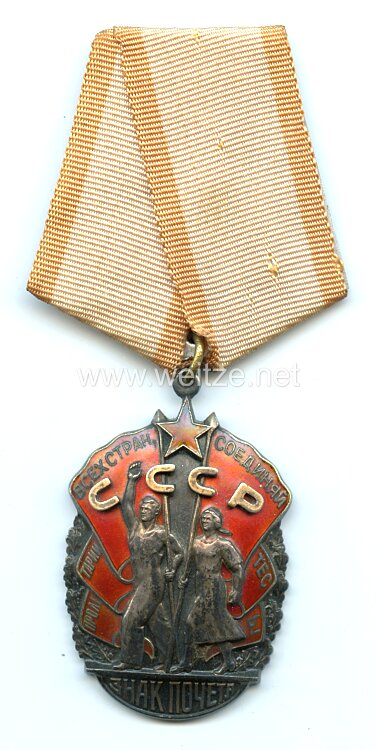
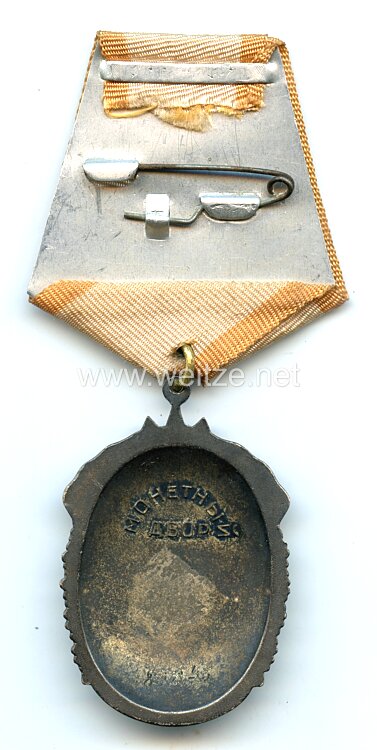
Silver, enameled, reverse numbered “1800...5”, with suspension bar, condition 2.
459178
90,00

Soviet Union Order of the Badge of Honor

The Soviet Order “Badge of Honour” (Russian: Орден "Знак Почёта") represents a significant decoration of the Soviet Union that was awarded over five decades to citizens and organizations for outstanding achievements in various areas of public life.

The decoration was instituted by decree of the Presidium of the Supreme Soviet of the USSR on November 25, 1935. Originally bearing the name “Badge of Honour,” the order belonged to the Soviet award system as a lower-ranking decoration, which nevertheless held great significance for social recognition.

The described example made of silver with enamel work corresponds to the classic design of this award. The order has a characteristic shape displaying a tall rectangular shield with the inscription “СССР” (USSR). Above it sits a five-pointed star, and at the bottom is a banner with the inscription “Знак Почета” (Badge of Honour). The overall height of the order is approximately 43 mm.

The serial number on the reverse, beginning with “1800...5,” is an important authenticity feature. Each awarded order received an individual serial number, which was recorded together with the recipient's name in official registers. Numbering began in 1935 with low numbers and reached several million over the decades. Numbers in the range of 1.8 million suggest an award from the late 1970s or early 1980s.

The order was worn on a standardized suspension bar featuring a pentagonal block covered with red moiré ribbon. The bar allowed the order to be worn on the left breast side of a uniform or civilian clothing.

Award Criteria and Recipients: The Order “Badge of Honour” was awarded for various merits, including outstanding achievements in production, agriculture, science, culture, sports, as well as for strengthening the defense capabilities of the USSR. Workers, collective farm workers, members of the intelligentsia, members of the armed forces, and employees of security organs could receive this decoration.

In 1988, as part of a reform of the Soviet award system, the order was renamed the “Order of Honour” (Орден Почёта), with the design being slightly modified as well. The example described here dates from the period before this reform.

Manufacturing took place at the Moscow Mint (Monetny Dvor) as well as other authorized facilities. The orders were made from silver with a fineness of 925/1000 and weighed approximately 21-23 grams. Enameling was done in several colors, with red used for the Soviet banner and various shades of blue for other elements.

Statistics and Significance: During its existence, the Order “Badge of Honour” was awarded over 1.5 million times, making it one of the most frequently bestowed Soviet decorations. This underscores its importance in the Soviet system of social recognition and motivation.

The condition grade 2 of the described example indicates a well-preserved piece with only minor signs of wear. The enamel work is intact, which is particularly important for collectors' appreciation of orders of this type, as enamel damage is common.

After the dissolution of the Soviet Union in 1991, the order was continued in modified form as the “Order of Honour” in the Russian Federation, with Soviet symbolism replaced by Russian state symbols. Original Soviet orders like the described example are now sought-after collectibles that represent important testimonies to Soviet history.

This decoration documents not only individual achievements but also the Soviet system of social motivation and control, in which state awards played a central role in directing and recognizing social activities.