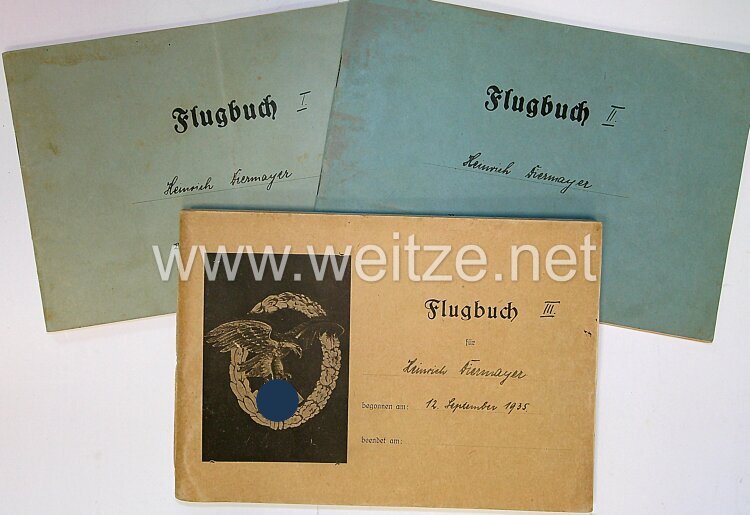
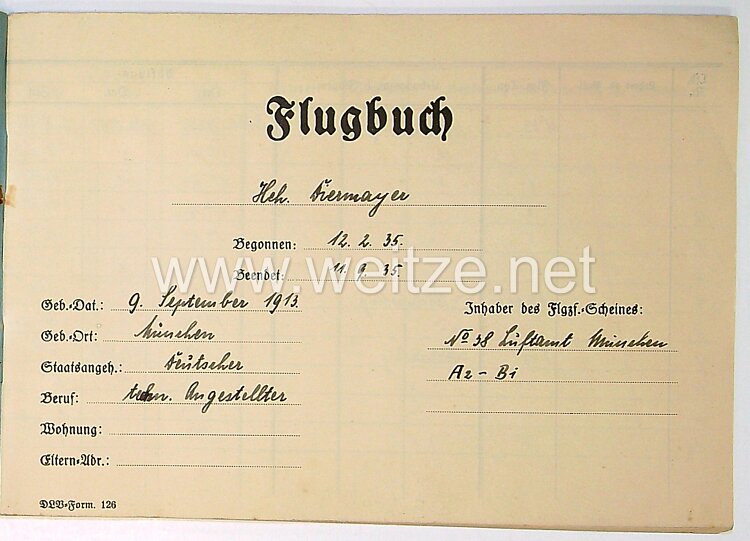
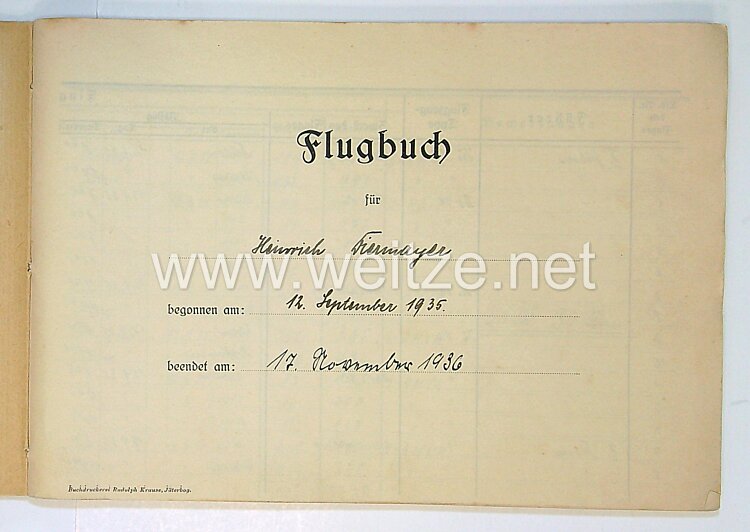
Luftwaffe - 3 Flight Logbooks for a Flight Instructor from 1934-1935
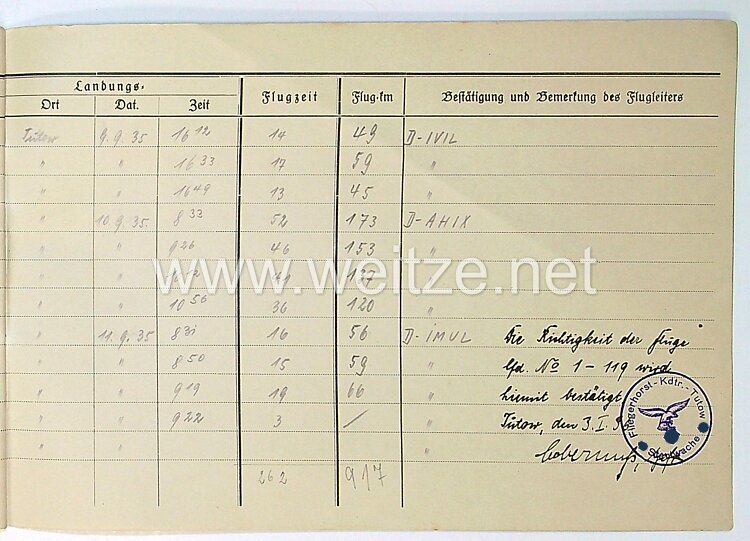
These three flight logbooks document the aviation activities of a flight instructor during the critical buildup phase of the German Luftwaffe between 1934 and 1936. With a total of 974 documented flights over a period of nearly two years, these documents provide an authentic insight into the intensive training activities during the secret and later open rearmament of the German Reich.
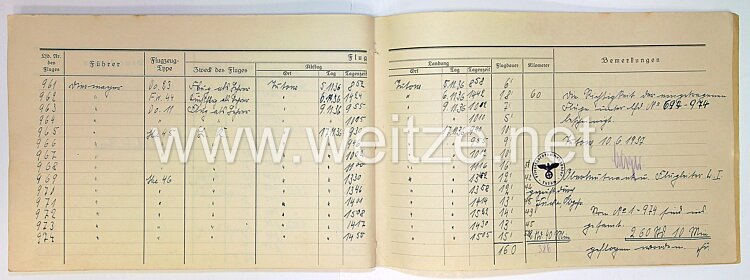
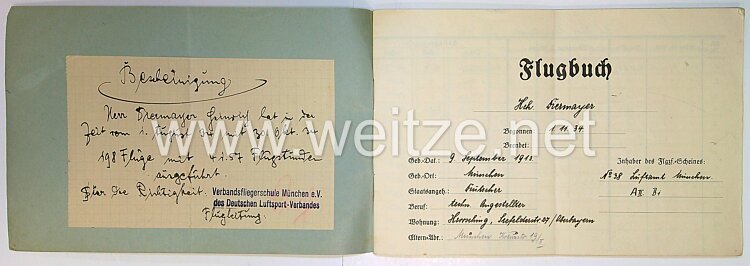
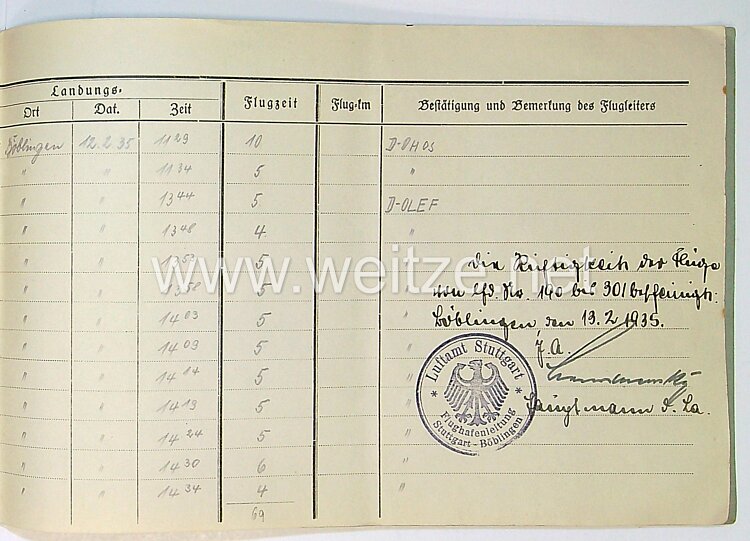
The Flugbuch (flight logbook) was an official document in which every flight by a pilot was meticulously recorded. It contained information about the date, aircraft type, departure location, destination, flight duration, type of flight (training flight, cross-country flight, night flight, etc.), and any special incidents. For flight instructors, the names of students were of particular importance. These records served not only for personal documentation but were also crucial for military authorities to track training progress and personnel qualifications.
The temporal context of these flight logbooks is of considerable historical significance. The first logbook began on November 1, 1934 – at a time when the existence of a German air force was still officially denied. The Treaty of Versailles of 1919 had prohibited Germany from having any military aviation. Nevertheless, pilot training had been secretly advanced since the early 1920s, initially disguised as civilian flight schools or through cooperation with the Soviet Union, such as at the secret flight school in Lipetsk.
After the Nazi seizure of power in 1933, rearmament was massively accelerated. In February 1933, Hermann Göring was appointed Reich Commissioner for Aviation. On March 1, 1935, the existence of the Luftwaffe was officially announced, representing an open breach of the Treaty of Versailles. The flights documented here thus fall into both the phase of covert preparation and the period of open rearmament.
The high number of 974 flights in a relatively short time underscores the intensive training activity that prevailed during these years. The Luftwaffe urgently needed qualified personnel, and flight instructors played a key role in this process. They were responsible for basic training of student pilots, instruction on various aircraft types, and teaching tactical knowledge. An experienced flight instructor could conduct several flights daily, particularly during circuit training and shorter practice flights.
The mention of various aircraft types in the logbooks is also revealing. During the Luftwaffe's buildup phase, numerous different aircraft models were employed, both for basic training and advanced instruction. Typical training aircraft of this era included the Focke-Wulf Fw 44 “Stieglitz”, the Heinkel He 72 “Kadett”, and the Arado Ar 66. For advanced training, aircraft such as the Heinkel He 51 or early versions of the Messerschmitt Bf 109 were used.
Training to become a pilot in the Luftwaffe followed a strictly regulated system. After basic flight training (A-license), advanced training (B-license) followed, and finally specialization in specific branches such as fighter, bomber, or reconnaissance aviation. Flight instructors themselves had to possess extensive flight experience and undergo special pedagogical training.
The fact that three separate logbooks were used corresponds to contemporary practice. When a logbook was completely filled or a pilot was transferred to a new unit, a new book frequently began. The temporal overlap between the first and second logbooks (both contain entries from 1935) might indicate different operational areas or various aircraft categories that were documented separately.
These flight logbooks are not only military-historical documents but also personal testimonies of an individual who participated in one of the most consequential chapters of German history. They document the construction of an air force that would play a fateful role in World War II just a few years later. For historians and collectors, such documents offer authentic primary sources that provide insights into military daily life, training methods, and the organizational structures of the early Luftwaffe.
The indicated condition 2 suggests very good preservation of the documents, which is remarkable given their age of nearly 90 years and increases their documentary and collectible value.