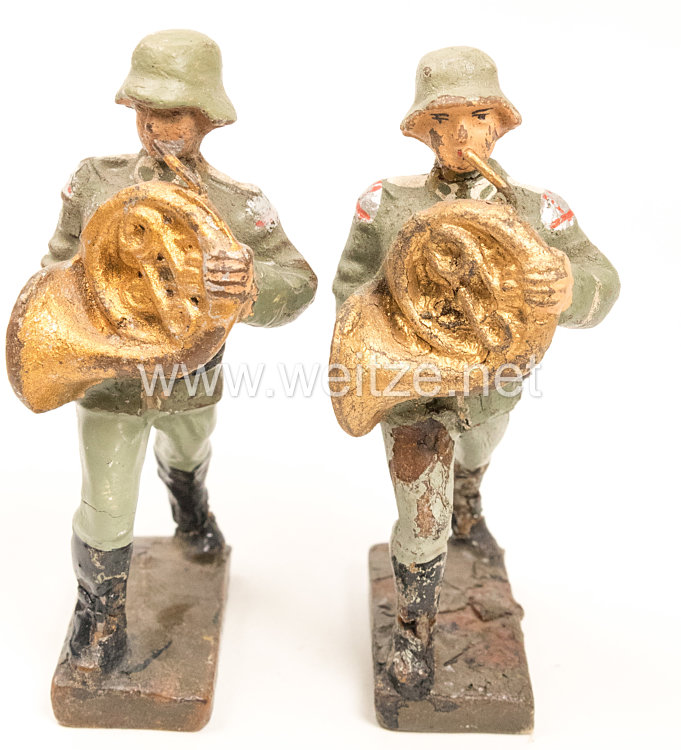
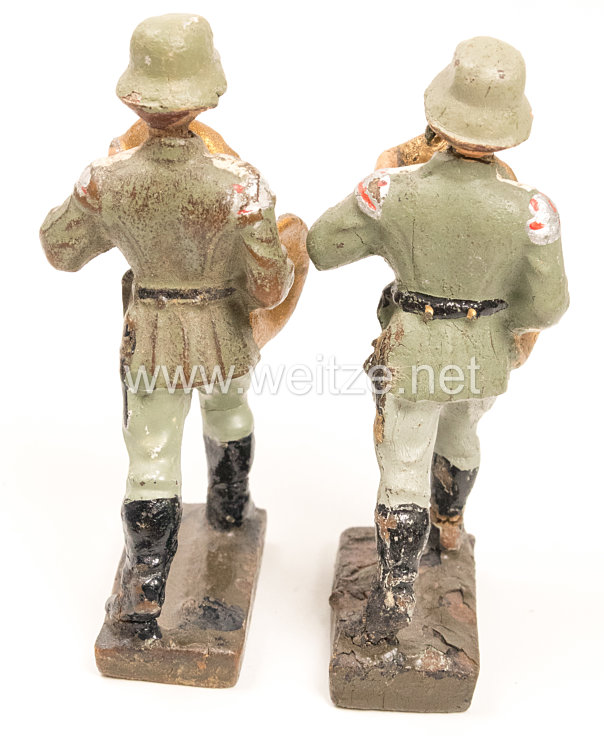
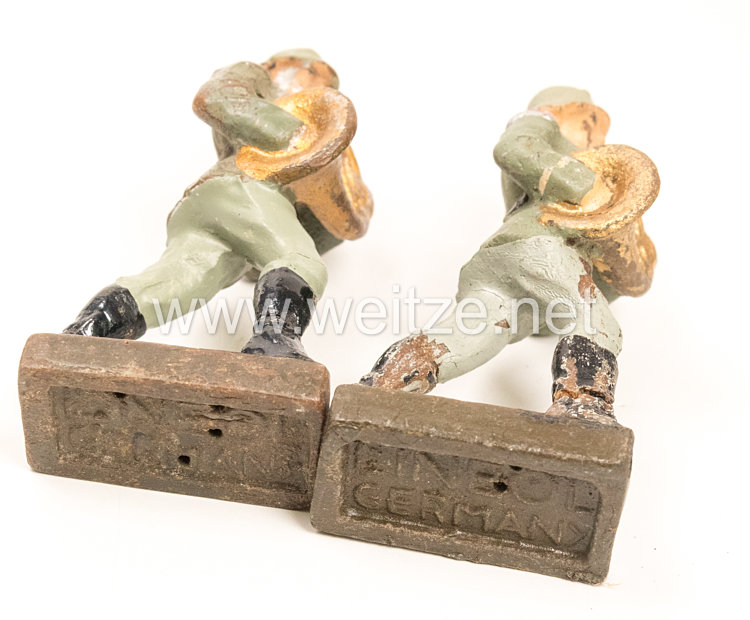
Lineol - Army 2 French Horn Players Marching
This Lineol figure depicting two marching French horn players of the Wehrmacht-Heer (Army) represents a fascinating example of German toy production from the era of the Third Reich. Standing approximately 7 cm tall, this figure belongs to the typical size range of Lineol composition figures manufactured between the 1930s and 1940s.
Lineol was founded in 1906 by Oskar Wiederholt in Brandenburg an der Havel and developed into one of Germany's leading manufacturers of toy soldiers. The company name derived from the word “Linie” (line) and the material “Elastolin,” a special composition made from casein, chalk, glycerin, glue, and other additives. This composition material allowed for detailed molding and was more durable than tin, the traditional material for toy soldiers.
The military tradition of French horn players in the German army reaches far back in history. Hunting horns and later French horns played an important role in military signaling and ceremonial occasions. In the Wehrmacht from 1935 onwards, military bands were an integral part of troop organization. The Heeresdienstvorschrift (HDv) (Army Service Regulations) and other regulations defined the composition and function of these musical units.
Marches and military ceremonies played a central role in the Wehrmacht's self-presentation. The military bands, typically consisting of 40 to 50 musicians, were present at parades, oath ceremonies, and other public events. The French horn players formed an important part of the brass section and contributed to the full sound of march music.
The uniform depicted on the Lineol figures corresponds to the typical field uniform of the Army from the 1930s and early 1940s. The figures typically show the characteristic field-grey uniform with appropriate insignia and equipment. The detailed representation of the instruments and marching posture testifies to the craftsmanship for which Lineol was renowned.
The production of military toy figures had a long tradition in Germany. Alongside Lineol, companies such as Elastolin (Hausser) were the main competitors in this market. These figures served not only as toys but also as collectibles and undoubtedly had a propagandistic function in glorifying the military during the Nazi era.
Manufacturing these figures required several steps: First, the figures were cast in brass molds, then hand-painted and equipped with accessories such as weapons and instruments. The hand-painting explains the individual variations between figures from the same series.
After World War II, the production of military toys in Germany was initially restricted. Lineol ceased production in 1945, though it was later revived on a reduced scale before the company finally closed in the 1980s.
Today, these Lineol figures are sought-after collectibles. The condition is evaluated according to a standardized system, with condition 2/2- (as indicated for this object) suggesting very good to good preservation with only minimal signs of wear. Collectors value these figures both for their craftsmanship and as historical documents of a specific period in German toy production.
Academic study of such objects provides insights into various aspects: the history of toy production, military uniform studies, the role of the military in society, and the propagandistic use of toys. Museums and private collections preserve these artifacts as part of cultural heritage, always considering the critical historical context.
These figures represent a complex intersection of commercial production, militarism, and childhood culture during a specific historical period. While they were designed as children's playthings, they simultaneously served to normalize and glorify military culture in German society during the 1930s and 1940s. Understanding them today requires both appreciation of their craftsmanship and critical awareness of their historical context.