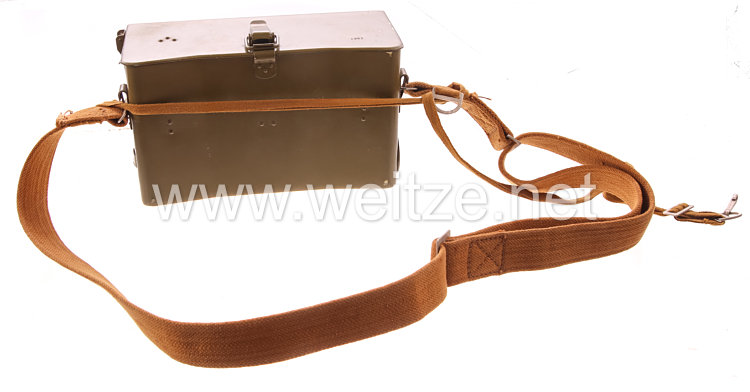
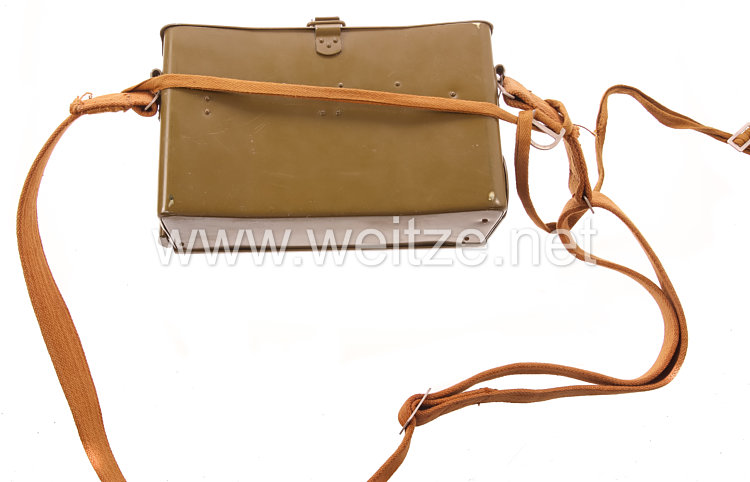
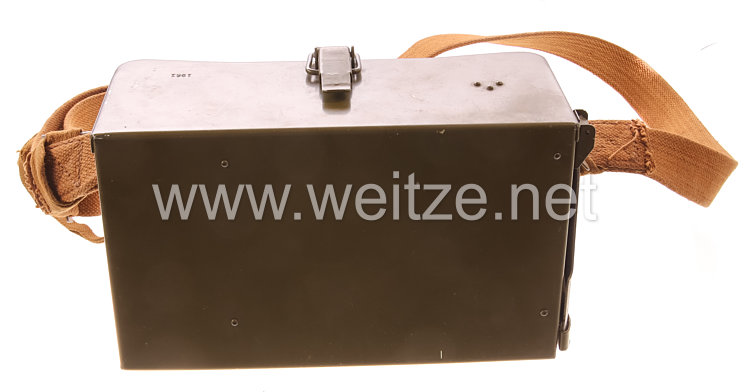
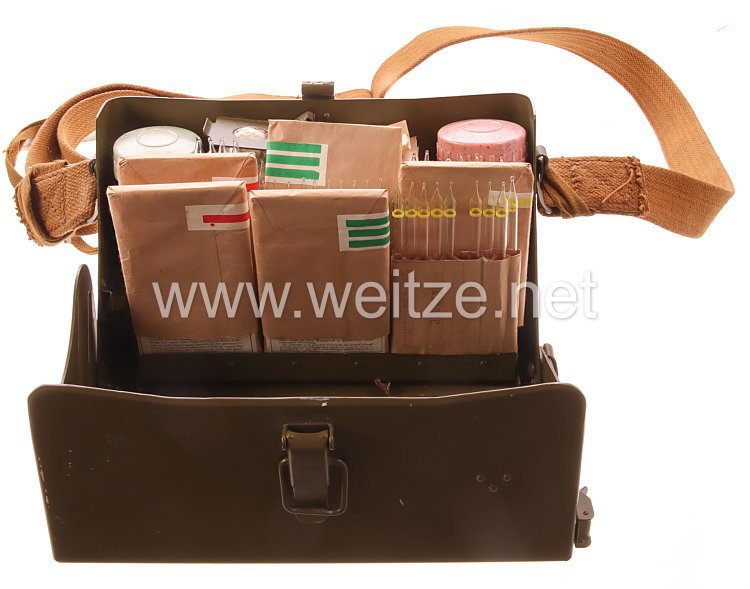
German Democratic Republic (GDR) National People's Army (NVA) Chemical Warfare Agent Detection Pumps and Accessories
The National People's Army (Nationale Volksarmee - NVA) of the German Democratic Republic (GDR) served as the military force of the socialist German state from 1956 to 1990 and was an integral component of the Warsaw Pact. In the context of the Cold War, NBC (Nuclear, Biological, and Chemical) defense played a central role in the military training and equipment of the NVA.
The described chemical agent testing pump with accessories from 1961 represents an important aspect of military defense readiness during the height of the Cold War. Such equipment served the rapid identification of chemical warfare agents in the battlefield and was essential for troop protection as well as tactical decision-making in combat situations.
The Soviet origin of this equipment underscores the close military cooperation between the USSR and the GDR. The NVA was largely organized and equipped following Soviet models. Soviet military advisors were instrumental in building up the NVA during the 1950s and 1960s, and standardization of equipment within the Warsaw Pact was a strategic goal to ensure interoperability among allied forces.
The ampoules for yperite, soman, phosgene, and diphosgene contained in the case reference the most important chemical warfare agents that were considered potential threats during the Cold War. Yperite, also known as mustard gas or lost, had already been used in World War I and causes severe burns to skin and respiratory tract. Soman belongs to the group of highly toxic nerve agents (G-agents) developed in the 1940s that attack the nervous system through inhibition of acetylcholinesterase. Phosgene and diphosgene are asphyxiating pulmonary agents that were also employed in World War I.
The testing pumps functioned on the principle of colorimetric detection. Contaminated air was drawn through the pump and passed over special testing tubes or reagent papers. Depending on the warfare agent present, the color of the indicator would change, enabling rapid identification. This system was simple to operate, required no electrical power, and was robust enough for field deployment.
The labeling in German language with simultaneous Russian instructions is typical for NVA equipment from Soviet production. This facilitated handling for German-speaking soldiers while the Russian instructions documented the original source and maintenance regulations. The dating to 1961 falls within a phase of intensive armament and modernization of the NVA following the construction of the Berlin Wall on August 13, 1961.
NBC defense was firmly anchored in NVA training. Every soldier received basic training in recognizing and responding to chemical agent attacks. Specialized NBC defense troops were equipped with more extensive gear and were responsible for reconnaissance, decontamination, and protective measures. Testing pumps belonged to the standard equipment of reconnaissance units and medical services.
The metal case with carrying strap was designed for mobile deployment. The robust construction was intended to protect the sensitive ampoules even under combat conditions. The systematic arrangement of accessories enabled quick access and prevented confusion, which could be vital in stress situations.
After the end of the Cold War and German reunification in 1990, the NVA was dissolved. Large quantities of equipment were scrapped, sold, or transferred to museums. NBC defense equipment such as the described testing pump is today an important historical testament to the military reality of divided Germany and the omnipresent threat perception during the Cold War.
From today's perspective, such objects illustrate the seriousness with which both sides in the Cold War regarded chemical warfare as a realistic scenario. Although chemical weapons were outlawed under international law by the Geneva Protocol of 1925, all major military powers maintained stockpiles and prepared for their possible use. The detailed preparation for chemical warfare reflects the deeply rooted fear of a Third World War that would have mobilized all available means.
These testing devices represent the practical implementation of defensive doctrine. The ability to quickly identify chemical agents could mean the difference between effective protective measures and mass casualties. The comprehensive nature of the kit, with multiple detection capabilities, demonstrates the variety of chemical threats that military planners anticipated during this period of heightened international tension.