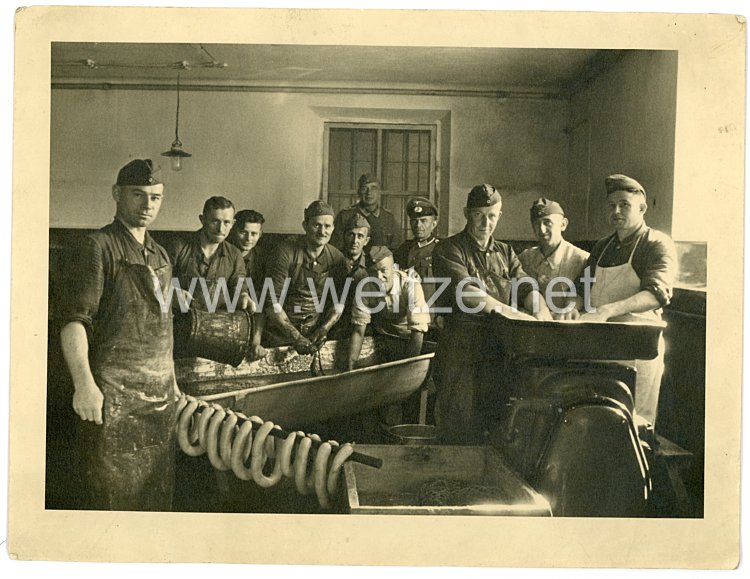
Wehrmacht Heer Photograph, Soldiers of a Butcher Company
This object is an original photograph from the Second World War era, showing soldiers of a butcher company (Schlachter-Kompanie) of the Wehrmacht Heer. With dimensions of approximately 24.4 x 18.6 cm, the format corresponds to typical photographic standards of the 1940s. Such photographs today represent important historical documents that provide insight into military daily life and the organizational structures of the German Wehrmacht.
The butcher companies were specialized units within the Wehrmacht that belonged to the supply troops. Their main task consisted of slaughtering livestock and meat processing for troop provisions. These units were an essential component of army provisioning and organizationally belonged to the supply offices (Verpflegungs-Ämter) of various divisions and army corps. The importance of functioning field provisioning for troop morale and combat effectiveness cannot be underestimated.
According to the Army Service Regulation (Heeresdienstvorschrift - H.Dv.) and corresponding supply directives, each soldier was entitled to a specific daily quantity of foodstuffs, with meat representing an important component of the ration allocations. The butcher companies were therefore indispensable for maintaining supply, especially in occupied territories where local livestock was requisitioned and processed. The units had mobile slaughtering facilities and specially trained personnel who possessed both craft and military skills.
Photographs like this were frequently produced as mementos and served for personal documentation of military service. They often show comrades during daily work, rest periods, or special events. Soldiers of the supply troops, to which the butchers belonged, led a life that differed significantly from that of front-line troops, but were nevertheless exposed to the dangers of war, especially from partisan attacks or air raids on rear areas.
The uniforms of soldiers in butcher companies generally corresponded to the standard army uniform, supplemented by special work clothing for slaughtering activities. To identify their function, they possibly wore special career badges or branch colors that identified them as members of the supply troops. The Waffenfarbe (branch color) for administrative and supply troops was light blue.
The historical context of these photographs extends to a time when the Wehrmacht had to undertake enormous logistical efforts to supply millions of soldiers at various fronts. The supply situation deteriorated increasingly during the course of the war, especially after 1943, when strategic initiative was lost and transport routes were disrupted by Allied air attacks.
From a scholarly perspective, such photographs are of considerable value for military-historical research. They document not only military organization but also social-historical aspects of wartime daily life. Research on supply units has gained increasing importance in recent decades, as it conveys a more complete picture of warfare that goes beyond pure combat operations.
The condition of the photograph is described as “used,” which indicates actual contemporary use. Signs of aging, possible creases, or damage are typical of photographs that were preserved during the war and in the post-war period. Such signs of use do not diminish historical value but rather underscore the authenticity of the object.
Today, such photographs serve historical education and research in museums, archives, and private collections. They help to understand the complex organization of the Wehrmacht while simultaneously serving as reminders of the horrors of the Second World War and the millions of victims claimed by this conflict.