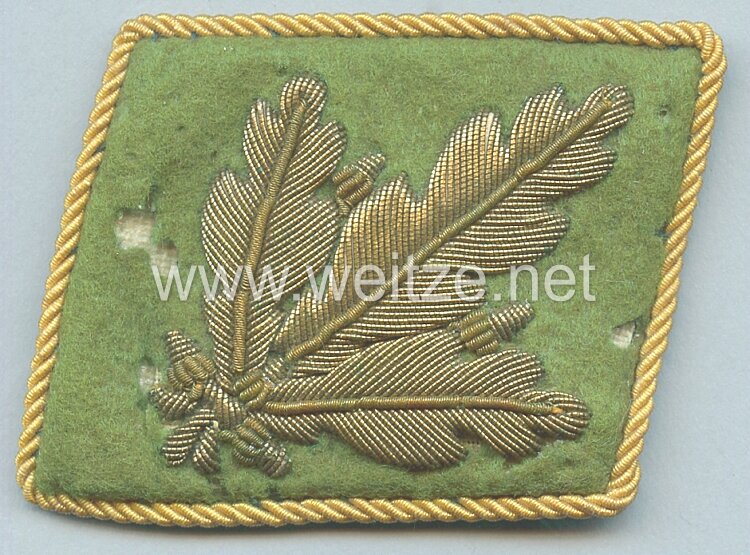
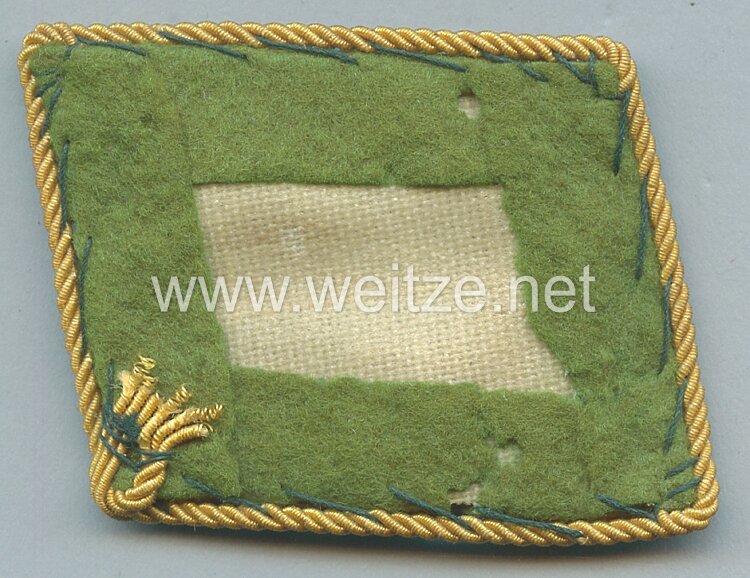
Police Single Collar Tab for an SS-Brigadeführer and Generalmajor der Polizei

Pattern from 1942 onwards. Gold metal thread hand-embroidered on green, with celleon piping around the edge. Lightly worn, with minor moth damage, condition 2. Very rare.
239877
650,00

Police Single Collar Tab for an SS-Brigadeführer and Generalmajor der Polizei

This collar tab for an SS-Brigadeführer and Generalmajor der Polizei represents a significant artifact of the complex rank structures within the National Socialist power apparatus. This version, used from 1942 onwards, illustrates the close intertwining of the SS hierarchy and the state police organization during World War II.

The Police in National Socialism came increasingly under SS influence from 1936, when Heinrich Himmler was appointed Chief of the German Police in the Reich Ministry of the Interior. This merger of party and state structures led to the creation of a dual rank system, whereby high-ranking police officers simultaneously held corresponding SS ranks. The rank of SS-Brigadeführer and Generalmajor der Polizei corresponded to a major general in the Wehrmacht and positioned the wearer in the upper leadership level of the National Socialist security organs.

The technical execution of this collar tab is characteristic of wartime police insignia. The hand embroidery with gold thread on green base fabric was reserved for higher police ranks and differed significantly from the standardized versions of lower ranks. The green base color was the traditional Waffenfarbe (branch color) of the Ordnungspolizei (Order Police) and was retained in all rank insignia. The surrounding piping made of Celluloid, an early plastic material, reflects the war-related material shortages that led to the use of substitute materials.

The introduction of the modified version from 1942 was connected with various uniform reforms undertaken during the war. The Army Regulation Sheets and corresponding SS service regulations precisely governed the design, wearing, and authorization to wear such rank insignia. For the police, the Reich Law Gazette additionally applied, which established uniform regulations for state police forces.

An SS-Brigadeführer and Generalmajor der Polizei typically commanded larger police units, was deployed as a senior commander in occupied territories, or headed important departments within the Security Police and SD. These positions were associated with considerable power and responsibility and played a central role in enforcing National Socialist rule in Germany and occupied territories.

The hand embroidery of such rank insignia was usually carried out in specialized workshops or by authorized manufacturers. Well-known firms such as ASSMANN in Lüdenscheid or other traditional insignia producers manufactured these high-quality badges. The quality of the embroidery and the use of genuine metal threads served not only for rank identification but also for representing the power and status of the wearer.

The mentioned light moth damage is typical for textiles from this period and testifies to the organic material of the base fabrics. The Celluloid piping, however, often shows better preservation due to its synthetic nature, though it can become brittle or discolored over the decades.

The rarity of such collar tabs is explained by several factors: First, the number of people who held this high rank was limited. Second, many of these uniform items were destroyed or hidden at the end of the war. Third, the dual rank structure meant that not all police generals wore this specific version.

From a historical perspective, this collar tab documents the institutional structure of a criminal system. The wearers of such rank insignia were often involved in serious war crimes and crimes against humanity. The Nuremberg Trials and subsequent legal proceedings made it clear that senior police and SS leaders played central roles in carrying out the Holocaust and other atrocities.

Today, such objects have exclusively documentary and educational value. They serve in museums and educational institutions to illustrate the structures of National Socialist rule and to commemorate the crimes of that period. Scholarly engagement with such militaria is important for historical understanding but must always occur in the context of critical examination of the Nazi era.

r