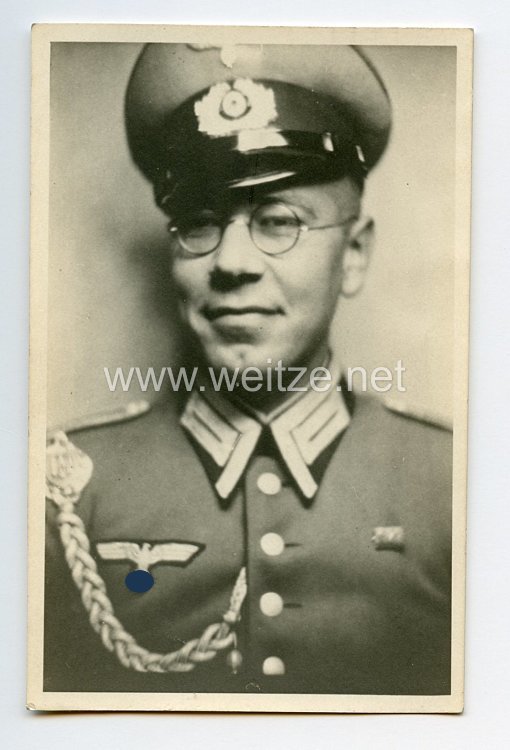
Wehrmacht Portrait Photograph, Non-Commissioned Officer with Marksmanship Lanyard

Approx. postcard size, condition 2.
401076
10,00

Wehrmacht Portrait Photograph, Non-Commissioned Officer with Marksmanship Lanyard

This portrait photograph depicts a Wehrmacht non-commissioned officer (Unteroffizier) wearing a marksmanship lanyard (Schützenschnur), a typical document of military portrait photography from the Third Reich period between 1935 and 1945. Such photographs in postcard format were widespread during World War II and served both private and documentary purposes.

The Schützenschnur, also known as a marksmanship award, was an important military decoration in the Wehrmacht that recognized outstanding shooting performance. It was awarded as a braided cord in various grades and worn on the right shoulder of the uniform. The introduction of the marksmanship lanyard in the Wehrmacht occurred through Army regulation of August 9, 1936, with the system building upon traditions from the Reichswehr and the Imperial era.

There were different versions of the marksmanship lanyard: The simplest form consisted of an aluminized cord for the first grade, followed by cords with woven metal plaques for higher performance levels. The highest award was the special grade (Sonderstufe) with particularly elaborate design. To earn a marksmanship lanyard, soldiers had to achieve certain scores during annual shooting exercises, with requirements varying according to branch of service.

The rank of Unteroffizier represented the first level of non-commissioned officer grades in the Wehrmacht. Non-commissioned officers formed the backbone of the military leadership structure at the lower level and were responsible for training and leading enlisted personnel. Promotion to Unteroffizier occurred after appropriate proving and training, with rank insignia consisting of silver braids on shoulder straps.

Military portrait photography held significant importance in the Wehrmacht. Soldiers frequently had themselves photographed in uniform to send these images to family members, fiancées, or wives. The photographs were taken either in professional photo studios in garrison towns or by mobile photographers who visited troop locations. The postcard format (approximately 9 x 14 cm) was particularly popular as it could be easily mailed and kept in photo albums.

Photographic studios during the NS era were well familiar with military uniforms and decorations. Photographers ensured that medals, badges of honor, and special awards like the marksmanship lanyard were clearly visible. This corresponded both to soldiers' pride in their achievements and the regime's propagandistic goals of highlighting military virtues.

The quality of such photographs varied depending on the studio and photographer. Professional shots were characterized by careful lighting, neutral or militarily appropriate backgrounds, and clear representation of uniform details. Soldiers typically posed in frontal or half-profile views, often with a serious, dutiful expression that corresponded to the military ideal of the time.

From a historical perspective, such photographs are today important contemporary historical documents. They document not only military ranks and decorations but also uniforming practices, social aspects of military service, and the visual culture of the Wehrmacht. For military historical research, they provide information about uniform development, the wearing of decorations, and regional differences in photographic practice.

The preservation of such photographs varies. The stated condition 2 indicates well-preserved material with slight signs of use. Typical aging characteristics may include slight yellowing, minimal edge damage, or wear at the corners. The photographic technique of the time mostly used gelatin silver prints on baryta paper, which remain stable for decades when properly stored.

For collectors of military historical objects and documents, such photographs represent authentic witnesses of the era. They complement understanding of military everyday culture beyond official propaganda and war photography. The combination of documented rank and visible marksmanship award makes such photographs particularly revealing for reconstructing individual military careers and researching the Wehrmacht's decoration system.