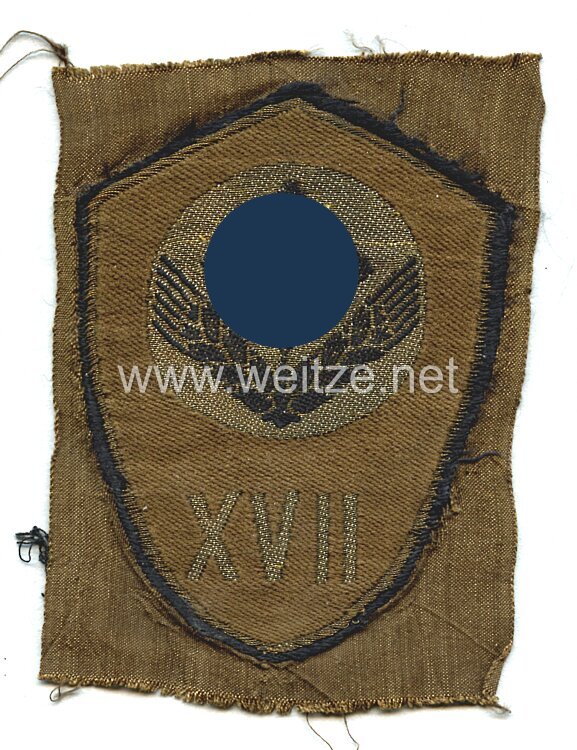
RAD Female Sleeve Shield “XVII” worn by women in the ranks of Stabsführerin, Stabsoberführerin and Stabshauptführerin

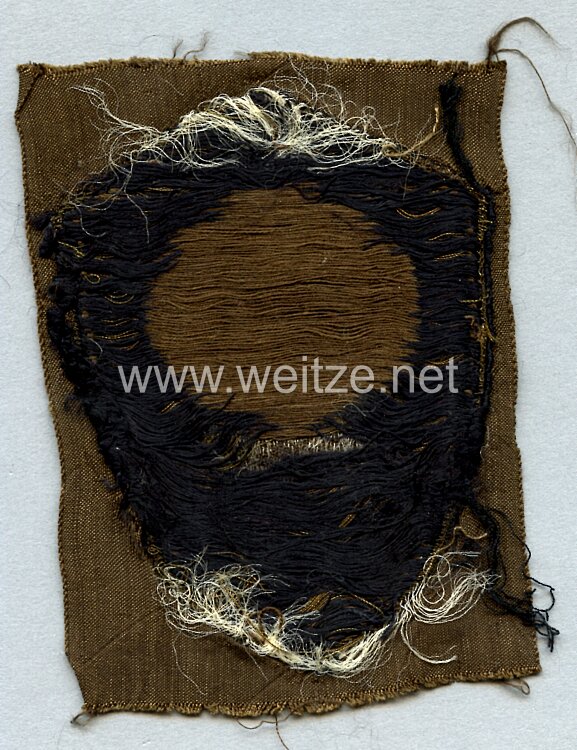
Niedersachsen-Mitte, metal thread woven construction. Worn condition, Grade 2-. Very rare.
239876
650,00

RAD Female Sleeve Shield “XVII” worn by women in the ranks of Stabsführerin, Stabsoberführerin and Stabshauptführerin

The sleeve shield bearing the Roman numeral XVII of the Reich Labour Service for Female Youth (RAD/wJ) represents a rare testimony to the organizational structure of the National Socialist labour service. This particular insignia was worn by female leaders in the ranks of Stabsführerin, Stabsoberführerin, and Stabshauptführerin and indicated membership in Arbeitsgau XVII Niedersachsen-Mitte (Lower Saxony-Central).

The Reich Labour Service was established on June 26, 1935, through the Reich Labour Service Law as compulsory service for all young Germans. While initially only male youth were enlisted, the service obligation was extended to female youth in 1939. The RAD for Female Youth (RAD/wJ) thus became an independent formation within the organization, which continued until the end of the war.

The RAD was organized according to geographical units called Arbeitsgaue (labour districts), which were numbered with Roman numerals. Arbeitsgau XVII encompassed the region of Niedersachsen-Mitte and was one of over 40 such territorial administrative units. Each Arbeitsgau was led by an Arbeitsgauführer (for men) or Arbeitsgauführerin (for women) and was further subdivided into groups, detachments, and camps.

The present sleeve shield displays the characteristic metal-thread woven construction typical of higher leadership ranks. This manufacturing technique differed significantly from the simpler embroidered or printed variants for lower ranks. The use of metal threads, usually in silver or aluminum-coated finish, gave the insignia a representative character and emphasized the leadership status of its wearers.

The three mentioned service ranks formed the upper leadership level of the female RAD. The Stabsführerin corresponded roughly to a captain, the Stabsoberführerin to a major, and the Stabshauptführerin to a lieutenant colonel in the Wehrmacht. These leaders were responsible for organizing, training, and commanding larger units and served as a link between local camps and district leadership.

Female RAD members performed their six-month compulsory service primarily in agriculture, domestic service, and from 1941 increasingly in war-essential auxiliary services. They replaced workers who had been drafted into the Wehrmacht and were also deployed toward the end of the war for tasks in the armaments industry and air raid protection. The leaders organized these assignments and were responsible for the ideological indoctrination and practical training of their subordinates.

The uniforms of the female RAD included brown service clothing with specific insignia. The sleeve shield bearing the district designation was worn on the left upper arm and enabled immediate identification of territorial affiliation. Additionally, the leaders wore other rank insignia on collars and shoulder straps.

The rarity of this specific sleeve insignia can be explained by several factors: First, the number of senior leaders compared to ordinary labour maidens was very limited. Second, many of these uniform pieces were destroyed after the war or disposed of by the wearers themselves. Third, woven metal-thread versions survived less frequently than more robust fabric badges due to their delicate nature.

From today's perspective, such objects are important contemporary historical documents that provide insight into the organizational structure and hierarchy of the National Socialist system. They document the systematic integration of female youth into the structures of the NS state and illustrate the militarization of all aspects of life during the Second World War.

The indicated condition grade of 2- suggests a worn specimen with slight signs of use, which underscores its authenticity and confirms that this was an actually used service insignia. Such original pieces are of considerable documentary value for historical research and museum collections.