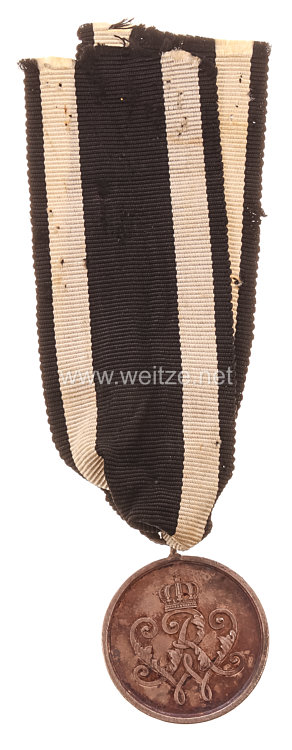
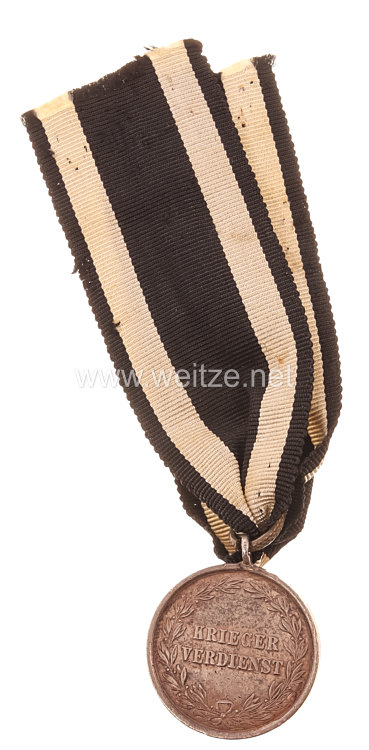
Prussia Warrior Merit Medal 1873-1918
The Prussian Warrior's Merit Medal (Krieger-Verdienstmedaille) represents a significant decoration within the system of military honors of the Kingdom of Prussia, awarded from 1873 until the end of the monarchy in 1918. This medal embodies the Prussian tradition of recognizing faithful service and military merit among non-commissioned officers and enlisted men.
The establishment of this decoration was instituted by Emperor Wilhelm I on December 5, 1873, during a time when the German Empire had just been founded. The medal was intended to fill a gap in the Prussian order system by being specifically created for long-serving and meritorious soldiers who did not meet the requirements for higher orders. It was designed for non-commissioned officers and enlisted men who had distinguished themselves through exceptional loyalty to duty and exemplary service.
The Warrior's Merit Medal was manufactured in silver and had a diameter of 25 millimeters. The obverse displayed the portrait of the reigning Prussian king and German emperor, with the representation changing according to the reign: initially Wilhelm I (1873-1888), then Friedrich III (1888), and finally Wilhelm II (1888-1918). The reverse bore the inscription “Krieger Verdienst” (Warrior's Merit), surrounded by an oak leaf wreath symbolizing German tradition and strength.
The award criteria were precisely regulated. The medal could be awarded to non-commissioned officers and enlisted men who had served irreproachably for at least nine years and had distinguished themselves through exceptional loyalty to duty, bravery, or outstanding performance in service. During peacetime, it was awarded for extraordinary service, while in wartime, special bravery or merit to the troops could also lead to its conferral.
The medal was worn on its original ribbon, which was held in the Prussian national colors of black and white. The ribbon was worn on the left side of the chest, with the exact position in the medal bar determined by military wearing regulations. The Warrior's Merit Medal ranked in the hierarchy of Prussian decorations below the actual orders but was nevertheless a valued recognition for common soldiers.
During World War I (1914-1918), the medal gained particular significance. Many soldiers received it for their service at the front or in the rear areas. The mass mobilization and the long war years led to numerous awards being made, with the original criteria sometimes being relaxed to account for the extraordinary situation.
The craftsmanship of the medal met high Prussian standards. It was manufactured by various state-authorized minting facilities, including the Royal Mint Berlin. The silver used was of high quality, and the striking showed fine details that reflected the high art of Prussian medallists.
With the end of the monarchy and the abdication of Emperor Wilhelm II on November 9, 1918, the era of the Warrior's Merit Medal also ended. The Weimar Republic abolished the monarchical order system, and the medal was no longer awarded. However, recipients were allowed to continue wearing their already awarded decorations.
Today, these medals are important witnesses to Prussian and German military history. They document the system of military recognition in the Empire and the appreciation shown even to common soldiers. For collectors and historians, they are valuable objects that provide insight into the military culture of Wilhelmine Germany. The condition, striking, and authenticity of the ribbon are important factors for the historical and collector evaluation of such pieces.