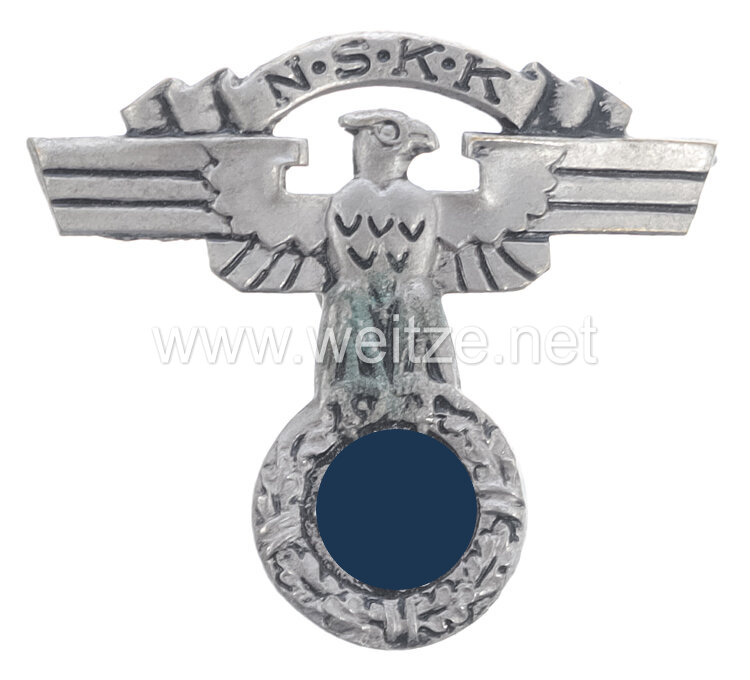
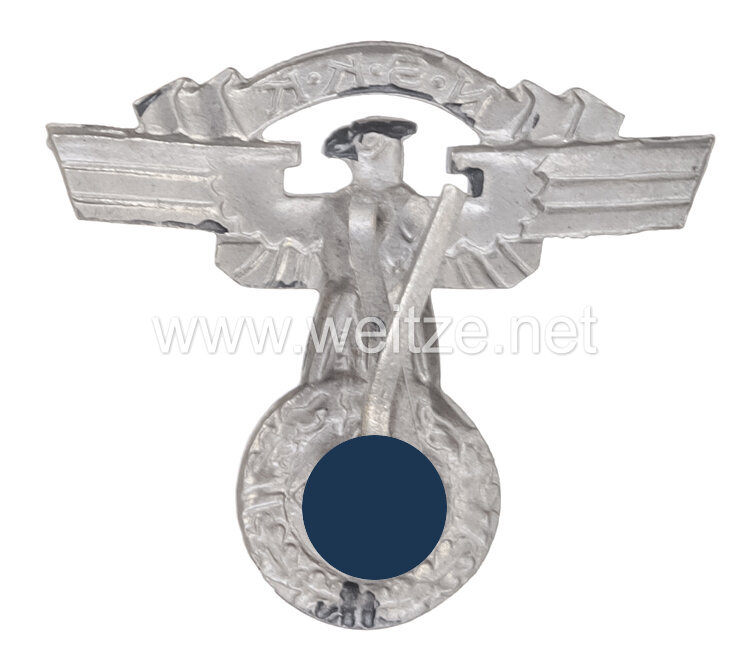
National Socialist Motor Corps (NSKK) Eagle for Shako Cap, 1st Model
The Nationalsozialistisches Kraftfahrkorps (NSKK) eagle for the peaked cap represents a significant example of National Socialist uniform insignia used during the Third Reich era. This first model represents the early phase of NSKK uniform design and is of particular interest to collectors and historians.
The NSKK was founded on April 1, 1931, as a motorized formation of the NSDAP and was initially subordinate to the Sturmabteilung (SA). After the seizure of power in 1933, the NSKK developed into a significant organization within the Nazi state. Under the leadership of Korpsführer Adolf Hühnlein from 1933 onwards, the NSKK was considerably expanded and served to motorize the German population and provide pre-military training in motor vehicle operations.
NSKK uniforming followed strict guidelines laid down in various service regulations. The eagle, the central sovereign symbol of the German Reich, was an essential component of headgear. The first model of the NSKK eagle for the peaked cap was introduced in the early 1930s and was characterized by specific design features that distinguished it from later variants.
The technical execution of this insignia is characteristic of the early Nazi period. The non-ferrous metal used was typical for uniform insignia of this period, as it was inexpensive to produce while still offering an appealing appearance. The attachment by means of split pins (also called prongs or metal splits) on the reverse side was the standard method for affixing such insignia to caps and other uniform items. These pins were pushed through the cap material and bent over on the inside to ensure a secure hold.
The design of the NSKK eagle was based on the general design principle of Nazi sovereign symbols: a stylized eagle with outstretched wings holding a swastika in its talons. However, the specific design for the NSKK differed in details from the eagles of other Nazi organizations such as the Wehrmacht, SS, or SA. The first model typically featured somewhat coarser stamping than later, more refined versions.
In the context of uniform history, the first model of the NSKK eagle marks an important phase in the standardization of National Socialist uniform insignia. The years between 1933 and 1935 were characterized by intensive efforts to create uniform appearances for the various Nazi organizations. This led to several model changes and adaptations in uniform parts and insignia.
The peaked cap itself was a central element of the NSKK uniform. It was worn by members of various ranks and was distinguished by additional elements such as cords, cockades, and of course the eagle. The placement of the eagle on the cap followed precise specifications laid down in uniform regulations.
From today's perspective, such objects are important witnesses to a dark period of German history. They document the comprehensive penetration of public life with National Socialist symbolism and the role of paramilitary organizations in the Nazi state. The NSKK played a significant role in preparing the German population for war by providing motor vehicle training and serving as a reservoir for military drivers.
The specified condition 2 indicates, according to common collector grading systems, a very good state of preservation in which the object is completely intact with only minimal signs of wear. This is remarkable for objects from this period, as many insignia were lost or damaged due to weather conditions, mechanical stress, or deliberate destruction after the war's end.
For military historical research and museums, authentic examples of such insignia are important for documenting and understanding the material culture of National Socialism. They enable the reconstruction of the development of uniform standards, manufacturing techniques, and the organizational structure of Nazi formations.