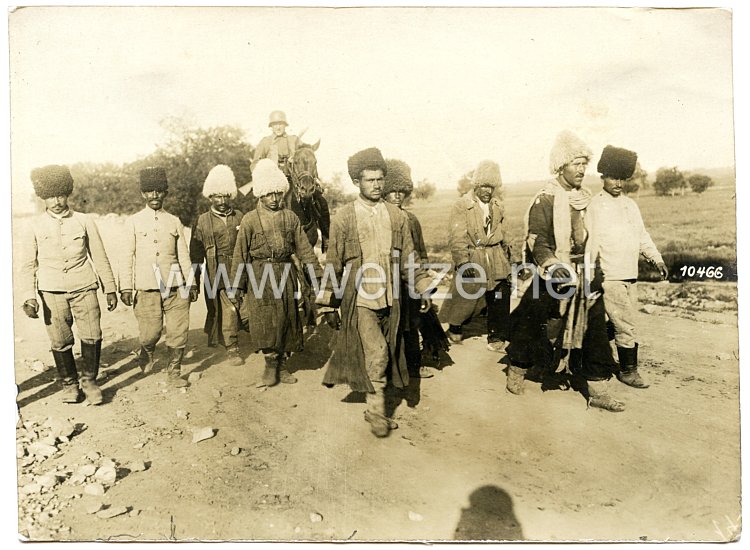
World War I German Empire Press Photograph: Tiflis in the Caucasus

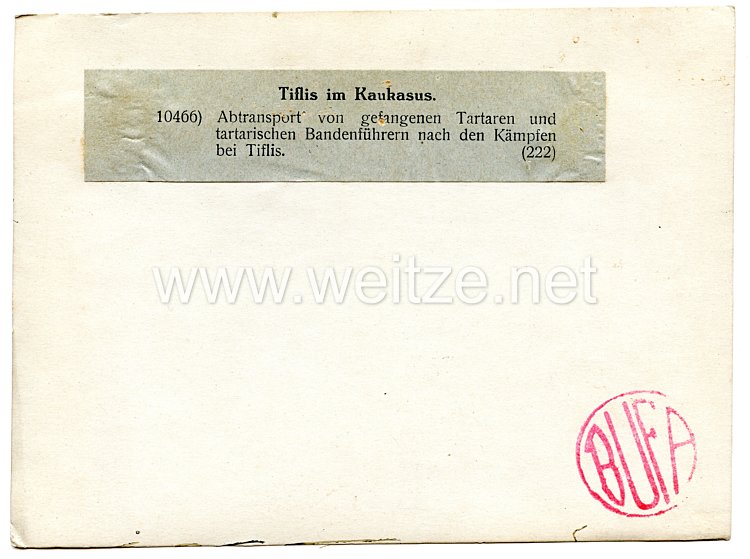
Dimensions approximately 16.5 x 12 cm, with inscription on reverse. Condition 2.
445275
20,00

World War I German Empire Press Photograph: Tiflis in the Caucasus

First World War Press Photography: Tiflis in the Caucasus

This press photograph documents a significant aspect of World War I (1914-1918) that is often neglected in Western European historiography: the Caucasus Front between the German Empire, the Ottoman Empire, and the Russian Empire. The city of Tiflis (present-day Tbilisi, capital of Georgia) played a central role as a strategic center in this region during the hostilities from 1914 to 1918.

Historical Context of the Caucasus Front

The Caucasus Front developed into an important secondary theater of war after the Ottoman Empire entered the conflict on the side of the Central Powers in November 1914. While the German military presence in this region was primarily characterized by military advisors, liaison officers, and logistical support for Ottoman forces, the German press followed developments in the Caucasus with great interest. The strategic importance of this region lay in the rich oil reserves of Baku, the important transportation routes, and the opportunity to pressure Russia from the south.

Tiflis functioned as the capital of Georgia and as an important administrative and military center of the Russian Caucasus Army. The city was the seat of the Viceroy of the Caucasus and housed significant garrisons. Fighting in the region was characterized by extreme climatic conditions, difficult terrain, and ethnic tensions.

The Role of Press Photography in World War I

Press photography during World War I was subject to strict military censorship. The German Empire established a sophisticated system for controlling and distributing photographic material from the very beginning of the war. The Military Office of the Foreign Ministry and the Picture and Film Office (BUFA), founded in 1917, coordinated photographic reporting. Press photos were used both for domestic propaganda and for international reporting.

Photographs from distant theaters of war such as the Caucasus were particularly valuable, as they offered German newspaper readers insights into little-known regions. Such images were frequently obtained from war correspondents, military photographers, or through the mediation of allied Ottoman sources. The notation on the reverse side was standard practice for press photos and served for clear identification and correct attribution for editorial offices.

German Interests in the Caucasus 1917-1918

After the October Revolution of 1917 and the subsequent Treaty of Brest-Litovsk (March 1918), German engagement in the Caucasus intensified considerably. The newly emerged Transcaucasian states of Georgia, Armenia, and Azerbaijan declared their independence. Germany recognized Georgia's independence on May 27, 1918, and dispatched a German Caucasus Expedition under General Friedrich Freiherr Kress von Kressenstein.

German troops marched into Tiflis in June 1918, when it was the capital of the independent Democratic Republic of Georgia. The German presence was intended to support the Georgian government, secure oil and manganese resources, and limit Ottoman expansionist ambitions. This situation made Tiflis a focal point of German foreign policy and military interests in the final months of the war.

Technical Aspects of War Photography

Press photos of this era were typically taken with plate cameras or early roll-film cameras. Development and reproduction took place under often difficult conditions. The format of approximately 16.5 x 12 cm corresponds to common formats of press photography of this time, optimized for reproduction in newspapers and illustrated magazines. Images were frequently produced as contact prints or in moderate enlargements.

The notation on the reverse provided important information about location, date, and context of the photograph. Such annotations frequently also contained censorship numbers, photographer names, or information about the photo agency. These metadata are invaluable today for historians in classifying and authenticating historical photographs.

Collector Value and Historical Significance

Press photographs from the Caucasus theater are significantly rarer than images from the Western or Eastern Fronts, which increases their documentary and collector value. They provide important visual testimony for a theater of war that is often overlooked in collective memory. For military historians and collectors, such photographs document not only military operations but also cultural, geographical, and social aspects of the affected regions.

The survival of such photographs over more than a century makes them important primary sources for historical scholarship and a material connection to an era that fundamentally shaped the modern world order. These images serve as tangible reminders of the global scope of the First World War and the complex geopolitical struggles that extended far beyond the trenches of Western Europe.

r