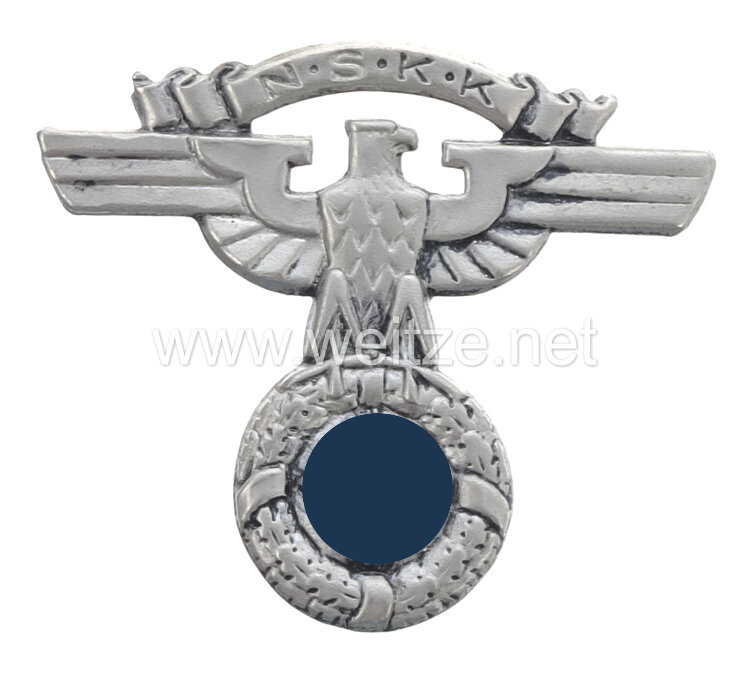
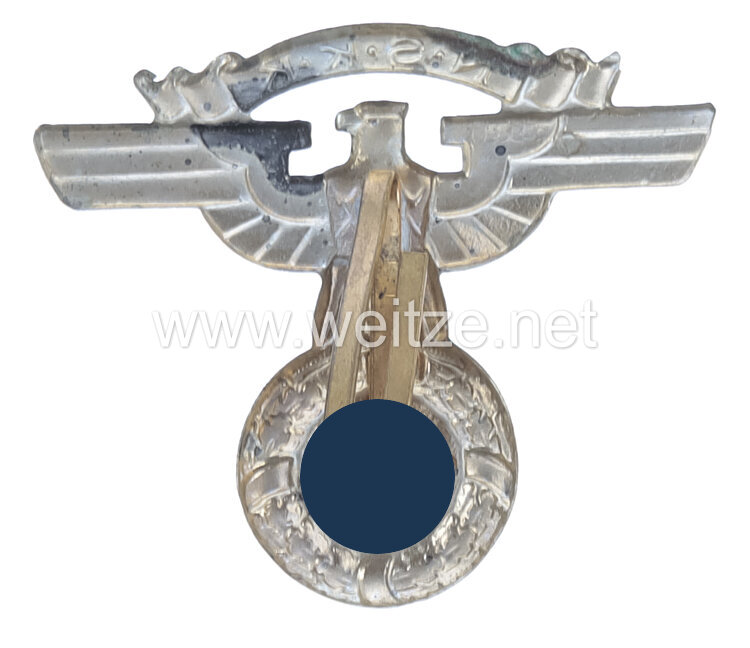
National Socialist Motor Corps (NSKK) Eagle for Shako Cap, 1st Model
The Nationalsozialistisches Kraftfahrkorps (NSKK) eagle for the side cap represents a characteristic insignia of the National Socialist paramilitary organization that existed between 1931 and 1945. This particular specimen belongs to the first model, which was used during the early phase of the organization and today represents a significant historical collector's item.
The NSKK was initially founded on April 1, 1930, as the Motor-SA and was restructured on August 23, 1934, under the leadership of Adolf Hühnlein into an independent organization within the NSDAP. The main task of the corps consisted of providing motor vehicle technical training to its members, promoting motorsports, and preparing for military transport duties. During World War II, the NSKK assumed important functions in Wehrmacht transportation and in the training of motor vehicle drivers.
The Schaftmütze (side cap), also known as a garrison cap or flight cap, was a flat, elongated headgear worn by various formations of the NSDAP. Along with the peaked cap, it represented one of the standard headgear items and was worn primarily during service duties and with certain uniform combinations. The side cap was practical, inexpensive to manufacture, and easy to store.
The eagle for the side cap described here was manufactured from non-ferrous metal (Buntmetall), an alloy typically containing copper, zinc, and other metals. This choice of material was common in the early years of the organization, before increasingly inferior materials were used due to wartime shortages. The first model is distinguished by certain stylistic features that differentiate it from later variants. The design followed National Socialist sovereignty symbols, with the eagle depicted with outstretched wings on a swastika within a wreath.
The reverse attachment with split pins is typical for this type of insignia. The split pins were passed through the fabric of the headgear and bent over on the inside to securely fix the badge. This attachment method was robust and prevented loss of the insignia during service. The number of pins varied depending on the size and weight of the badge; typically two to three pins were used.
The classification as condition 2 in the military-historical collector's world usually denotes a very good state of preservation. The object accordingly shows only minimal signs of wear, the surface is largely intact, and all essential details are clearly recognizable. For non-ferrous metal objects of this type, a natural patina may be present that emphasizes the age of the piece without significantly affecting the overall impression.
The development of NSKK uniforms and insignia underwent several changes during the organization's existence. The first model of the side cap eagle was used approximately between 1931 and the mid-1930s, before modified versions were introduced. These early insignia are particularly sought after today because they were produced in smaller quantities than later models and document the early phase of the organization.
The manufacture of such insignia was carried out by various supplier companies working according to specified standards. Despite uniform specifications, there were production-related variants that differed in details such as the exact formation of the feathers, size, or surface treatment. These variants are of particular interest to collectors and historians as they allow conclusions about manufacturing processes and temporal classification.
After 1945, all National Socialist organizations were dissolved and their symbols banned. The collecting and scientific examination of such objects is permissible in Germany within the framework of historical research and education, but is subject to strict legal regulations according to § 86a StGB (German Criminal Code). Militaria of this type today serve exclusively for historical documentation and education about the period of National Socialism.
For military-historical research, such objects are important primary sources that provide insights into the organization, hierarchy, and material culture of the NSKK. They document the self-representation and symbolism of National Socialist formations and contribute to understanding the propaganda mechanisms and military structure of the Nazi regime.