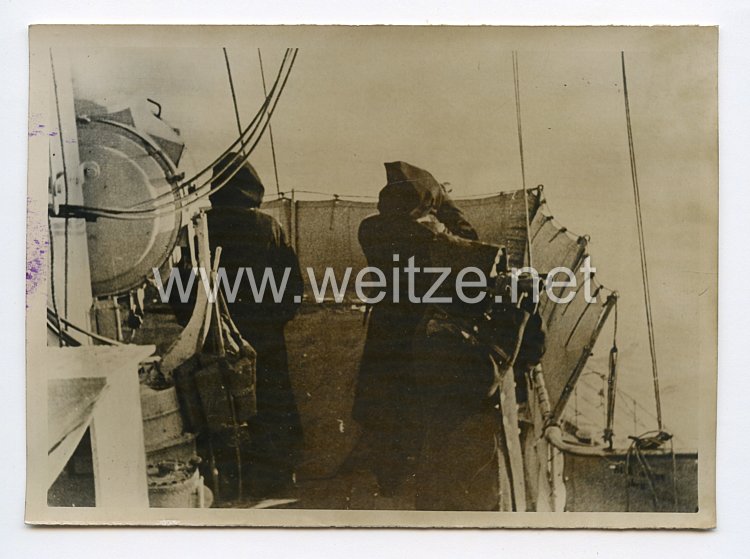
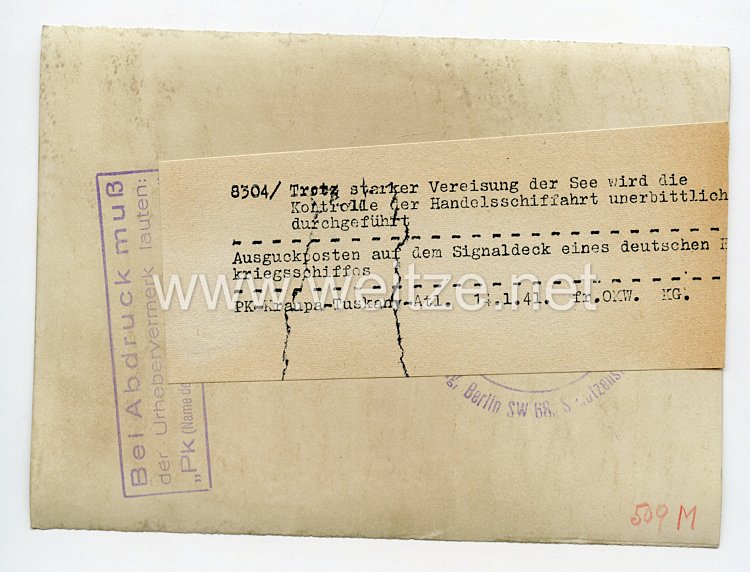
Kriegsmarine Press Photo: Lookout Post on the Signal Deck of a German Warship 14.1.1941
Kriegsmarine Press Photography: Lookout Posts on the Signal Deck
This press photograph from January 1941 documents a crucial aspect of naval warfare during World War II: the observation and lookout posts aboard German warships. The image dated January 14, 1941, shows crew members on the signal deck, one of the most strategically important areas of any Kriegsmarine warship.
The signal deck, also referred to as the command bridge or bridge area, served as the nerve center of ship operations. Lookout posts were stationed here, tasked with continuously scanning the horizon for enemy ships, submarines, aircraft, or other threats. In January 1941, the Kriegsmarine was engaged in intensive operations in the Atlantic and the North Sea. The Battle of the Atlantic was in full swing, with German surface vessels and U-boats attempting to sever British supply lines.
The press photography of the Kriegsmarine played an important propagandistic role. The Propaganda Companies (Propaganda-Kompanien, PK) of the Wehrmacht, including their naval units, were charged with documenting the war and preparing material for domestic and international reporting. These photographs were distributed through the High Command of the Wehrmacht (OKW) and the High Command of the Navy (OKM) to newspapers, magazines, and newsreels. They were intended to demonstrate the striking power of the German fleet and bolster morale on the home front.
The technical equipment of lookout posts was advanced for its time. Beyond the naked eye, observers used binoculars, scissor telescopes, and other optical devices from manufacturers such as Zeiss or Leitz. Despite the increasing introduction of radar technology (Funkmessgerät) from 1940/41 onward, visual observation remained indispensable. Early-generation radar systems were still unreliable and susceptible to interference, which meant trained lookout posts continued to play a central role.
The timing of this photograph, January 14, 1941, falls within a significant phase of the naval war. At this point, the Kriegsmarine was preparing Operation Berlin, during which the battleships Scharnhorst and Gneisenau sailed into the Atlantic in January 1941 to operate against Allied convoys. Simultaneously, the U-boat arm under Karl Dönitz was intensifying its operations against British merchant shipping. The vigilance of lookout posts was vital to survival – they had to identify not only enemy ships but also icebergs, mines, and increasingly, enemy aircraft.
Training to become a lookout was demanding and included intensive instruction in recognizing ship silhouettes, aircraft types, and maritime hazards. Crew members had to maintain their vigilance under extreme weather conditions – in storms, freezing cold, fog, and heavy seas. Duty on the exposed signal deck was particularly grueling during the winter months in the North Atlantic.
The format and condition of this photograph correspond to the standard press photographs of the Kriegsmarine from this period. The dimensions of approximately 18 x 13 cm were typical for press images intended for publication. The notation on the reverse served for identification and cataloging by editorial offices and archives. The yellowing of the paper is a natural aging process common to photographs from this era.
Such press photographs are today important historical sources that provide insights into daily life in the Kriegsmarine, technical circumstances, and the propagandistic self-representation of the Nazi regime. They document not only military aspects but also the living conditions of sailors and the challenges of naval warfare. For maritime historical research, such images are indispensable documents that enable insights extending beyond purely military aspects into social-historical and cultural-historical understanding.