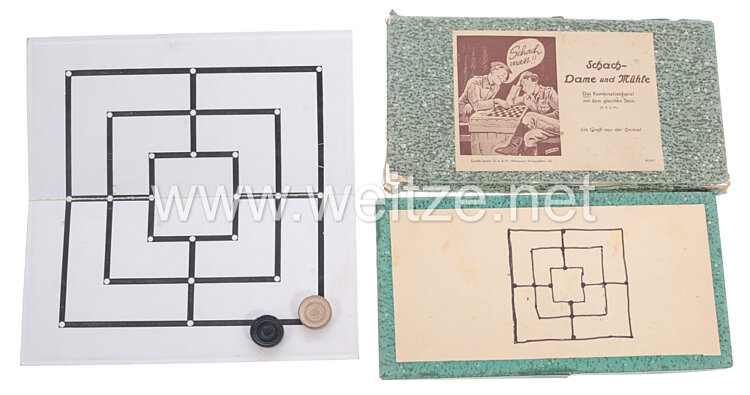
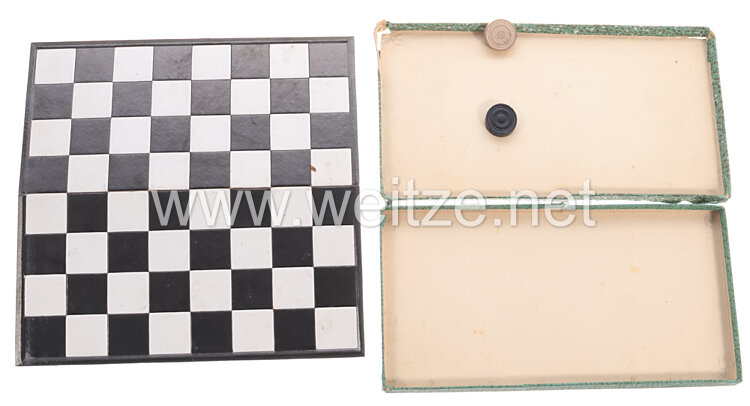
Third Reich / Wehrmacht - Board Game “Chess-Checkers-Nine Men's Morris”

A greeting from the homeland, with game rules, game board and 2 game pieces, used condition.
464674
35,00

Third Reich / Wehrmacht - Board Game “Chess-Checkers-Nine Men's Morris”

The object at hand is a board game set from the era of the Third Reich, combining three classic games: chess, checkers (Dame), and Nine Men's Morris (Mühle). Titled “Ein Gruß aus der Heimat” (A Greeting from Home), it was specifically designed for soldiers of the Wehrmacht serving far from their homeland.

During World War II (1939-1945), German military leadership recognized the importance of morale and psychological well-being for soldiers at the front. The long periods of inactivity between combat operations, monotonous guard duties, and separation from family and home presented significant challenges for the troops. To maintain combat morale and provide distraction, various leisure activities were promoted.

Field post parcels played a central role in maintaining the connection between home and front. These packages contained not only essential goods such as food, tobacco, and clothing, but also items for entertainment. Board games like this example were particularly popular because they were compact, durable, and suitable for multiple players.

The combination of three games in one set was practical and space-saving – important qualities for soldiers who had only limited storage space. Chess was considered an intellectually demanding game that promoted strategic thinking – skills that were also valued in a military context. Checkers offered a somewhat more accessible alternative, while Nine Men's Morris served as a quick game for short breaks.

The inscription “A Greeting from Home” illustrates the propagandistic dimension of such items. They were meant to convey to soldiers that the home front was thinking of them and appreciating their sacrifices. The Reich Ministry of Public Enlightenment and Propaganda under Joseph Goebbels systematically coordinated measures to maintain morale, including the promotion of such supply packages.

The production of such games often occurred through smaller businesses or as part of home-work programs. Due to the war economy, materials were frequently simple: cardboard, wood, and basic printing processes. As the war progressed, especially from 1942/43 onward, as resource scarcity increased, the quality of such products often deteriorated.

Soldiers used these games in dugouts, bunkers, and field camps. Eyewitness accounts and field post letters document how important such distractions were for psychological survival. During the long Russian winters on the Eastern Front, in positions in North Africa, or during occupation duty in various European countries, these games provided welcome entertainment.

The military-historical significance of such everyday objects is often underestimated. While weapons, uniforms, and military equipment represent the obvious relics of war, items like this game set provide insight into the daily life of ordinary soldiers. They document efforts to maintain a minimum of normalcy under extreme conditions.

After the war, many such items were kept by returning soldiers, often as mementos of survived dangers and lost comrades. Other examples were taken by Allied soldiers as war souvenirs. Today, they are part of private collections and museum holdings that document the everyday history of World War II.

The condition – described as “used” – is typical for such field items. The traces of use tell their own story about the circumstances under which they were employed. Wear, soiling, or damage are authentic witnesses to their use under field conditions.

For collectors of military historical objects, such everyday items represent an important aspect of military history. They complement the picture of pure militaria with the human dimension of the war experience and remind us that behind the military events stood individual fates.

r