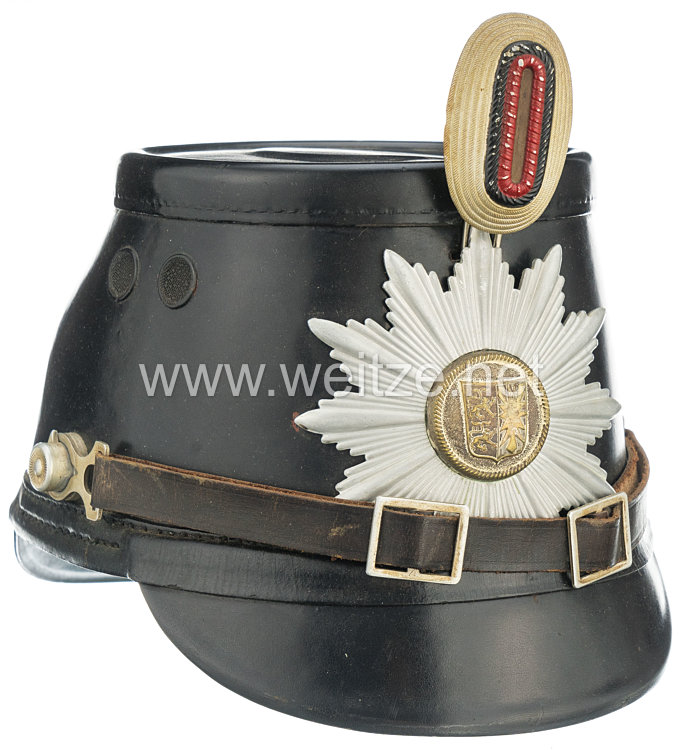
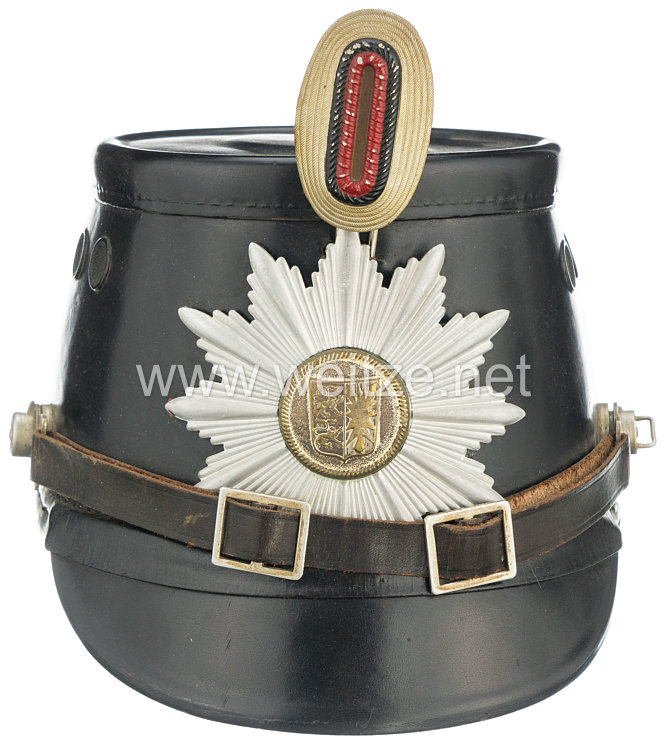
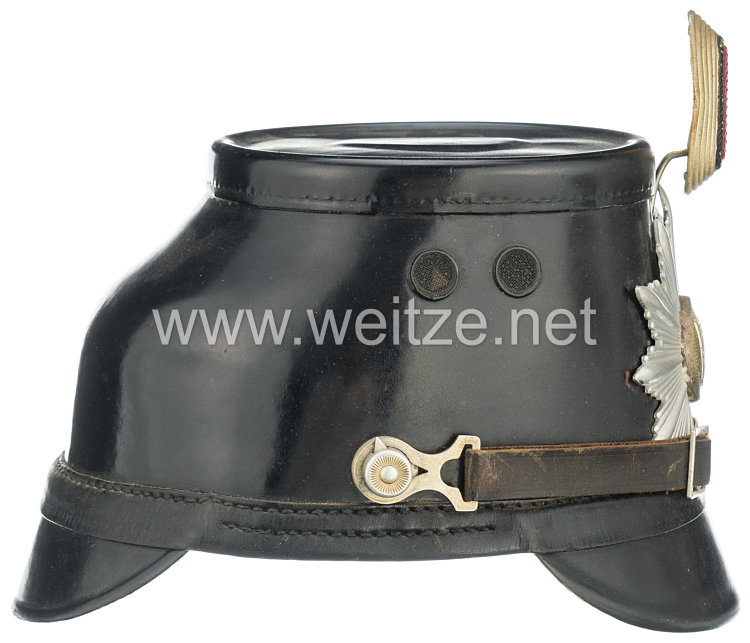
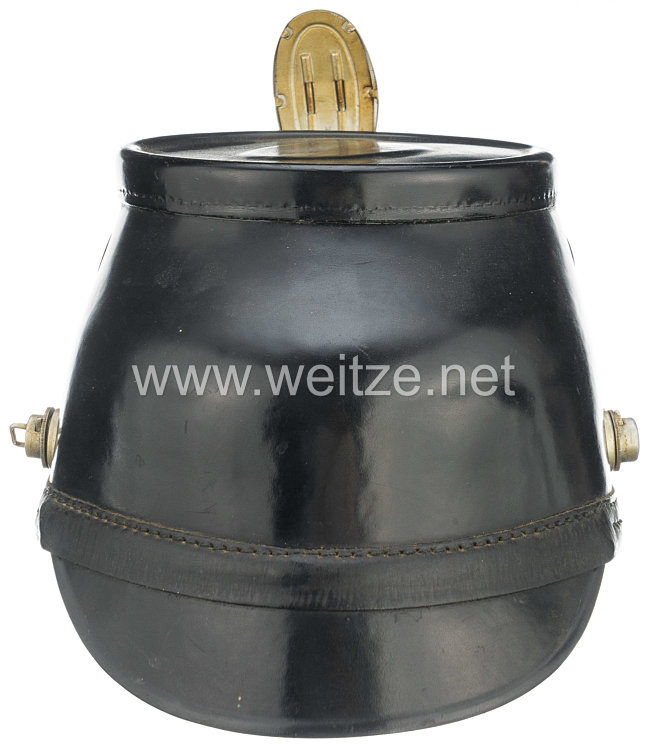
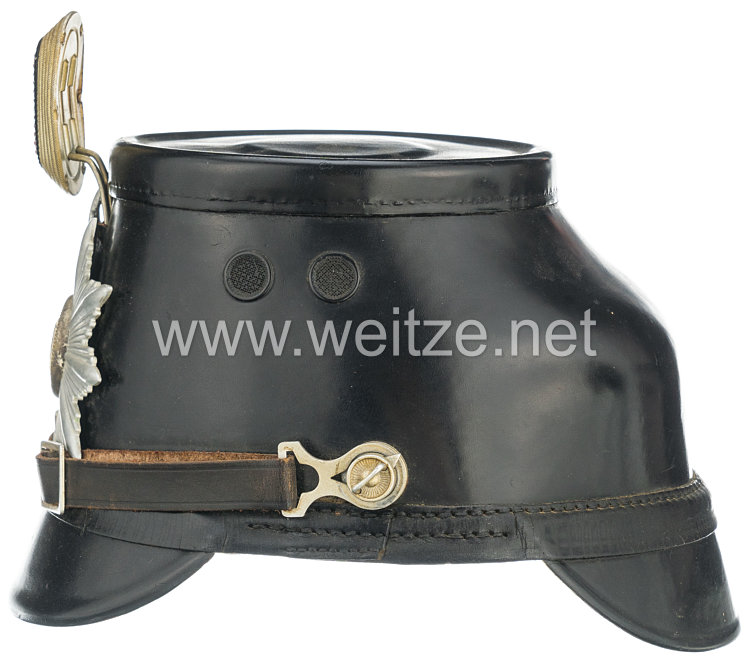
Federal Republic of Germany (FRG) Police Shako for Enlisted Men, State of Schleswig Holstein
The Schleswig-Holstein Police Shako: Symbol of the Young Federal Republic
This police shako for enlisted ranks from the state of Schleswig-Holstein represents a significant transitional phase in postwar German history. Worn around 1955, this headgear embodies the efforts of the young Federal Republic of Germany to build a new civilian law enforcement force that deliberately distanced itself from the militaristic past of the Third Reich.
Historical Context of Postwar Policing
After the collapse of the National Socialist regime in 1945, Germany came under Allied occupation. The Allies initially dissolved all German police units and began building new, democratically oriented police forces. In the western occupation zones, from which the Federal Republic of Germany emerged in 1949, police authority rested with the individual federal states – a principle that remains in effect today.
Schleswig-Holstein, the northernmost federal state, was under British occupation. The British promoted the establishment of a civilian police force based on Anglo-Saxon models, which was to differ markedly from the heavily militarized police of the Nazi era. From the early 1950s, the federal states developed their own uniform traditions that, on one hand, drew upon German police traditions of the 19th century, while on the other hand integrated new, democratic symbols.
The Shako as Traditional Headgear
The shako (also spelled tschako or schako) has a long tradition in European military and police units. Originally from Hungary, this cylindrical headgear spread throughout Europe from the late 18th century. In Germany, both military and police units wore various forms of shakos, especially in the 19th century and into the Weimar Republic.
Schleswig-Holstein's decision to reintroduce shakos in the mid-1950s was deliberately symbolic: they wanted to connect with positive traditions of German police history, particularly the period before National Socialism.
Materials and Construction
The described shako is made of vulcanized fiber, a material developed in the 19th century consisting of multiple compressed layers of cellulose. Vulcanized fiber was lightweight, relatively inexpensive, yet robust enough for daily service. In the postwar period, when high-quality materials were scarce and expensive, vulcanized fiber offered a practical alternative to leather or metal.
The black color was traditional for German police uniforms, a legacy from the 19th century when police units distinguished themselves chromatically from the mostly field-gray or colorful military uniforms.
Symbolism and Insignia
The central element of the shako is the large silver-colored police star, with the coat of arms of Schleswig-Holstein at its center. The police star had a long tradition in Germany and symbolized order, protection, and state authority. The Schleswig-Holstein state coat of arms with its two lions and nettle leaf emphasized the federal structure of the Federal Republic and the independence of state police forces.
The lacquered cockade – a circular insignia – was another traditional element of German uniforms. The black leather chin strap, attached with button 91, served both practical purposes (securing the headgear in wind or physical activity) and decorative functions.
Wearing and Use
This shako was intended for enlisted ranks, meaning police officers in the lower and middle service grades. Officers often wore more elaborately designed versions with additional decorations. The shako was worn on special occasions, at parades, official events, and guard duty. For everyday patrol duty, more practical headgear was common.
The indicated size 57 corresponds to the head circumference in centimeters, a standard measurement still used in Germany today. The laced lining inside provided wearing comfort and sweat absorption.
The End of an Era
The use of shakos by German police in the 1950s and early 1960s was a retrospective look at traditional forms. During the 1960s, however, these ceremonial headgear pieces were increasingly replaced by more modern, practical peaked caps. Police reforms of the late 1960s and 1970s, which aimed at modernizing and demilitarizing the police, led to the final disappearance of the shako from active service.
Today, such shakos are sought-after collector's items documenting a brief but significant epoch in German police history – the years of reconstruction when the young Federal Republic attempted to strike a balance between tradition and democratic new beginning. This particular example, in condition 2 (indicating good preservation with minor wear), serves as a tangible reminder of the postwar effort to create state institutions that could command respect while embodying democratic values.