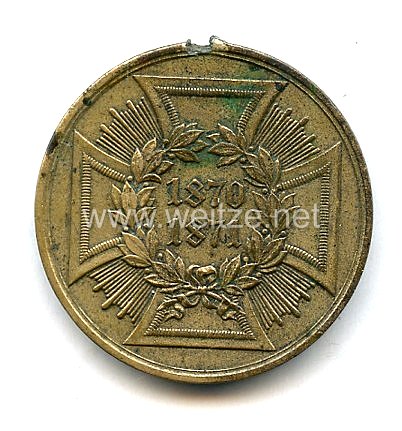
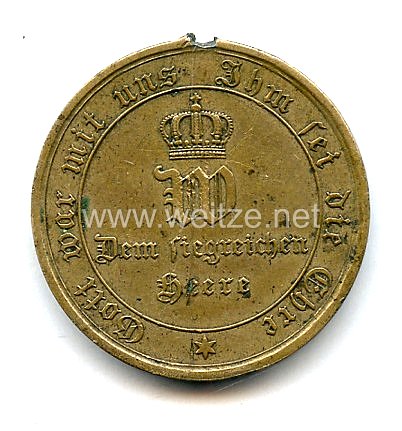
Prussia War Commemorative Medal 1870-1871 for Combatants
The Prussian War Commemorative Medal 1870-1871 for Combatants represents one of the most significant military decorations of the German Empire and documents participation in the Franco-Prussian War of 1870 to 1871. This campaign led to the founding of the German Empire on January 18, 1871, at Versailles and marked a turning point in European history.
The establishment of this commemorative medal was authorized by King Wilhelm I of Prussia, who was later proclaimed German Emperor, on May 20, 1871. The decoration was intended to be awarded to all Prussian soldiers who had actively participated in combat operations. This included members of the regular army as well as the Landwehr (militia) and Landsturm (territorial reserve).
The present specimen bears the special edge inscription “Aus erobertem Geschütz” (From Captured Cannon), indicating that it was struck from gun-metal bronze. This variant was specifically manufactured from the material of French artillery pieces captured during the war. The use of captured gun metal for the production of orders and decorations had a long tradition in Prussian-German military history and gave the award special symbolic significance. It not only demonstrated military victory but transformed the weapons of the defeated enemy into badges of honor for the victors.
The Combatant version differed significantly from the Non-Combatant variant. While combatants received the medal in bronze, the version for non-combatants was struck in steel. This distinction made immediately visible who had directly participated in combat operations and who had served in supporting functions.
The obverse of the medal typically displays the crowned monogram “W” (for Wilhelm) beneath the Prussian royal crown, surrounded by oak leaves. The reverse bears the inscription “1870-1871” and often additional patriotic symbols or inscriptions. The design followed traditional Prussian numismatic and phaleristic conventions of the 19th century.
The Franco-Prussian War began on July 19, 1870, with the French declaration of war against Prussia. The conflict resulted from complex diplomatic tensions, particularly the so-called Ems Dispatch, and rivalry for supremacy in Europe. The Prussian-German troops under the command of Field Marshal Helmuth von Moltke achieved a series of decisive victories, including at Sedan on September 1 and 2, 1870, where Emperor Napoleon III was captured. The war officially ended with the Treaty of Frankfurt on May 10, 1871.
The award policy for the war commemorative medal was relatively generous, as all active participants in combat operations were entitled to the decoration. This resulted in a large number of medals being awarded. Nevertheless, the medal retained its value as proof of war participation and was worn with pride by veterans.
The medal was originally worn on a black and white ribbon, the Prussian national colors. The suspension ring, which connected the medal to the ribbon, is broken on the present specimen, suggesting intensive wear or the effects of over 150 years of history. Such damage is not uncommon with historical militaria and only slightly diminishes the historical value.
From a collector's perspective, the War Commemorative Medal 1870-1871 is an important testimony to German military history. The version made from captured cannon is particularly sought after, as it symbolizes the direct connection to combat operations. The indicated condition 2 suggests a well-preserved medal with light signs of use, which is quite normal for an awarded example.
This war commemorative medal stands as an exemplar of 19th-century militaria tradition and documents a historically significant period that permanently altered the political map of Europe and led to the founding of the German Empire, which would endure until 1918.