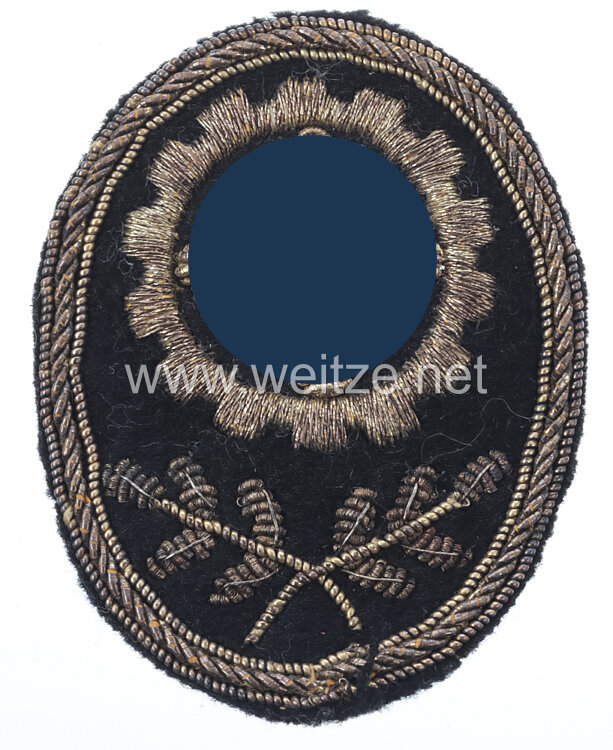
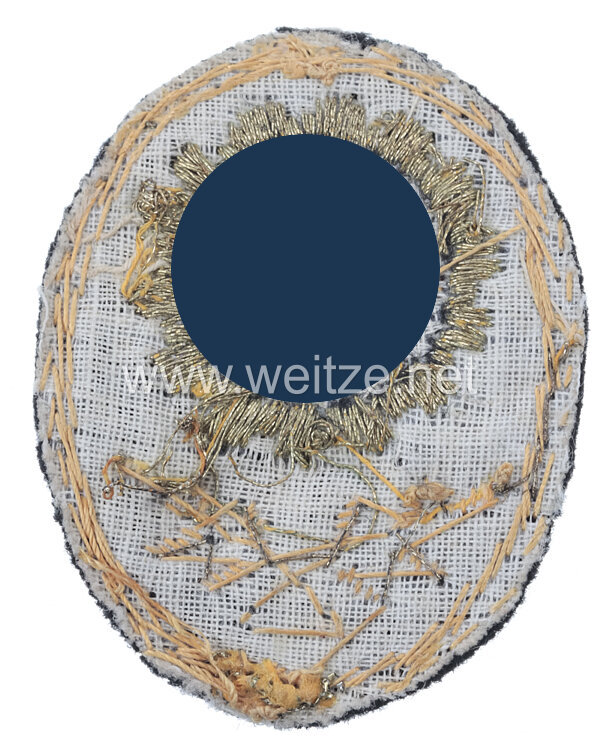
Deutsche Arbeitsfront (DAF) Visor Cap Badge
The Deutsche Arbeitsfront (DAF) cap badge represents a significant emblem of the National Socialist labor movement that existed in Germany from 1933 to 1945. The German Labour Front was founded on May 10, 1933, under the leadership of Robert Ley and replaced the dissolved free trade unions as well as the Christian and liberal labor associations.
This hand-embroidered metal thread version represents what is known as a luxury execution of these badges. Unlike the machine-manufactured or stamped standard versions, these high-quality specimens were produced through elaborate manual craftsmanship. The use of metal threads, typically made of aluminum or silver-plated copper wire, gave these badges a special luster and high level of detail.
The DAF developed into the largest mass organization of the Third Reich with over 25 million members by 1939. Its stated objectives included the “creation of a true people's and performance community” of all Germans. In practice, it served to control and coordinate the workforce and spread National Socialist ideology in workplaces.
The cap badge typically displays the characteristic DAF symbol: a gear wheel as a symbol of industry and technology, combined with the swastika as the central element of NS symbolism. This combination was intended to visualize the connection between labor and National Socialist ideology. The design followed strict guidelines set forth in the DAF uniform regulations.
Such hand-embroidered luxury versions were primarily worn by higher functionaries and officials of the DAF. The hierarchy within the organization was complex and included various ranks from simple members to Reich Works Community Leaders. The quality of uniform badges often signaled the wearer's status and position within the organization.
The production of these badges was carried out by specialized craft workshops and insignia factories that worked according to precise specifications. Well-known manufacturers such as firms in Lüdenscheid and Wuppertal produced both standard and luxury versions. The hand-embroidered variant required considerable craftsmanship and significantly more working time than machine-made versions.
The peaked cap itself was a central component of the DAF uniform. It was worn in various versions depending on rank and function. The basic form corresponded to military models but was adapted through specific colorings and DAF badges. The cap badge was prominently attached to the front and was thus the most clearly visible identification mark.
In the context of NS symbolic politics, uniforms and badges played a central role. They served not only for identification and organization but also for the psychological integration of members and public demonstration of power and unity. The aestheticization of politics, characteristic of National Socialism, also manifested itself in the careful design of such insignia.
After the end of World War II, the German Labour Front, together with all other NS organizations, was banned and dissolved by Control Council Law No. 2 of October 10, 1945. Wearing its symbols and uniform parts was prohibited. Today in Germany, these objects fall under §86a StGB, which regulates the use of symbols of unconstitutional organizations, with exceptions for historical, scientific, and educational purposes.
From a military-historical and collector's perspective, such badges document the material culture and organizational structure of the NS regime. They are testimonies to the propaganda and control mechanisms through which the regime permeated society. The craftsmanship quality of the luxury versions also illustrates the continuity of traditional German craftsmanship even in this problematic historical context.
The condition rating of 2 typically indicates an item in good to very good condition with minimal wear, suggesting this particular badge has been well-preserved over the decades. Such specimens are of interest to museums, researchers, and serious collectors who study the material history of the period, serving as tangible evidence of the extensive organizational apparatus of the Third Reich.