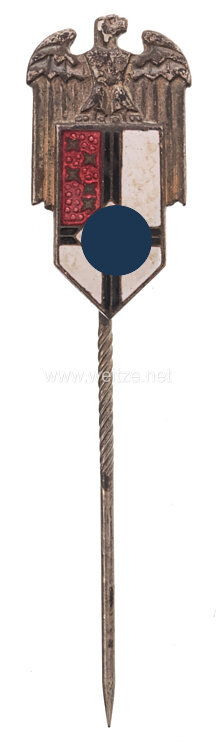
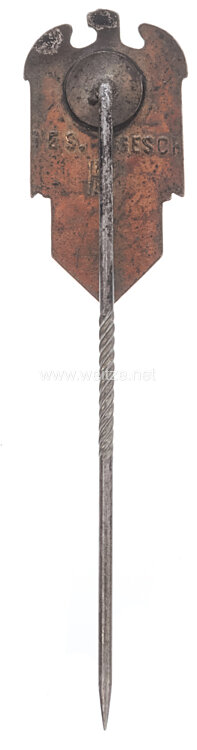
Reichskolonialbund (RKB) - Official's Badge in Silver
The Silver Official Badge of the Reichskolonialbund (RKB) represents a significant artifact from Germany's colonial ambitions during the National Socialist era. This official badge was awarded to functionaries within the organization and symbolized their position and commitment to the colonial political goals of the Third Reich.
The Reichskolonialbund (Reich Colonial League) was founded on June 8, 1936, through the merger of various colonial organizations, including the German Colonial Society and the Women's League of the German Colonial Society. Under the leadership of Franz Ritter von Epp, who served as Reich Commissioner for Colonial Affairs, the RKB became the central organization for all colonial political activities in National Socialist Germany. The organization aimed to promote colonial ideology among the German population and support demands for the return of former German colonies.
After World War I, Germany had lost all its colonial territories through the Treaty of Versailles in 1919. These included territories in Africa such as German East Africa, German Southwest Africa, Cameroon, and Togo, as well as areas in the Pacific. Nazi propaganda used the loss of these colonies as part of their revisionist claims against the Versailles order. The Reichskolonialbund played a central role in disseminating these demands and organized exhibitions, lectures, and publications on the subject.
The Silver Official Badge was awarded according to specific criteria. It distinguished individuals who held important functions within the organization and had proven particularly meritorious. The badge was typically worn on a long pin, as was common with many NS organizational badges. This pin allowed secure attachment to uniforms or civilian clothing.
The production of such badges was carried out by state-authorized manufacturers. The manufacturer listed on this specimen, HFB GES.GESCH. (Gesellschaft geschützt - Protected Company), was among the official producers of NS badges and decorations. Marking by manufacturer's marks was common with NS awards and served quality control as well as prevention of counterfeits. Production was strictly regulated, and only authorized companies were permitted to manufacture these official badges.
The design of the badge followed the aesthetic principles of NS symbolism. Typically, RKB badges displayed colonial motifs, frequently with the swastika as a central element of National Socialist iconography. The silver version indicated a middle to higher rank within the organization. In addition to the silver version, there were also bronze versions for lower-ranking functionaries.
Membership in the Reichskolonialbund was considerable. By 1939, the organization counted approximately 2 million members. The RKB was divided into various subdivisions, including regional associations, local groups, and specialized sections. The organization also operated its own publication system and maintained the Colonial Museum in Berlin.
With the outbreak of World War II in 1939, the colonial political ambitions of the German Reich increasingly lost significance. Military resources were needed for the war in Europe and later worldwide. Nevertheless, the Reichskolonialbund formally continued to exist until the end of the war in 1945. After the German capitulation, all NS organizations were dissolved by the Allies, and wearing their badges was prohibited.
Today, official badges of the Reichskolonialbund are important historical objects for researching the NS period and German colonial history. They document the ideological connection between colonial revisionism and National Socialist ideology. Collectors and museums preserve such objects as witnesses to this historical epoch, whereby the scientific and educational context must always be paramount.
The preservation and documentation of such historical artifacts is important for historical memory and scholarly engagement with National Socialist rule and its diverse organizations. They serve as reminders of a time when colonial and racist ideologies were state-sponsored and manifested through a sophisticated system of symbols and badges.