Hunting Hanger circa 1850
This hunting hanger (Jagdplaute) from the mid-19th century represents a fascinating transition in European hunting and weapons culture. In an era marked by profound social changes, hunting weapons evolved from purely functional tools into elaborately crafted status symbols of the rising bourgeoisie and traditional nobility.
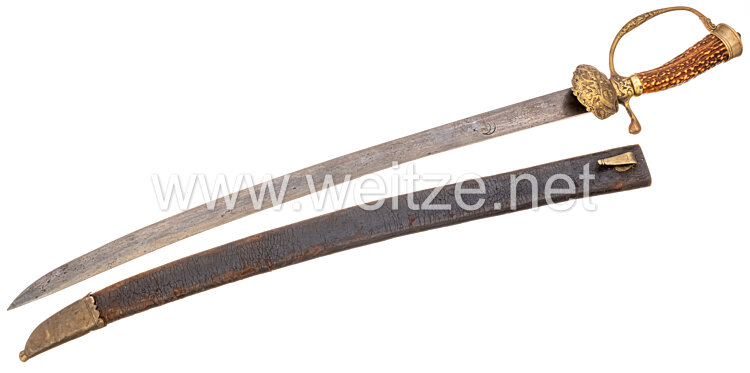
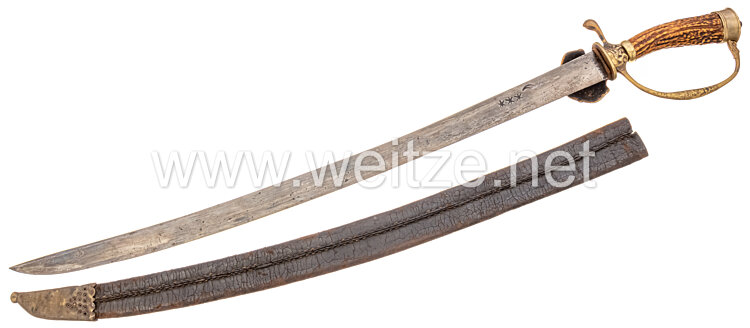
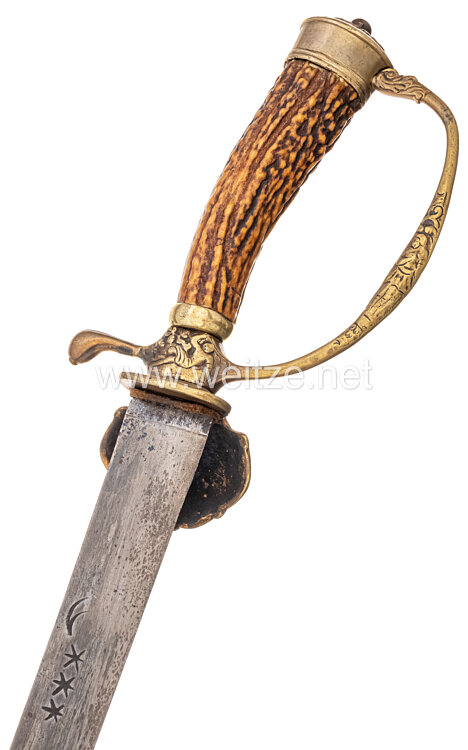
The term “Plaute” or “Hirschfänger” (literally “deer catcher”) designates a special form of hunting weapon with origins in the late Middle Ages. Originally conceived as a dispatching weapon, this instrument served to deliver the final blow to wounded or cornered game. The slightly curved wedge blade without fuller was characteristic of German hunting weapon production during the Biedermeier period and early Industrial Age.
Around 1850, Germany was experiencing a phase of political and economic upheaval. The revolutionary years of 1848/49 had shaken the old estate-based order, while industrialization was fundamentally transforming society. Hunting rights, for centuries an exclusive privilege of the nobility, began to slowly democratize. Wealthy citizens, merchants, and factory owners sought to establish themselves socially through the practice of hunting and the possession of appropriate equipment.
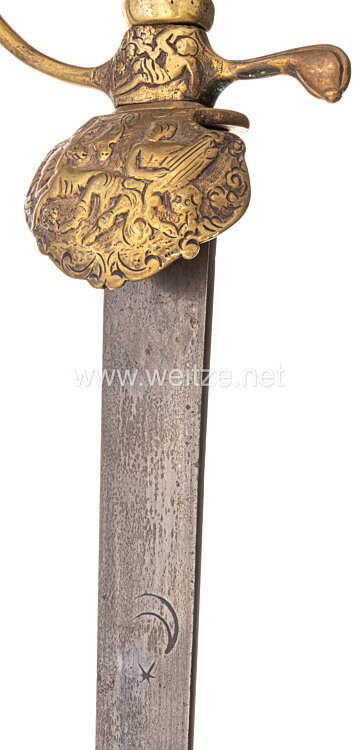
The decoration featuring moon and stars on the blade is a typical element of romantic symbolism from this epoch. These ornamentations were not merely aesthetic but carried deeper meaning. Celestial bodies symbolized in the romantic tradition the connection with nature, nocturnal hunting, and the mystical relationship between hunter and prey. The Biedermeier period (1815-1848) and the subsequent phase were characterized by a strong turn toward nature and rural life, which was reflected in the design of hunting weapons.
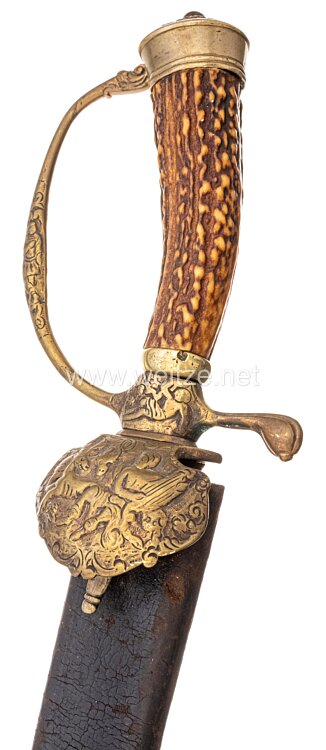
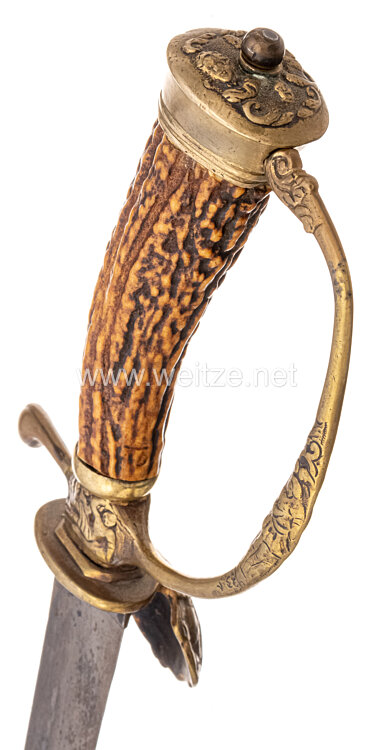
The brass hilt with thin crossguard and knuckle bow demonstrates the craftsmanship quality of contemporary weaponsmiths. Brass was a preferred material for hilt components as it was corrosion-resistant and easily workable. The knuckle bow with hunting motif – presumably depicting game or hunting scenes – underscores the representative character of this weapon. Such decorations were often executed by specialized engravers who worked in weapon production centers such as Solingen, Suhl, or southern German cities.
The staghorn grip was the material of choice for 19th-century hunting weapons. Staghorn not only symbolized the connection to hunting itself but also offered practical advantages: it provided good grip, was weather-resistant, and could be easily shaped. The use of trophy material for weapon grips had a long tradition and symbolically connected successful hunts of the past with future endeavors.
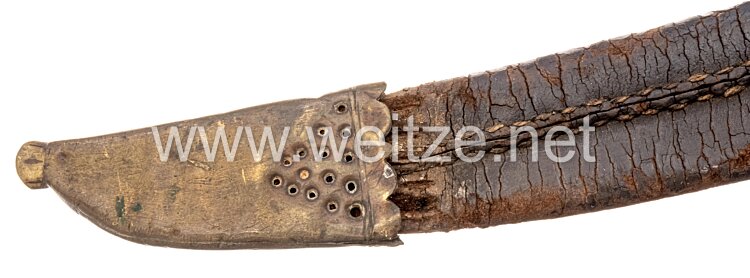
The leather scabbard with brass fittings – chape and suspension loop – completes the typical appearance of an upscale hunting weapon from the mid-19th century. The suspension loop allowed carrying on a baldric or belt, with the hanger traditionally worn on the left side to enable quick access with the right hand.
In the mid-19th century, hunting was a complex social ritual. The court hunts of German principalities followed strict ceremonial rules, while parallel to this, a bourgeois hunting culture developed. Hunting weapons like this hanger were integral parts of hunting equipment and were often acquired in sets with rifles, powder horns, and other accessories.
Production methods around 1850 stood at the transition between traditional craftsmanship and industrial manufacturing. While blades could already be machine-forged, decorations, assembly, and fine work were still performed by hand. This explains the individual differences between various specimens despite similar basic forms.
From a military-historical perspective, this epoch also marks the decline of edged weapons as primary weapons of war. Needle rifles and improved firearms fundamentally changed warfare. Side arms such as sabers and hunting hangers, however, retained their ceremonial and symbolic significance, especially in Jäger and forester units of German armies.
The preservation of such objects over more than 170 years testifies to the esteem in which they were held. Today they are important witnesses to a bygone hunting and weapons culture, documenting the craftsmanship of an era when functional objects were still understood as carriers of cultural meaning and aesthetic ambitions.
These hunting hangers also reflect the complex relationship between humans and nature during the 19th century. The romantic movement idealized the forest and hunting as places of authentic experience and spiritual renewal. Simultaneously, systematic forestry and game management were developing into scientific disciplines. The hunting hanger thus stood at the intersection of romantic idealization and practical utility, of tradition and modernity.