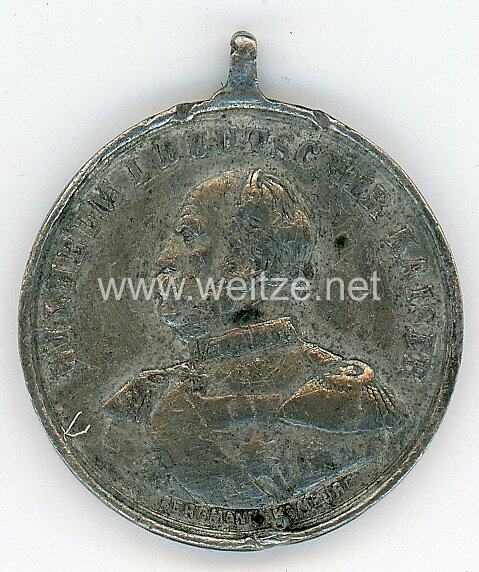
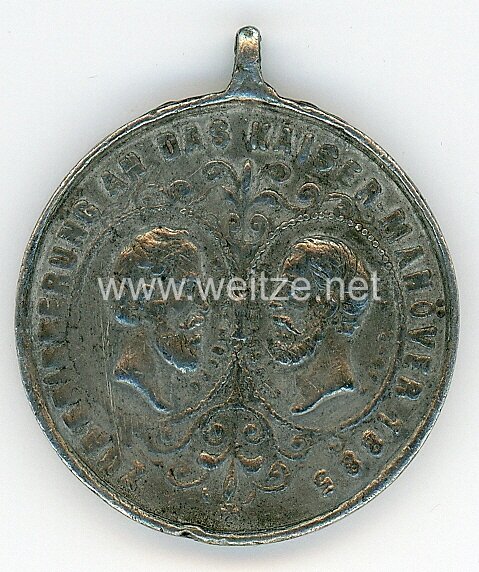
German Empire - Commemorative Medal "In Memory of the Imperial Maneuvers 1885"
The Commemorative Medal “In Memory of the Imperial Maneuvers 1885” represents a fascinating chapter in Prussian-German military history during the late 19th century. This silver-plated medal, approximately 29 millimeters in diameter, belongs to those military commemorative pieces issued during the reign of Kaiser Wilhelm I (1871-1888) and documents the growing importance of large-scale military maneuvers in the German Empire.
The Imperial Maneuvers (Kaisermanöver) represented the pinnacle of the German Empire's annual military exercises. Following the unification of Germany in 1871, they evolved into spectacular large-scale military events, bringing together several army corps under the personal supervision of the Kaiser. The 1885 maneuvers took place during a period when the German Empire, under Chancellor Otto von Bismarck, sought to consolidate its position as a European great power.
The military significance of these exercises cannot be overstated. The Imperial Maneuvers served several strategic purposes: they enabled the Prussian General Staff to test new tactical concepts, improve coordination between different branches of service, and assess the operational readiness of large troop formations. Simultaneously, they served an important representative function, demonstrating the striking power of German armed forces to both the domestic population and foreign military observers.
The year 1885 held particular military-political significance. The German Empire found itself in the midst of the so-called “Armed Peace” between European great powers. The experiences of the Wars of Unification (1864-1871) had underscored the necessity of continuous military training and modernization. The German General Staff under Field Marshal Helmuth von Moltke the Elder and later under his successor systematically developed concepts for warfare with mass armies.
Commemorative medals such as this were typically issued to officers, non-commissioned officers, and enlisted men who had participated in the maneuvers. They served as decorations of honor and were intended to emphasize loyalty to the Imperial House and the importance of military service. The silver plating indicates a higher-quality execution, possibly intended for officers or those who distinguished themselves during the maneuvers.
The iconography of such medals typically followed the conventions of imperial commemorative insignia: often featuring the Kaiser's portrait, Imperial eagles, military symbols, or depictions of military scenes. They were part of a broader medal culture in the German Empire that honored military merit, service periods, and special occasions.
In the context of military history, such medals document the professionalization and ritualization of the military system in the late 19th century. The Imperial Maneuvers were not merely military exercises but also social events that attracted considerable public attention. They drew thousands of spectators and received extensive coverage in the contemporary press.
For collectors and military historians, such commemorative medals provide important insights into the military culture of the Imperial era. They document the appreciation of military virtues, the central role of the Kaiser as supreme warlord, and the importance accorded to the military in Wilhelmine society. The condition grade 2 of this medal indicates good preservation, which is remarkable for an object over 135 years old.
The tradition of Imperial Maneuvers continued until World War I and reached its zenith under Kaiser Wilhelm II. The experiences gained directly influenced military planning, although it later became evident that maneuvers could only simulate the reality of modern warfare to a limited extent. Today, medals such as this are important testimonies to a bygone military culture and remind us of an era when the military played a central role in German social and political life.