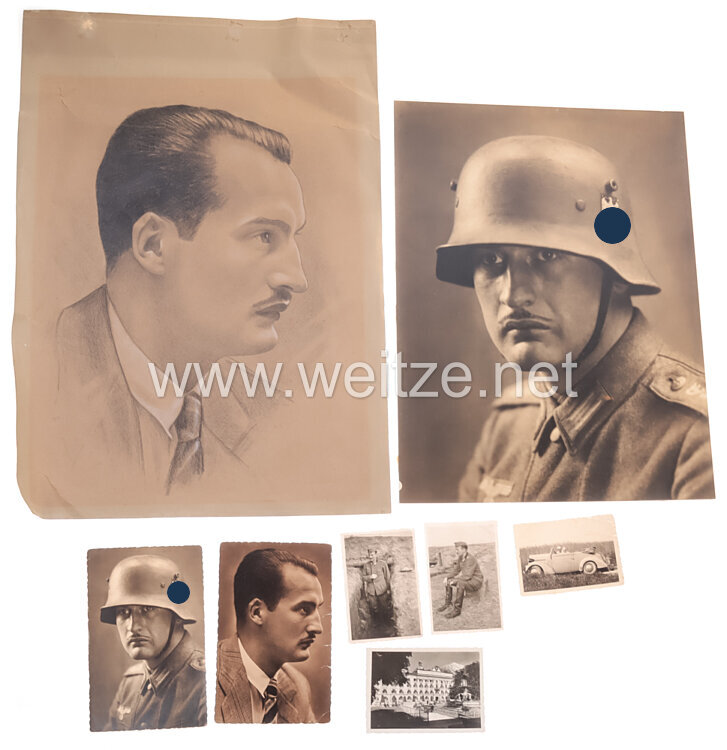
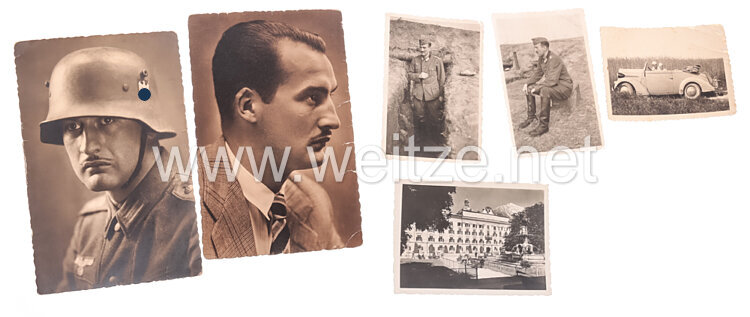
Wehrmacht Heer Photographs, Soldier with M18 Stahlhelm of a Replacement Unit

7 photographs, 1 large-format portrait drawn in pencil, dimensions approx. 30 x 43 cm. Condition 2.
458471
120,00

Wehrmacht Heer Photographs, Soldier with M18 Stahlhelm of a Replacement Unit

This collection of seven photographs and a large-format pencil portrait documents a soldier of the Wehrmacht Heer during World War II, wearing an M18 Stahlhelm and belonging to a replacement unit (Ergänzungseinheit). This group of objects provides valuable insights into the organization, equipment, and daily life of the German armed forces during this period.

The M18 Stahlhelm visible in the photographs represents a significant detail. Officially designated as the “Stahlhelm M1916” or “M1918,” this helmet model was originally developed and introduced toward the end of World War I. After the Treaty of Versailles in 1919, the production of new military equipment was heavily regulated; nevertheless, large stocks of these helmets were stored. With rearmament beginning in 1935 and the introduction of the more modern M35 Stahlhelm, the older M18 models were not immediately phased out but were primarily used by second-line units, replacement and training units, and supplementary units.

The replacement units (Ergänzungseinheiten, also called Ersatzeinheiten) played a central role in the Wehrmacht's replacement system. These units were responsible for basic training of new recruits, continuing education of soldiers, and providing replacement personnel for field units. They were typically organized within the Wehrkreis system, which divided the German Reich into various military districts. Each Wehrkreis had its own replacement units for different branches of service.

The fact that the depicted soldier wears an M18 helmet strongly suggests that the photographs were taken during the training phase, presumably between 1939 and 1942. During this time, it was common for recruits and soldiers at home stations to be trained with older equipment, while more modern equipment was reserved for front-line units. This was a pragmatic solution given the enormous material requirements of expanding warfare.

The large-format pencil portrait measuring 30 x 43 cm represents a special form of artistic documentation. Such portraits were relatively common during World War II and were often created by local artists, sometimes by talented comrades. They served as personal mementos for soldiers and their families. The size and quality of the portrait suggest professional or at least highly competent execution. These artworks were frequently created from photographs and were popular gifts or keepsakes sent home.

Photographic documentation of soldiers was widespread during the war. Many Wehrmacht members owned their own cameras or had their pictures taken in professional photo studios in garrison towns. These images served various purposes: they were personal memories, were sent to family members, and documented military service. The quality and condition of such photo collections vary considerably, with the indicated condition 2 suggesting good preservation with minor signs of use.

Uniforms and equipment in replacement units often differed from those of field units. While front-line soldiers generally received the latest available equipment, training units frequently had to make do with older stocks. This affected not only helmets but also weapons, uniform pieces, and other equipment items. The use of the M18 helmet in replacement units was only gradually replaced by newer models as sufficient production capacity became available.

The Wehrkreis system, to which the replacement units were assigned, formed the organizational backbone of the Wehrmacht. There were a total of 15 Wehrkreise (later more through territorial expansions), each responsible for recruitment, training, and supply of troops in their area. The replacement units bore specific markings indicating their affiliation with a particular Wehrkreis and a particular parent unit.

Such personal photo collections and artworks are important historical sources today. They document not only military equipment and uniforms but also provide insight into the personal experiences and self-perception of soldiers. For military historical research, they are valuable supplements to official documents and enable a more comprehensive reconstruction of everyday reality in the Wehrmacht.

The combination of photographs and portrait art in this collection makes it particularly valuable for understanding how soldiers and their families sought to preserve memories during wartime. These items represent both official military service and the deeply personal human dimension of war, offering researchers and collectors alike a tangible connection to this historical period.

r