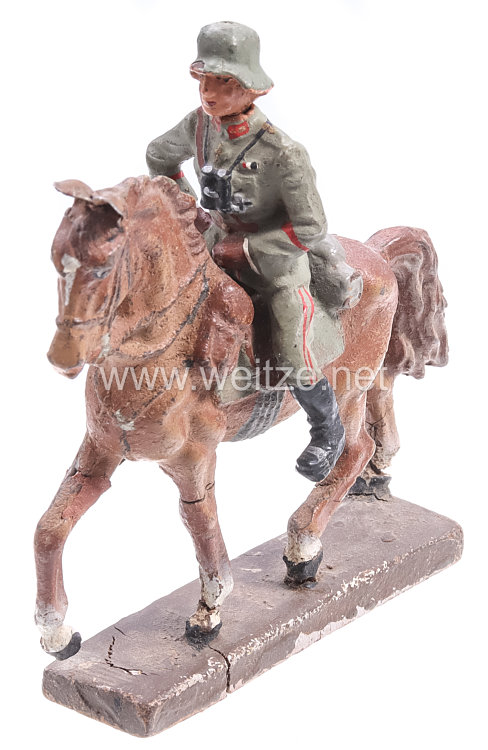
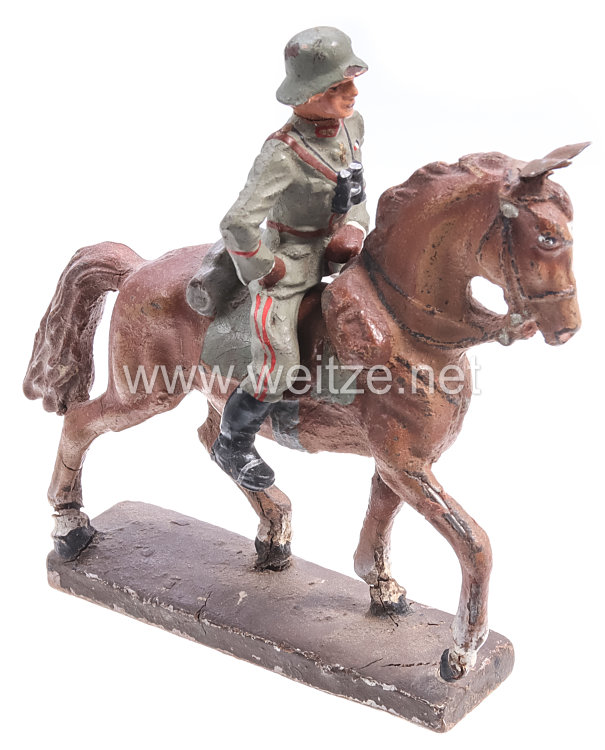
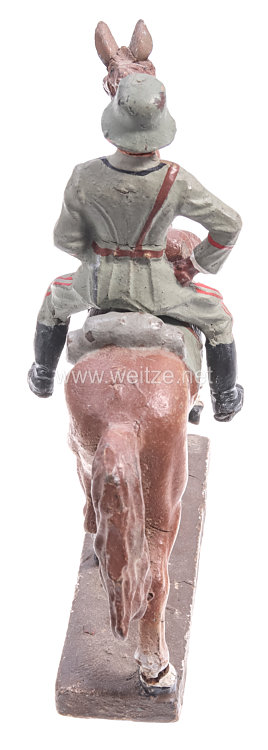
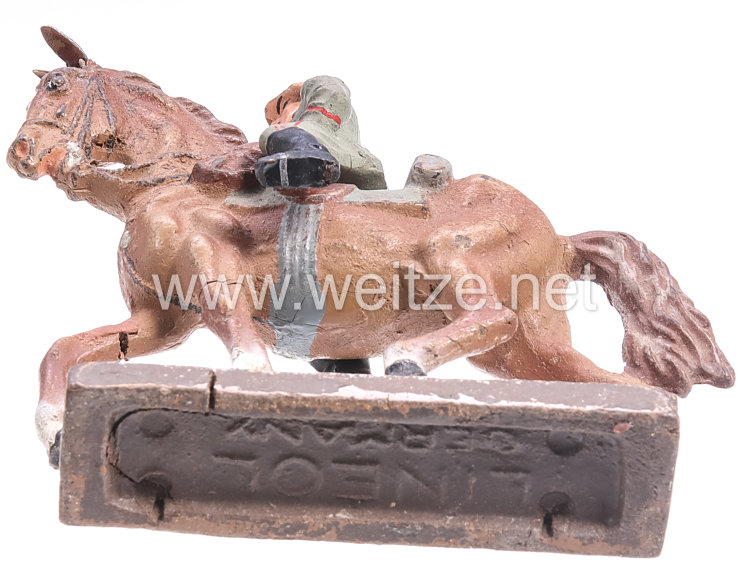
Lineol - Army General with Binoculars Mounted on Walking Horse

7.5 cm, condition 2.
402471
65,00

Lineol - Army General with Binoculars Mounted on Walking Horse

Lineol Figure: Army General with Binoculars on Walking Horse

This figure of a mounted Army General with binoculars by the company Lineol represents a remarkable example of German toy production from the 1930s and early 1940s. At 7.5 cm in size, it belongs to the standard scale of Lineol-Elastolin figures, which were the leading mass-produced figures for play and collecting purposes during this era.

The Lineol Company was founded in 1906 by Oskar Wiederholz in Brandenburg an der Havel. The name “Lineol” was a coined word referring to the use of linoleum as a binding agent in the composition material. This material consisted primarily of sawdust, glue, casein, and oil, making the figures considerably more stable and elastic than traditional lead figures. This innovation enabled more detailed modeling and greater durability, which was particularly important for children's toys.

Lineol experienced its golden age during the 1930s. The company produced extensive series of military figures depicting the contemporary Wehrmacht. Generals on horseback were particularly popular subjects, as they symbolized authority and military leadership. The representation of a general with binoculars on a walking horse corresponded to the military reality of that time, when cavalry and mounted commanders still played an important role, even though motorization was already advancing.

Military-Historical Context: In the Wehrmacht of the 1930s and 1940s, generals were often still mounted, particularly during parades, inspections, and in battlefield command. Binoculars or scissor telescopes were indispensable equipment for officers of all ranks. High-ranking officers typically used high-quality optical devices from manufacturers such as Zeiss or Leitz. The depiction of the general on a walking horse shows a typical observation scene, as would occur during terrain reconnaissance or the direction of maneuvers.

An Army General's uniform was characterized by special features: golden shoulder boards with general's stars, red general's stripes on the trousers, and often a highly decorated tunic. Lineol placed great emphasis on the accurate reproduction of these details, as far as was possible at this scale. The painting was done by hand, making each figure an individual piece.

Production Technical Aspects: Manufacturing took place in several stages. First, the individual parts were cast in metal molds. The composition material was heated and pressed into the molds. After hardening, the parts were assembled – often horse and rider were manufactured separately and then joined together. This was followed by priming and detailed painting with oil paints. The quality of painting varied depending on the year of production and available resources.

Collecting History and Significance: After World War II, production of such military figures was initially discontinued. The Lineol company increasingly produced civilian figures in the postwar period. Many of the prewar figures were destroyed during the war or were lost. This makes well-preserved examples highly sought-after collector's items today. The indicated Condition 2 according to the common collector's scale (1 = mint condition, 6 = heavily damaged) suggests a very well-preserved piece, possibly with minimal signs of use or small paint chips.

Today, Lineol figures are valued not only for their craftsmanship but also as historical documents of their time. They reflect the military iconography and representational conventions of their period of origin. For military historians, they offer insights into uniform studies and Wehrmacht equipment. For toy historians, they document the development of the German toy industry and the social values of the era.

Preserved Lineol figures are now found in numerous private collections and museums worldwide, including the German Historical Museum in Berlin and specialized toy museums. They are preserved and studied as important witnesses to everyday culture and toy production of the 20th century.