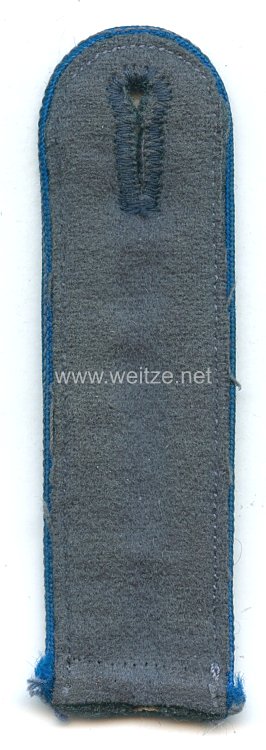
DLV Deutscher Luftsport Verband: Single Shoulder Strap for Enlisted Men

circa 1935, for sewing onto the tunic. Condition 2.
342571
85,00

DLV Deutscher Luftsport Verband: Single Shoulder Strap for Enlisted Men

This single shoulder strap for enlisted ranks of the Deutscher Luftsport-Verband (DLV) from around 1935 represents a significant artifact from the pre-military aviation organizations of National Socialist Germany. Designed to be sewn into the dress tunic, this shoulder strap embodies the transitional phase between civilian aviation sports organizations and the emergence of the German Luftwaffe.

The Deutscher Luftsport-Verband (German Air Sports Association) was founded on March 25, 1933, and served as the umbrella organization for all civilian aviation sports activities in the German Reich. After the Nazi seizure of power, the DLV was placed under the leadership of Hermann Göring and rapidly developed into a paramilitary organization. The association's official mission was to inspire youth for aviation and provide flight training, while actually concealing the establishment of a German air force in violation of the Treaty of Versailles.

The DLV uniform system was deliberately modeled on military precedents and differed only in details from later Luftwaffe uniforms. Shoulder straps as rank insignia had a long tradition in German military history and were adopted by the DLV. The enlisted ranks' shoulder straps were typically gray or blue in base color and featured characteristic elements that identified the wearer as a simple member without non-commissioned or commissioned officer rank.

The Waffenrock (dress tunic) for which this shoulder strap was intended represented the walking-out uniform of DLV members. Unlike slip-on shoulder straps for service uniforms, these shoulder straps were permanently sewn in, indicating their use with the formal dress uniform. The manufacturing and execution of such shoulder straps followed specific regulations laid down in the DLV's uniform regulations.

The dating to around 1935 is of particular historical significance. In this year, on March 1, 1935, the existence of the Luftwaffe was officially announced, marking Germany's open violation of the Treaty of Versailles provisions. While the DLV formally remained as a civilian organization, it increasingly lost importance as military pilot training could now take place openly in the Luftwaffe. Many DLV members transferred to the newly established Luftwaffe, and uniform parts were sometimes continued in use or adapted.

The enlisted ranks (Mannschaften) formed the lowest rank level within the DLV hierarchy. They comprised simple members without leadership functions who were completing their basic flight training or working as auxiliary personnel in the various organizational levels of the association. The shoulder straps of enlisted ranks differed clearly from those of non-commissioned and commissioned officers through the absence of braiding, stars, or other rank insignia.

The production of such uniform items was carried out by specialized textile companies and insignia factories working to prescribed standards. Quality and execution varied depending on manufacturer and production period. Sewing in the shoulder straps required craftsmanship and was performed either by the wearer, by tailors, or in clothing depots.

As a historical collectible, this shoulder strap documents the complex history of German rearmament in the 1930s. The DLV played a central role in circumventing the Versailles Treaty provisions and preparing for the establishment of a powerful air force. The organization made it possible to train thousands of pilots and ground personnel who later saw action in World War II.

The preservation of such militaria is significant for historical research, as they represent material evidence of an era that profoundly shaped the 20th century. Shoulder straps and other uniform items enable us to trace the development of organizational structures, rank hierarchies, and the visual representation of military and paramilitary associations.

Today, such items serve as tangible reminders of the systematic preparation for war that characterized the Nazi regime's policies. They illustrate how supposedly civilian organizations were instrumentalized for military purposes and how the regime methodically worked to overturn the post-World War I peace order.