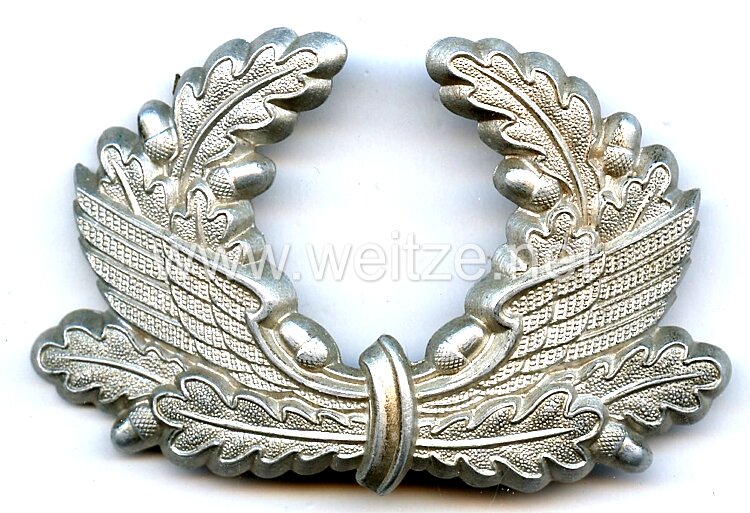
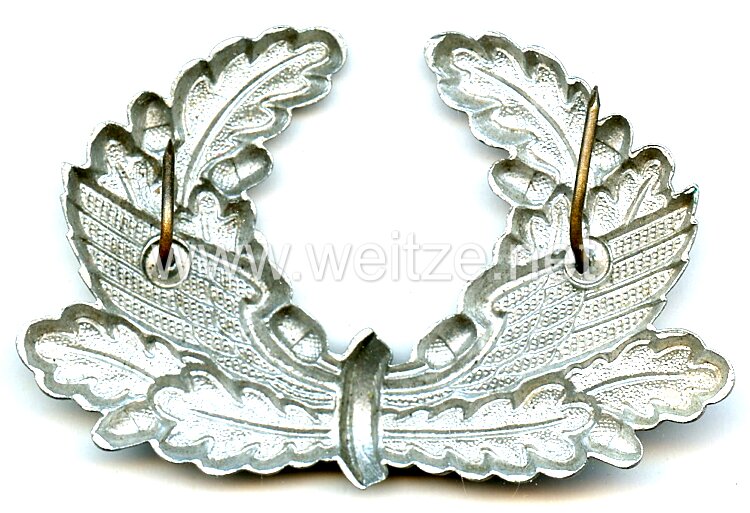
Railway Protection Oak Leaf Wreath 2nd Model for Visor Cap

Aluminum construction, Condition 2.
464371
80,00

Railway Protection Oak Leaf Wreath 2nd Model for Visor Cap

The Bahnschutz oak leaf wreath in its second model represents a fascinating artifact from the German railway protection organization during World War II. This specific cockade wreath for the peaked cap was manufactured from aluminum and represents the service insignia of the Bahnschutzpolizei (Railway Protection Police), a paramilitary formation responsible from 1942 onwards for protecting the war-essential railway infrastructure of the German Reich.

The Bahnschutzpolizei was officially established on December 1, 1942, by decree of the Reich Transport Ministry. Its primary mission was to protect railway installations, trains, and routes from sabotage acts, partisan attacks, and enemy air raids. With the expansion of the war theater and increasing partisan activity, especially in the occupied eastern territories, the protection of railway lines became a war-decisive necessity. The organization was directly subordinated to the Deutsche Reichsbahn (German State Railway) and worked closely with the Wehrmacht and the SS.

The uniform of the Bahnschutzpolizei followed military standards but differed in details from the Wehrmacht and police forces. The second model of the oak leaf wreath was introduced after the first model showed weaknesses in practice or production-technical simplifications became necessary. The aluminum version was typical for German military and police insignia during the war years, as valuable metals like non-ferrous metals were increasingly needed for armaments production.

The oak leaf wreath itself had a long history in German military tradition. Since the 19th century, oak leaves symbolized strength, steadfastness, and national virtues. In the design of headgear, the wreath was traditionally used as a frame for the cockade. For the Bahnschutzpolizei, the oak leaf wreath enclosed the organization's specific cockade, which differed from those of other formations.

The production of such insignia was carried out by specialized metalware factories distributed throughout the Reich territory. The aluminum version was manufactured using die-casting or embossing processes, with the details of the oak leaves being more or less finely worked. Attachment to the peaked cap was usually done through split pins or small screws on the reverse side of the wreath.

The peaked cap (Schirmmütze) was the official headgear for service and representative occasions. In contrast to the field cap model worn in operational duty, the peaked cap with its oak leaf wreath was a sign of formal service. The cap itself was in the characteristic field-gray or green color, depending on the specific uniform regulations of the Bahnschutzpolizei.

The strength of the Bahnschutzpolizei grew considerably during the course of the war. From initially a few thousand men, the formation expanded to over 100,000 members by 1944. These men were stationed at all important railway junctions, bridges, and strategic route sections throughout the German sphere of influence. Particularly in the occupied territories of Eastern Europe, frequent combat occurred with partisan units that specifically attacked railway infrastructure to disrupt German supply lines.

The armament and training of the Bahnschutzpolizei corresponded to military standards. Members received infantry weapons and were instructed in combat tactics. Many members were older soldiers who had left active front service but were still fit for security duties. Former railway workers with local knowledge were also preferentially recruited.

After the war ended in 1945, the Bahnschutzpolizei was dissolved. Most of its uniform parts and insignia were destroyed or lost. Preserved pieces like the described oak leaf wreath are today sought-after collector's items for militaria enthusiasts and historians studying the organization of the German transportation system and security apparatus during World War II. They document a specific aspect of total warfare, in which civilian infrastructure also had to be militarized and protected.