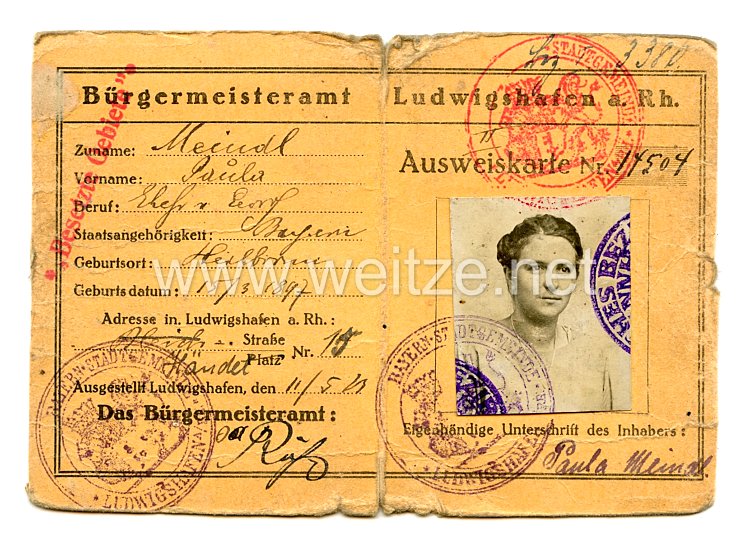
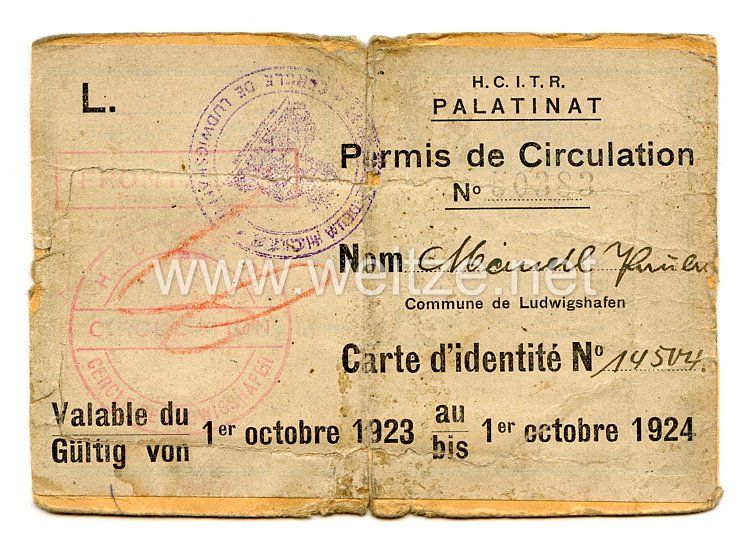
Weimar Republic - Identity Card Ludwigshafen for a Woman Born in 1897

bilingual, French and German, valid from 1.10.1923 - 1.10.1924.
416470
30,00

Weimar Republic - Identity Card Ludwigshafen for a Woman Born in 1897

This identity card from Ludwigshafen from the era of the Weimar Republic represents a remarkable testimony to a particular phase of German history – the French occupation of the Rhineland after World War I. This bilingual document, valid from October 1, 1923, to October 1, 1924, was issued to a woman born in 1897 and reflects the complex political and administrative conditions in the occupied territories.

Following the Treaty of Versailles of June 28, 1919, the Rhineland and adjacent areas were occupied by Allied troops. The city of Ludwigshafen on the Rhine was located in the French occupation zone, which extended over large parts of the Palatinate and the left bank of the Rhine. This occupation was originally planned to last 15 years and take place in three stages, with the occupying powers exercising extensive control rights over the civil administration.

The bilingual format of such identity documents was not a voluntary measure but a mandatory requirement of the French occupation authorities. All official documents, announcements, and identity papers had to be written in both German and French. This served to control population movements and enforce military order through the Inter-Allied Rhineland Commission, which was headquartered in Koblenz.

The year 1923, when this identity card was issued, was a particularly critical year for Germany and the occupied territories. The Ruhr occupation by French and Belgian troops in January 1923 dramatically exacerbated the already tense situation. When Germany fell behind on reparation payments, French troops occupied the Ruhr area, to which the German government responded with “passive resistance.” This led to a catastrophic economic crisis and hyperinflation, which reached its peak in autumn 1923.

For the civilian population in the occupied areas, this period meant considerable restrictions and hardships. Identity card requirements were strict, and freedom of movement was heavily controlled by the occupation authorities. Women in particular, like the holder of this card, needed such documents for everyday activities such as traveling, changing jobs, or even visiting other parts of the occupied zone. The French authorities implemented a complex system of permits and controls that covered every aspect of civilian life.

The woman in question, born in 1897, belonged to a generation that had already experienced World War I as young adults. In 1923, she was 26 years old and living in a time of extraordinary political and economic uncertainty. Women of this generation often had to serve as family breadwinners, as many men had been killed or disabled in the war.

The city of Ludwigshafen, as an industrial center, particularly through BASF (Badische Anilin- und Soda-Fabrik), had special strategic importance. The French occupation authorities monitored industrial facilities particularly strictly, fearing they could be used for military purposes. This led to additional controls and tightened identity card regulations for people working in such establishments or living nearby.

The one-year validity of such identity cards was typical for this period. It forced the population into regular contact with the occupation authorities and enabled continuous surveillance. Renewal or reissuing was often associated with bureaucratic hurdles and could be refused for politically suspect individuals.

The situation in the occupied territories only gradually relaxed after 1924, when Germany found a regulated solution to the reparations issue through the Dawes Plan and the economy began to stabilize. French troops gradually withdrew, with the final evacuation of the Rhineland not occurring until 1930 – five years earlier than stipulated in the Treaty of Versailles.

Such identity documents are today important historical sources that document the administrative reality of the occupation period. They testify to the penetration of everyday life by military and bureaucratic controls and serve as reminders of a time when German sovereignty was restricted in large parts of its own territory. For the local history of cities like Ludwigshafen, they are invaluable testimonies to a formative epoch between war and the relative stabilization of the middle Weimar years.