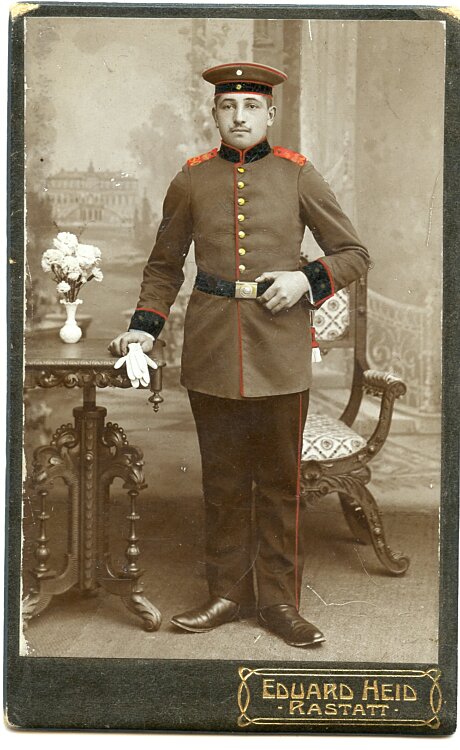
Photograph of a Soldier of the 2nd Baden Field Artillery (Rastatt)
This colorized soldier photograph from the German Empire period documents a member of the 2nd Baden Field Artillery Regiment garrisoned in Rastatt. Such portrait photographs were extremely popular between 1870 and 1918 and today represent important historical sources for the military history of the Grand Duchy of Baden and the German Empire.
The 2nd Baden Field Artillery was established during the army reforms following the Austro-Prussian War of 1866. The regiment officially bore the designation 2nd Baden Field Artillery Regiment No. 30 in the numbering system of the German Army. Its garrisoning in Rastatt, a significant Baden fortress city on the Upper Rhine, underscored the strategic importance of this unit in southwestern Germany. Rastatt had been an important military location since the 18th century and housed several artillery units.
The Field Artillery formed the most important mobile artillery branch in the German Empire. Unlike foot artillery, which was designated for fortress warfare, or heavy artillery, the field artillery accompanied infantry and cavalry on the battlefield. The Baden field artillery regiments were equipped with field guns and field howitzers, typically with calibers ranging from 7.7 cm to 10.5 cm. After 1896, modernization to quick-firing guns took place.
Soldier photographs like the one described were typically produced in professional studio photographers found in every garrison town. Photographers specialized in military portrait photography and offered various services, from simple calling card photographs to elaborately colorized cabinet pieces. The colorization was done by hand, with uniform colors, insignia, and decorations carefully worked over. This required thorough knowledge of military clothing regulations.
The Baden Army maintained its independence within the German contingent army until 1918. Baden uniforms differed in details from Prussian models. Artillerymen traditionally wore dark blue tunics with black facings and red piping. Headgear consisted, depending on the era, of shakos, pickelhaubes, or later the practical peaked cap. Characteristic of the artillery were crossed cannon barrels as collar insignia and specific epaulettes or shoulder straps with the regiment number.
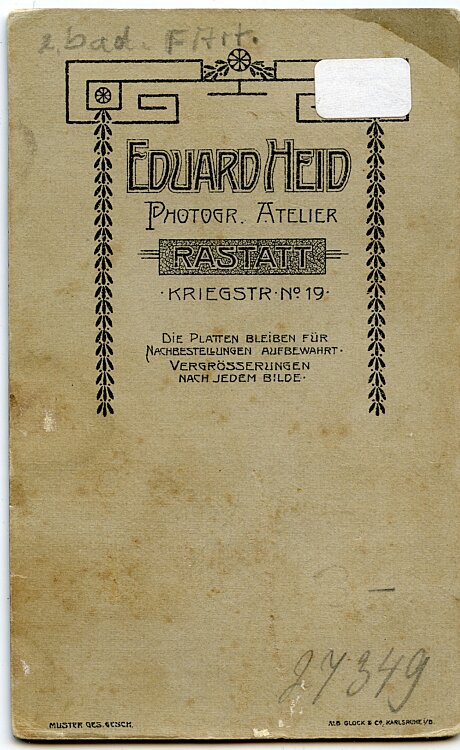
The reverse of the photograph bears a handwritten inscription, which was typical for such memorabilia. Soldiers had these photographs made to send to family, friends, or comrades. Often the reverse inscriptions contained names, ranks, units, dates, and personal dedications. This information makes such photographs valuable genealogical and local historical sources.
Service time in the Imperial Army typically consisted of two to three years of active duty for enlisted men, followed by several years in the reserve and Landwehr. Artillerymen required longer training than infantrymen, as they had to learn the operation of technically complex guns, ammunition, and ballistic calculations. Training included drill, firing exercises, equestrian service, and equipment maintenance.
The 2nd Baden Field Artillery Regiment participated in various military operations. In the Franco-Prussian War of 1870-71, Baden artillery units fought in several battles. During World War I 1914-1918, the regiment was deployed on various fronts, initially in the West, later partly in the East as well. Field artillery played a devastatingly important role in this industrialized mass warfare and caused the majority of casualties.
Such colorized soldier photographs are today sought-after collector's items and important documents for militaria research. They enable the reconstruction of uniform details, equipment items, and social aspects of military service. The professional presentation of these portraits also reflects the social prestige of the military in the Empire, where the soldier's profession enjoyed high esteem.
The preservation condition “condition 2” indicates a well-preserved specimen with possibly minor signs of use. The format of 10 x 6 cm corresponds to the widespread cabinet format of the time, which had established itself between the smaller calling card format and larger portrait photographs.