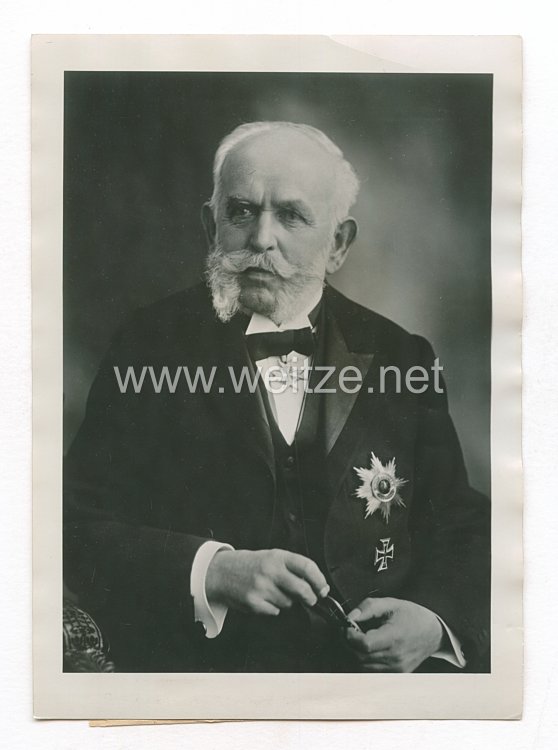
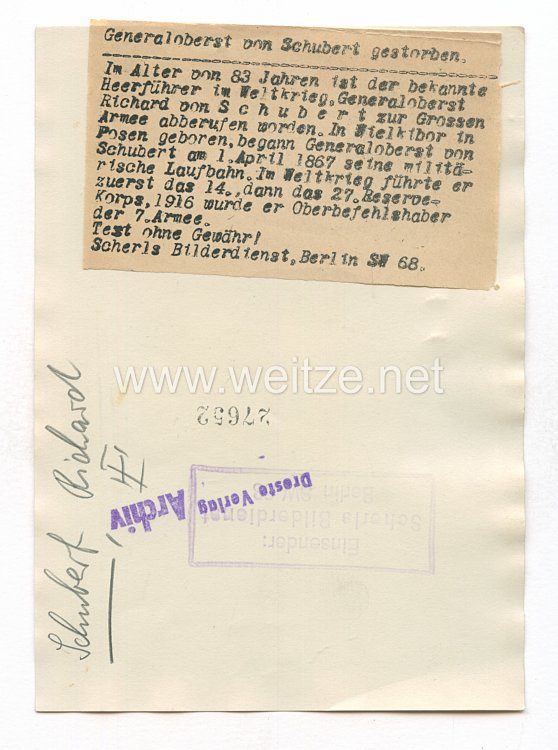
Weimar Republic Press Photo: Generaloberst von Schubert
This press photograph from the era of the Weimar Republic showing Generaloberst von Schubert represents an important document of German military history between 1919 and 1933. Such press photographs played a crucial role in public perception and reporting on military affairs in Germany's first democracy.
The Weimar Republic, which existed from 1919 to 1933, was a period of profound changes for the German military establishment. Following the end of World War I and the Treaty of Versailles in 1919, the German army was drastically reduced. The new Reichswehr was limited to 100,000 men, representing an enormous break with Imperial military tradition. The officer corps had to reorganize during this period and define its role in democratic society.
Press photographs like the present one were an important medium of mass communication in the 1920s and early 1930s. Press photography had developed since the late 19th century and reached its first golden age during the Weimar period. Photographs of military personalities were collected, archived, and used for reporting by news agencies and newspaper editorial offices. The typical size of approximately 13 x 18 cm corresponded to the practical requirements of newspaper production and archiving.
The inscription on the back of such photographs was standard in professional press photography. It typically contained information about the person depicted, the occasion of the photograph, the date, and possibly the name of the photographer or agency. These inscriptions are valuable historical sources today, as they provide context and authentication.
The rank of Generaloberst (Colonel General) was a significant position in the Reichswehr. Although the Reichswehr was considerably smaller than the Imperial Army, it maintained a traditional rank structure. Generaloberste belonged to the highest leadership level and played important roles in military planning and organization. Despite the restrictions of the Treaty of Versailles, the Reichswehr attempted to maintain professional standards and create a cadre force that could be expanded if necessary.
The military leadership of the Weimar Republic had a complex relationship with the democratic government. Many officers, especially from the old nobility (recognizable by the “von” in the name), were skeptical of the Republic and mourned the monarchy. At the same time, they had to function within the new democratic order. The Chief of Army Command General Hans von Seeckt, who served from 1920 to 1926, shaped the Reichswehr as a “state within a state” and attempted to preserve its political independence.
Press photographs of generals were created on various occasions: military ceremonies, maneuvers, official visits, appointments, or retirements. They served public information purposes but also represented the Reichswehr in society. The Reichswehr was eager to convey an image of professionalism, discipline, and continuity with Prussian-German military traditions.
The “used condition” of the photograph is typical for archival material from this period. Press photographs were actively used, passed through editorial offices, were possibly used for reproductions, and therefore often show signs of use such as creases, stamps, annotations, or signs of aging. These traces are themselves part of the object's history and testify to its active use in the contemporary media landscape.
The collection and preservation of such press photographs is of considerable historical value. They document not only the persons depicted but also the visual culture, media practices, and public representation of the military in the Weimar Republic. For historians, they are important sources for studying visual propaganda, military history, and the society of the interwar period.
Today, authentic press photographs from the Weimar Republic are sought after by collectors of military historical objects. They complement the understanding of this turbulent epoch of German history and offer visual insights into a period that paved the way for the dramatic developments of the 1930s.