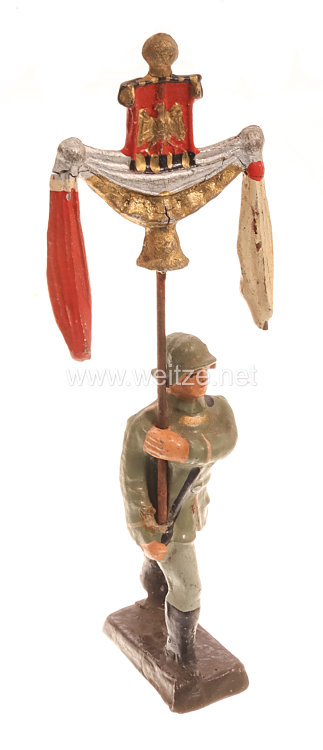
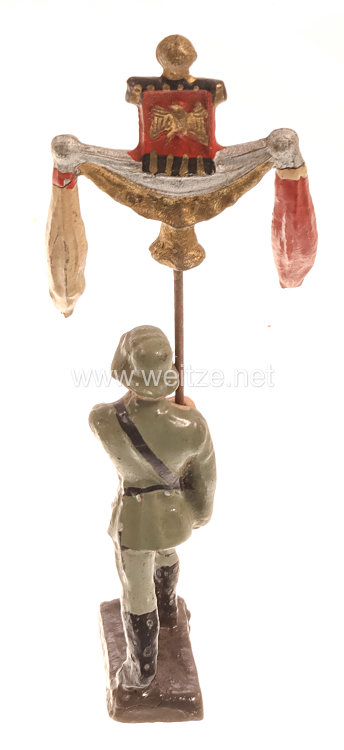
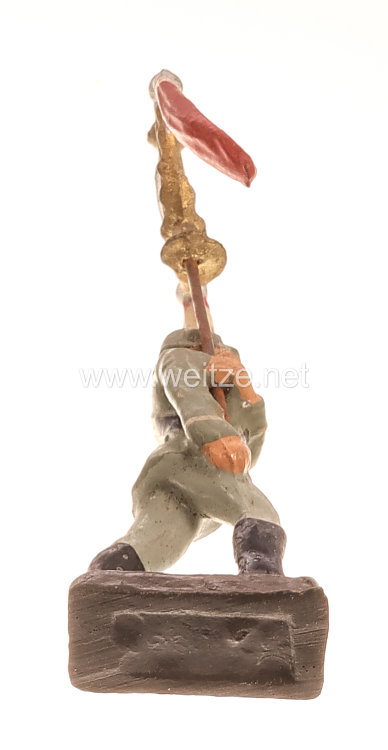
Schüssler - Army Schellenbaum Bearer Marching
The Schellenbaum (also known as Turkish Crescent, Jingling Johnny, or Chapeau Chinois) represents one of the most fascinating and visually impressive military musical instruments in European military history. The Schüssler Schellenbaum carrier described here, cast in pewter, depicts a marching soldier of the German Army troops and represents an important tradition of German military practice from the 18th to the 20th century.
The historical roots of the Schellenbaum lie in the Ottoman Empire, where such instruments were known as “Çevgan”. During the numerous military confrontations between European and Ottoman forces in the 16th and 17th centuries, Turkish Janissary music made a lasting impression on European armies. The exotic sounds and magnificent visual presentation of Ottoman military bands led to the adoption of this tradition into European military formations, first in Austria and Prussia.
The Schellenbaum typically consists of a long staff crowned with a crescent-shaped ornament. Attached to this frame are numerous bells, jingles, and often horsehair tails. During marches, the instrument was rhythmically struck on the ground and rotated, creating a characteristic sound from the bells. The visual effect was as important as the acoustic one: the gleaming metal decorations and imposing structure were meant to demonstrate military power and splendor.
In the Prussian Army, the Schellenbaum was officially introduced in the 18th century. The Royal Prussian Regiments adopted the tradition as part of their infantry music corps. Each regiment possessed a Schellenbaum that was carried during parades and ceremonial occasions. The position of Schellenbaum carrier was no ordinary assignment – it was an honorary position, usually awarded to particularly tall and imposing soldiers, as the instrument possessed considerable weight and its handling during marches required substantial physical strength.
The firm Schüssler was one of the renowned German manufacturers of military pewter figures active in the 19th and early 20th centuries. These figures served both as children's toys and as collector's items for military enthusiasts. The attention to detail in such figures makes them valuable historical sources today for the study of military uniforms (uniformology) and military history research.
In the German Empire (1871-1918), the Schellenbaum maintained its firm place in the military bands of the Imperial Army. The Army uniform of the Schellenbaum carrier was frequently particularly splendid and adorned with additional decorations. Typically, the carrier wore a parade uniform with epaulettes, aiguillettes, and a shako or other characteristic headgear.
After World War I, the Schellenbaum initially lost significance in the Reichswehr, but experienced something of a renaissance in the Wehrmacht. Even in the modern Bundeswehr, the tradition continues in modified form in certain military music corps, with the Schellenbaum primarily used at ceremonial occasions.
Pewter figures like the described Schellenbaum carrier were manufactured in various scales. A figure height of 7 cm corresponds approximately to the popular scale of 1:24 to 1:25, which was particularly suitable for detailed representations. The indicated condition 2 designates in collector's terminology a very good to good state of preservation with possibly minor signs of use but without significant damage.
The scholarly significance of such militaria objects lies in their function as three-dimensional historical documents. They preserve information about uniforms, armament, equipment, and military customs of past epochs. For military historians, they are valuable supplements to written sources and contemporary illustrations.
The Schellenbaum symbolizes the connection between military function and ceremonial representation. It stands for an era when military units were defined not only by their combat effectiveness but also by their visual and acoustic presence – a tradition that continues today in military bands worldwide.