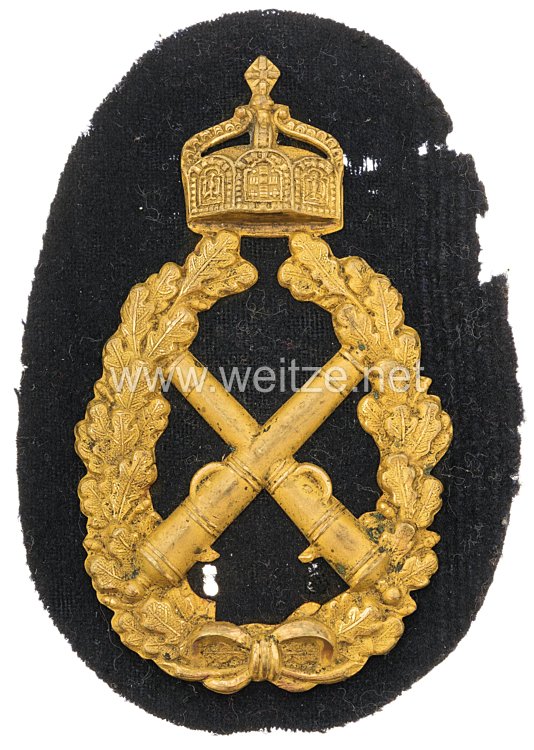
German Empire Kaiser Shooting Prize for Artillery

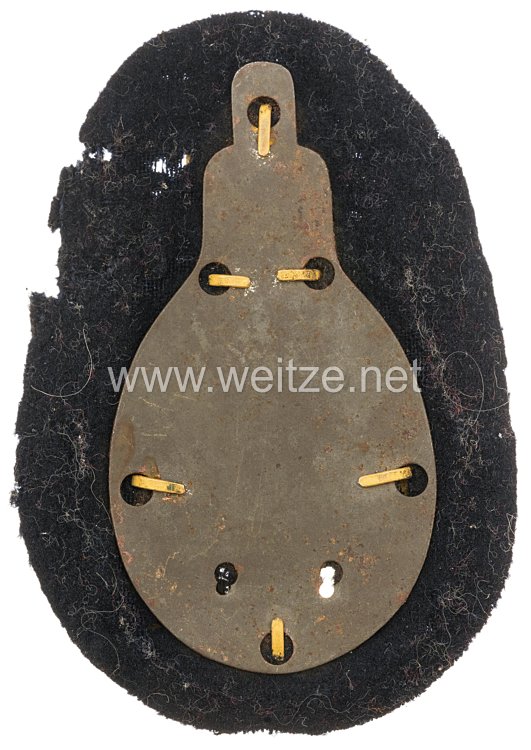
Sleeve badge, gold-plated, complete with dark blue cloth backing and back plate, without year designation. Worn condition, Condition 2.
425069
200,00

German Empire Kaiser Shooting Prize for Artillery

The Kaiser's Shooting Prize for Artillery (Kaiserschießpreis für die Artillerie) represents a significant military award of the German Empire, introduced to promote marksmanship skills and military proficiency within the artillery forces. This non-wearable distinction in the form of a sleeve badge exemplifies the high standards and competitive spirit cultivated in the Imperial Army.

The introduction of the Kaiser's Shooting Prize occurred as part of comprehensive efforts to enhance the military efficiency of the Prussian and later all-German armed forces. Already under Kaiser Wilhelm I, various shooting prizes were established, but under Kaiser Wilhelm II, who ascended to the throne in 1888, the system of military performance badges underwent significant expansion. Wilhelm II showed particular interest in modernizing the army and fostering a competitive spirit among his troops.

The sleeve badge was typically manufactured from gilded metal and mounted on a dark blue cloth backing, which was characteristic of the artillery branch. The blue color corresponded to the traditional branch color of artillery in the German army. The construction included a backing plate for secure attachment to the uniform sleeve. Ordinarily, these badges bore a year date marking the time of award, though examples without year dates served for repeated use or as pattern badges.

The award of the Kaiser's Shooting Prize followed strict guidelines and was based on outstanding performance in shooting exercises and competitions. Participating batteries and units had to prove themselves in complex shooting exercises that demanded both precision and speed. Artillery played a central role in warfare during the late 19th and early 20th centuries, and its effectiveness was crucial for military success. The promotion of excellent shooting abilities through awards like the Kaiser's Shooting Prize contributed to the continuous improvement of combat effectiveness.

The badge was worn on the uniform sleeve, making the distinction visible to comrades and superiors. This not only fostered individual pride among recipients but also esprit de corps and motivation within the entire unit. Public recognition of military achievement was an essential element of Imperial military culture.

In the context of the Empire's military organization, artillery was divided into various formations, including field artillery, foot artillery, and heavy artillery. Each of these formations had specific tasks and equipment. The Kaiser's Shooting Prize could be awarded to units of all artillery branches, provided they met the required performance standards.

The significance of such awards must be viewed in connection with the general military culture of the Empire. The German military was deeply rooted in society, and military honors enjoyed high prestige. Awards like the Kaiser's Shooting Prize were not merely symbols of individual or collective achievement but also expressions of the bond between Kaiser and army. Wilhelm II used the personal connection to his troops as a political and social instrument.

After the end of World War I in 1918 and Wilhelm II's abdication, Imperial awards lost their official significance. The Weimar Republic abolished the monarchical system, and with it ended the tradition of Kaiser's Shooting Prizes. Many veterans, however, retained their awards as personal mementos of their service time.

Today, these badges are sought-after collector's items that provide insight into the military history of the German Empire. Their state of preservation varies considerably, depending on storage and use over the decades. Examples in good condition with complete cloth backing and backing plate are particularly valuable for military-historical collections and museums.

The study of such objects contributes to understanding the military culture, organizational structures, and value systems of the Empire, and enables keeping the history of this significant epoch of German history alive.

r