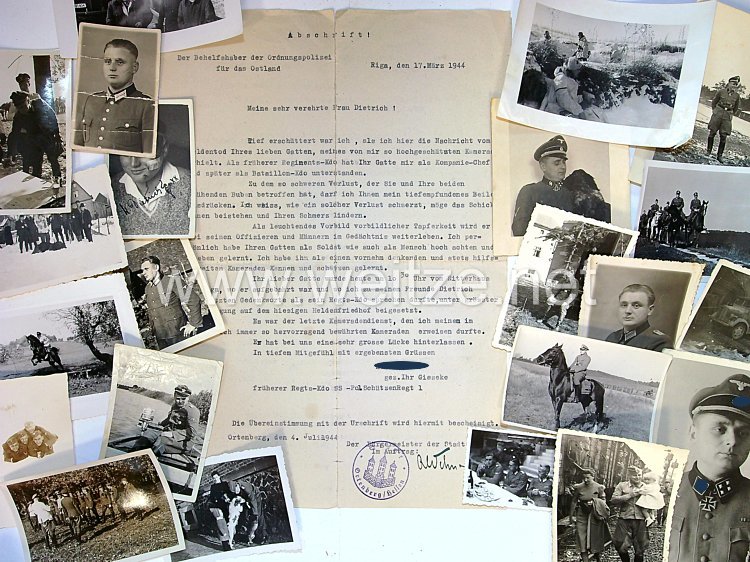
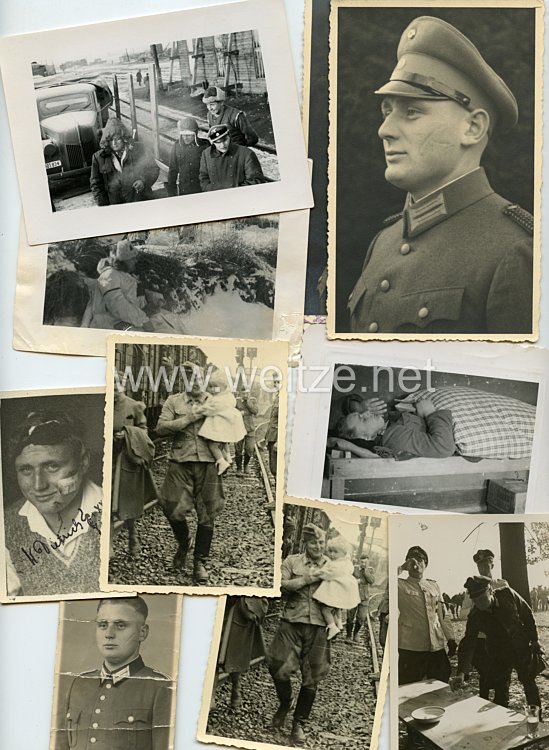
This collection of 29 photographs documents the military career of SS-Sturmbannführer Wilhelm Dietrich, a recipient of the Knight's Cross of the Iron Cross, who died on March 12, 1944, in a military hospital in Dorpat (now Tartu, Estonia) from wounds caused by shell splinters.
Wilhelm Dietrich was born on November 17, 1912, and began his career in the police force before the Nazi seizure of power in 1933. The photographs show his progression from young police cadet through various ranks to regimental commander. This development reflects the increasing militarization of the Order Police (Ordnungspolizei) in the Third Reich, which was centralized under Heinrich Himmler in 1936.
The SS Police Division, later known as the 4th SS Police Panzergrenadier Division, was formed in October 1939 from members of the Order Police. This unit differed from other SS formations through its recruitment from already trained police officers. The division participated in numerous combat operations on the Eastern Front, particularly during Operation Barbarossa from June 1941 onwards.
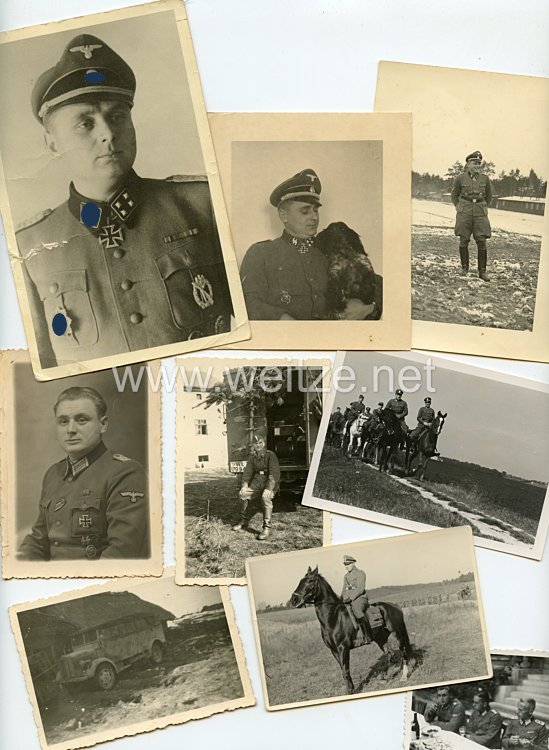
Dietrich received the Knight's Cross of the Iron Cross on October 15, 1942, as SS-Hauptsturmführer and commander of the III Battalion of SS Police Rifle Regiment 1. This highest German bravery decoration was awarded for exceptional military achievements. Only approximately 7,300 individuals received this decoration during the entire war, underscoring its significance. The award came during a phase of intense fighting in the northern sector of the Eastern Front, where the SS Police Division was deployed in the area of Lake Ilmen and Demyansk.
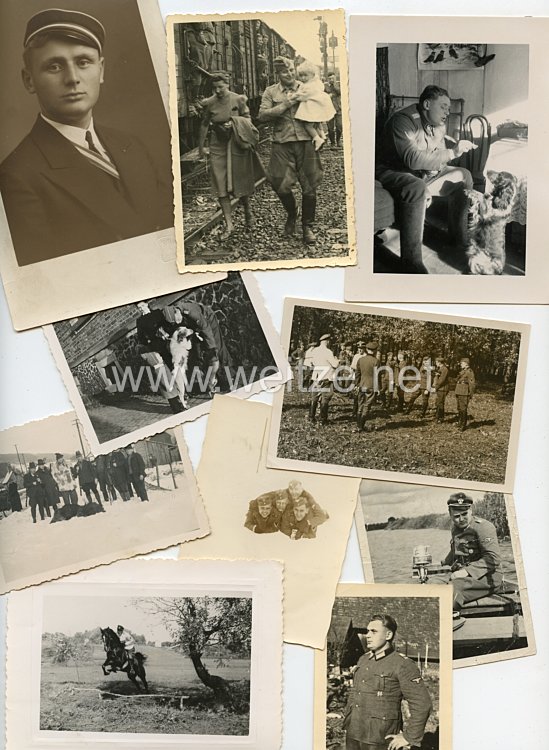
The photographs document various phases of his service: The early images as a police cadet show the period before 1933, when the German police were still organized under the Weimar Republic. Pictures from basic training and as a lieutenant in the SS Police Division illustrate the increasing militarization of these units. Particularly revealing are the winter photographs from the Eastern Front, documenting the extreme conditions under which these units fought. The Russian winter of 1941/42 claimed enormous casualties and presented German troops with logistical and human challenges.
Three photographs show Dietrich wearing the Knight's Cross as SS-Sturmbannführer, a rank equivalent to major in the Wehrmacht. These images were taken between his decoration in October 1942 and his death in March 1944. As Commander of SS Police Panzergrenadier Regiment 3, he led a regiment that was part of the restructured and modernized division, which was converted into a Panzergrenadier division in 1943.
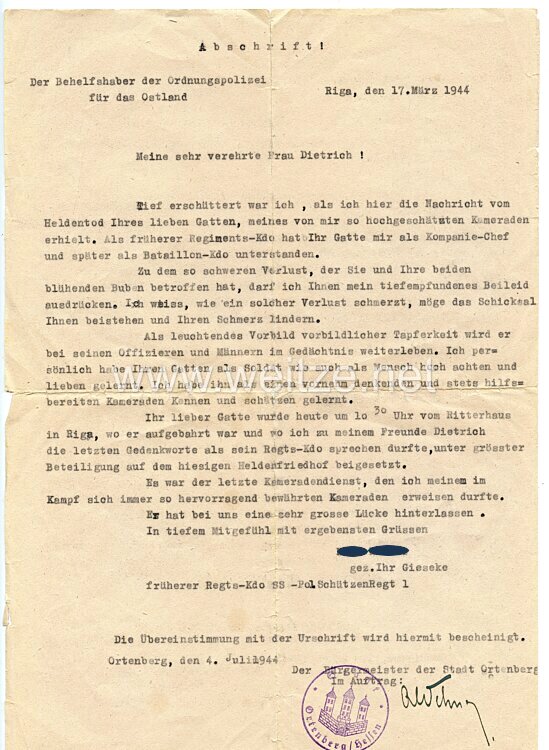
The attached letter of condolence from the Commander of the Order Police for the Ostland, Gieseke, dated March 17, 1944, in Riga, is an important historical document. It was transcribed on July 4, 1944, and addressed to Dietrich's mother. The administrative structure of the Order Police in the Ostland was part of the German occupation administration in the Baltic states and Belarus. Dietrich died on March 12, 1944, after being wounded by shell splinters at Lake Peipus (Pleskauer See) and was posthumously promoted to SS-Standartenführer, equivalent to the rank of colonel.
The fighting at Lake Peipus in March 1944 was part of the Soviet offensive to liberate the Baltic states. Army Group North found itself in an increasingly precarious situation at this time, under strong Soviet pressure. The SS Police Division was involved in heavy defensive battles that claimed high casualties.
This photograph collection offers a rare insight into the military career of a middle-ranking officer of the SS Police Division. It documents not only the personal history of a soldier but also the institutional development of the Order Police under National Socialism, its militarization, and its deployment on the Eastern Front. Such private estates are important sources for military history research, as they provide personal perspectives and details often absent from official documents.
The photos' annotations, some written on the reverse, add additional historical value, potentially providing dates, locations, and contexts that enhance our understanding of the division's operations. The progression visible through these images—from peacetime police service through combat operations to high decoration—represents a typical trajectory for many Order Police officers who found themselves transformed from domestic law enforcement personnel into frontline combat soldiers in one of history's most brutal conflicts.