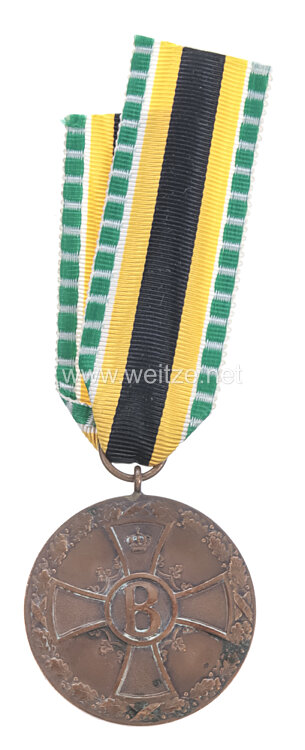
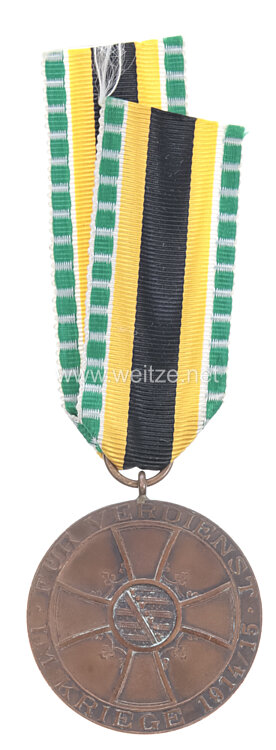
Saxe-Meiningen Medal for Merit in War 1915-1918

Base metal, on original ribbon, condition 2
464768
135,00

Saxe-Meiningen Medal for Merit in War 1915-1918

The Saxe-Meiningen Medal for Merit in War 1915-1918 represents a significant military decoration from the Duchy of Saxe-Meiningen, one of the German federal states during World War I. This medal embodies the duchy's recognition of exceptional military service rendered by its soldiers during the devastating years of the Great War.

The Duchy of Saxe-Meiningen was one of the Thuringian small states within the German Empire, ruled by Duke Georg II (1866-1914) and subsequently by his successor Bernhard III (1914-1918). Though territorially small, the duchy fulfilled its military obligations to the Empire with considerable dedication. Saxe-Meiningen's armed forces were integrated into the larger Prussian military system, yet retained the right to award their own decorations.

The institution of this war merit medal occurred during World War I, as evidenced by the dating 1915-1918. The medal was awarded to military personnel who distinguished themselves through particular bravery, military achievement, or outstanding service during the war years. Unlike purely valor decorations, this medal could also be awarded for other war-essential merits, including logistical accomplishments, medical services, or administrative excellence in wartime deployment.

The present medal is made of base metal (Buntmetall), a copper alloy typical for war decorations of this period. During World War I, precious metals were increasingly replaced by less expensive materials, as war-essential industry took priority. The original ribbon is still present, which considerably increases the historical value of the piece. Original ribbons are often lost or replaced with substitute pieces, making the preservation of the authentic ribbon particularly noteworthy.

The iconography of such medals typically followed the heraldic traditions of the respective princely house. Saxe-Meiningen decorations frequently displayed the ducal coat of arms, crowns, or monograms of the ruling dukes. The years 1915-1918 on the medal mark not only the award period but also the most dramatic years of the war, from the great offensives to the final collapse of the Central Powers.

Condition 2 designates, in numismatic and militaria collecting terminology, a very good state of preservation. The medal thus exhibits only minimal signs of wear, with details and striking remaining clearly visible. This suggests that the decoration was either carefully preserved or possibly rarely worn.

The historical significance of this medal extends beyond its purely military function. It documents the participation of one of the German small states in World War I and the efforts to maintain its own state identity even within the military hierarchy of the Empire. After the end of World War I and the November Revolution of 1918, all German monarchies were abolished, including the Duchy of Saxe-Meiningen. The awarding of military decorations by the individual federal states thus ended as well.

For collectors and historians, this medal offers important insights into the complex system of military honors in the German Empire. Each federal state maintained its own decoration system, resulting in remarkable diversity. Saxe-Meiningen decorations are relatively rare due to the small size of the duchy, which increases their historical and collector value.

The medal also stands symbolically for the fate of soldiers from the small states who were drawn into a war of industrial scale. The years 1915-1918 mark a period of unprecedented suffering and sacrifice, during which millions of German soldiers fought on various fronts. For the bearers of such decorations, they meant recognition and honor, but also the lasting memory of a traumatic epoch.

This particular example, with its well-preserved condition and original ribbon, serves as a tangible connection to that turbulent period. It reminds us of the complex political structure of Imperial Germany and the individual contributions of even its smallest constituent states to the war effort. Such artifacts are invaluable for understanding the full scope of German military history and the personal experiences of those who served.