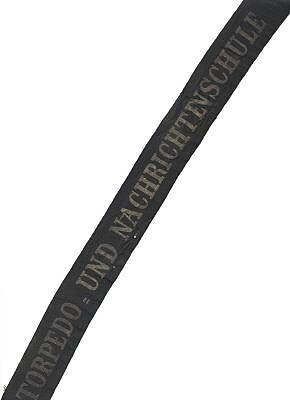
Reichsmarine Cap Tally "Torpedo- und Nachrichtenschule"
The cap tally of the Torpedo and Signals School of the Reichsmarine represents a fascinating testament to German naval history between the two World Wars. These special cap tallies were worn by members of the Kriegsmarine on their sailor caps and served to identify their respective unit, ship, or naval school.
The Reichsmarine was established in 1919 after World War I as the successor organization to the Imperial Navy. Due to the strict provisions of the Treaty of Versailles, Germany was permitted only a severely limited navy. The Reichsmarine was allowed a maximum of 15,000 men and was significantly restricted in armament and tonnage. Despite these limitations, the naval leadership placed great emphasis on training highly qualified specialists.
The Torpedo and Signals School was one of the most important training institutions of the Reichsmarine. Located in Flensburg-Mürwik, it was responsible for training specialists in two technically demanding areas: torpedo warfare and signals technology. These two branches were crucial for modern naval warfare and required highly specialized personnel.
Torpedo training encompassed the operation, maintenance, and tactical application of torpedo weapons. Since their introduction in the late 19th century, torpedoes had evolved into one of the most dangerous weapons in naval warfare. Training at the Torpedo School was technically demanding and lasted several months. Students had to master complex mechanics, targeting systems, and ballistic calculations.
The naval signals service, the school's second focus, included radio technology, signaling, and encryption. During the interwar period, radio technology developed rapidly, and the navy required specialists who could handle the latest communication systems. Signals training also included Morse telegraphy, optical signaling, and later the operation of the Enigma cipher machine.
The present cap tally in metal thread woven execution represents the higher-quality variant of these equipment items. Metal threads, usually made of gilt or silvered wire, were woven into the black base fabric and formed the golden lettering. This technique was more elaborate than the simpler version with embroidered letters and was often preferred by petty officers and officers, although it was not mandatory.
The manufacture of such cap tallies was carried out by specialized passementerie manufacturers and navy-certified suppliers. Quality and execution had to meet certain standards, although there were variations between different manufacturers. The length of approximately 119 cm corresponded to the standard measurement that allowed complete encirclement of the sailor cap with a bow at the back of the head.
The sailor cap itself had been the characteristic headgear of German naval personnel in walking-out dress since the Imperial Navy. The black cap tallies with golden lettering were highly visible identification features and contributed significantly to the esprit de corps of the respective units. For members of naval schools, wearing the corresponding cap tally was a particular source of pride, as it documented their specialized training.
With the renaming of the Reichsmarine to Kriegsmarine in 1935 and the massive rearmament under the Nazi regime, the Torpedo and Signals School gained even greater importance. The expanding fleet required increasingly more trained specialists. The school in Mürwik was expanded and modernized to meet the increased demand.
During World War II, the specialists trained at this school played a central role, particularly in submarine warfare. Torpedo specialists were essential for the effectiveness of the submarine weapon, while signals personnel were responsible for encrypted communication and radio reconnaissance. The training facility remained operational throughout the war, although it faced increasing difficulties.
After the war ended in 1945, all Kriegsmarine facilities were dissolved. However, the tradition of naval training in Mürwik was later continued by the Bundesmarine, which established its Naval School Mürwik there, which serves to this day as the central training facility of the German Navy.
For collectors and historians, original Reichsmarine cap tallies represent important historical documents. They allow conclusions about wearing practices, manufacturing techniques, and the organizational structure of the navy. The state of preservation varies greatly, as these textiles were affected by wear, moisture, and time. Repairs, as with the present specimen, are frequently encountered and testify to long periods of use or later conservation efforts.
The metal thread weaving technique used in this cap tally demonstrates the high level of craftsmanship in German military textile production. The wear patterns and any repairs provide insights into the everyday life of naval personnel and the practical challenges of maintaining uniform items in maritime conditions. Such artifacts serve as tangible connections to the men who served in these specialized schools and the technical expertise they developed.