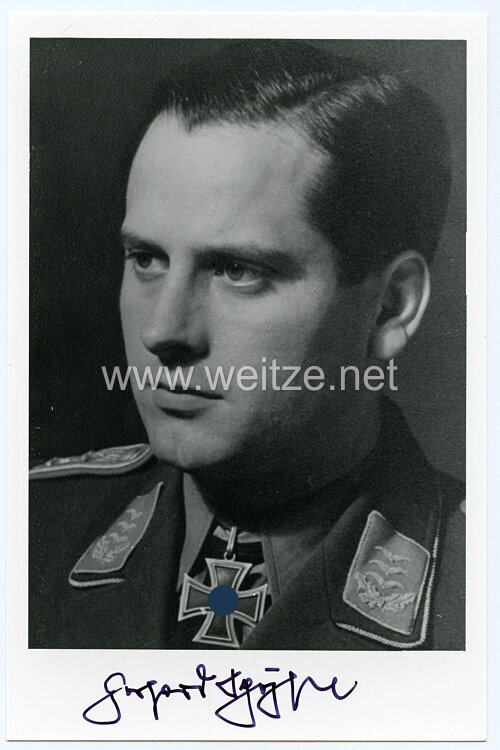
Luftwaffe - Post-War Signature of Knight's Cross Recipient Gerhard Schöpfel
This object represents a post-war signature of the Luftwaffe ace Gerhard Schöpfel on a photograph produced after 1945. Such signed photographs form a significant category of military historical collectibles and document the complex post-war history of German fighter pilots from World War II.
Gerhard Schöpfel (1912-2003) was one of the most successful German fighter pilots of World War II. He achieved 40 confirmed aerial victories, primarily during the Battle of Britain and on the Eastern Front. On September 21, 1940, he received the Knight's Cross of the Iron Cross, one of the highest military decorations of the Third Reich. Schöpfel temporarily commanded the famous Jagdgeschwader 26 "Schlageter", one of the Luftwaffe's most elite fighter units.
The practice of post-war signing of photographs developed into a widespread phenomenon in the decades after 1945. Former members of the Wehrmacht, particularly holders of high decorations such as the Knight's Cross, were contacted by collectors and military historians. They were asked for autographs on photographs that were either contemporary wartime images or later reproductions. This practice began in the 1960s and reached its peak in the 1970s through 1990s.
The present photograph, measuring approximately 10 x 15 cm, corresponds to a standard format for military photographs of that era. The fact that it is a post-1945 print is typical for such collectibles. Many original wartime photographs were lost during combat operations or in the immediate post-war period, so veterans often relied on later reproductions which they then signed.
The Knight's Cross recipients occupied a special position in the post-war period. On one hand, they were military heroes of their generation; on the other, they served a criminal regime. This ambivalence shaped how they were treated in German society. While a certain veneration of military achievement persisted in the early Federal Republic, a more critical examination of the Wehrmacht and its role in World War II developed from the 1960s onward.
Schöpfel himself joined the newly founded Bundesluftwaffe (West German Air Force) after the war and served there from 1956 to 1970, where he attained the rank of Colonel. This was typical for many former Luftwaffe officers, whose aviation expertise was valued during the Cold War era. The NATO integration of the Federal Republic enabled the reemployment of experienced military personnel, which was controversially discussed.
From a collector's perspective, such signed photographs are of varying value. Authenticity is the central criterion. Post-war signatures are generally less valuable than contemporary wartime signatures, but still possess historical and documentary value. The condition rating of 1, as indicated here, suggests excellent preservation.
The authentication of such signatures requires expertise. Schöpfel signed numerous photographs for collectors over decades, and his signature is well documented. Comparative material exists in abundance, which facilitates authentication. Nevertheless, a market for forgeries exists, especially for well-known Knight's Cross recipients.
The ethical dimensions of collecting such objects are complex. Critics argue that glorifying members of the Wehrmacht is problematic, regardless of individual guilt. Proponents emphasize the historical and educational value as well as the importance of documentation. German legislation permits trade in such objects, provided that unconstitutional symbols such as swastikas are not prominently featured.
In the broader context, this object represents the culture of remembrance of the post-war period. The willingness of former soldiers to give autographs reflects their handling of their past. For many, it was an acknowledgment of their military achievements, separated from ideological questions. Historians use such sources to understand this generation's self-perception.
Objects like this signed photograph serve as tangible connections to historical events and individuals. They enable personal engagement with history beyond textbooks and academic studies. The material culture of military collecting provides insights into how societies remember and interpret their past, making such items valuable resources for understanding both wartime experiences and post-war memory formation.