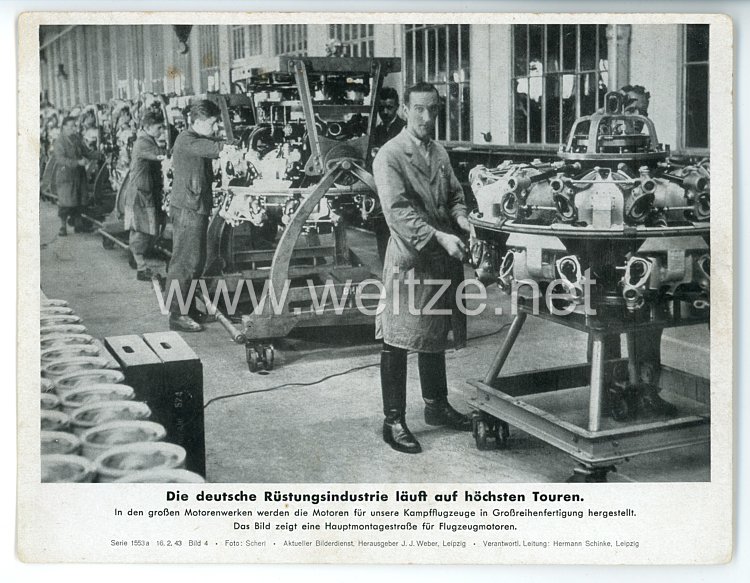
Third Reich - Printed Press Photo “The German Armaments Industry Runs at Full Capacity” February 16, 1943
Historical Context: Nazi Press Photography and Armaments Propaganda 1943 This press photograph from 1943, published by the Aktueller Bilderdienst (Current Picture Service), documents a critical turning point in National Socialist war propaganda. Titled “German Armaments Industry Running at Highest Speed” and dated February 16, 1943, this image appeared only a few weeks after the devastating defeat at Stalingrad, which ended with the capitulation of the 6th Army on February 2, 1943. The Aktueller Bilderdienst was one of the central institutions of Nazi visual propaganda. This organization operated under the Reich Ministry of Public Enlightenment and Propaganda led by Joseph Goebbels and supplied newspapers, magazines, and other media with pre-censored, ideologically aligned photographs. Press photos were an essential instrument for controlling public opinion and maintaining morale on the home front. In February 1943, the German Reich found itself in an increasingly precarious military situation. After Stalingrad and the growing Allied successes in North Africa, the intensification of armaments production became an absolute priority. On February 18, 1943, just two days after this photo's date, Goebbels delivered his infamous Sportpalast speech, proclaiming “total war.” The visual propaganda of this period was designed to convince the population of the unlimited capacity of the German war economy. Albert Speer, who had been appointed Reich Minister for Armaments and Munitions in February 1942, had indeed achieved a significant increase in armaments production. Despite increasing Allied air raids, German weapons production did not peak until 1944. The propaganda photographs of this time were meant to visualize these successes while honoring the workforce's willingness to sacrifice. The technical characteristics of the photograph – format 23.5 x 18.5 cm, unprinted on the reverse – correspond to the standard formats of press photography of that era. The absence of printing on the back suggests this may be an archive copy or a version that was not released for publication. Typically, press photos intended for publication bore stamps, captions, and usage instructions on the reverse. The visual propaganda of the armaments industry followed certain iconographic patterns: modern machinery, diligent workers, demonstrations of technical superiority, and the suggestion of unlimited production capacity. These images were intended to work both internally and externally – they were meant to reassure the domestic population and deter potential adversaries. The reality behind the propaganda was more complex. By 1943, the German armaments industry was increasingly dependent on forced laborers and concentration camp prisoners. Millions of foreign workers were forced to work under inhumane conditions. This dark side of armaments production was systematically excluded from official visual propaganda. As a historical document, this press photograph possesses multiple levels of meaning: it is both testimony to the propaganda efforts of the Nazi regime and a document of the visual historiography of that time. Such photographs today provide insights into the mechanisms of opinion manipulation and the aesthetics of totalitarian visual language. For collectors and historians, such press photographs are important sources for researching Nazi propaganda. They document not only the depicted scenes but also the intentions and strategies of the propaganda machinery. The preservation and scholarly examination of such materials contributes to understanding the mechanisms by which totalitarian regimes attempted to control public perception. The date of this photograph – mid-February 1943 – places it at a crucial juncture in World War II. The propaganda apparatus was working overtime to counter the psychological impact of military setbacks and to mobilize the population for even greater sacrifices. The emphasis on armaments production was part of a broader narrative that Germany could still win the war through industrial might and technological superiority, despite mounting evidence to the contrary.