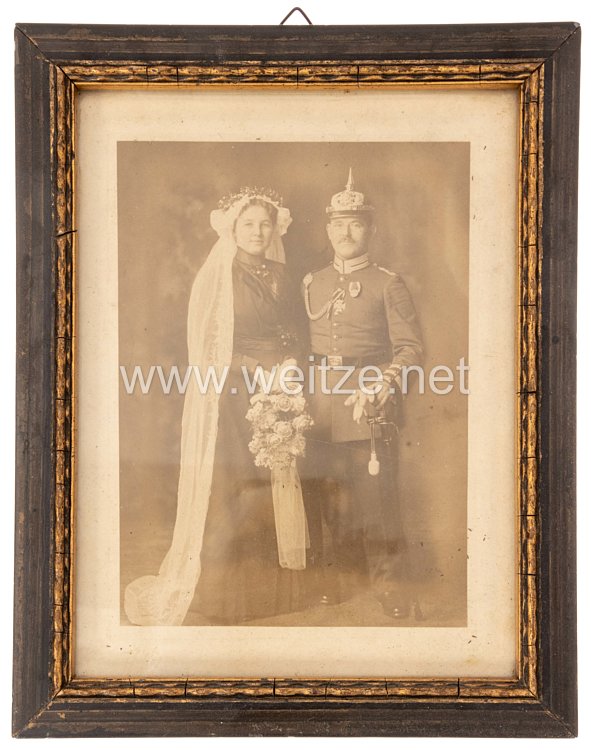
Hessen-Darmstadt Wedding Photograph of a Feldwebel in Leibgarde-Infanterie-Regiment Nr. 115
The Leibgarde-Infanterie-Regiment Nr. 115 of the Grand Duchy of Hesse-Darmstadt represents a significant part of the military history of medium-sized German states during the German Empire. This wedding photograph of a Feldwebel (sergeant major) from around 1900 documents not only a personal life moment but also the social significance of the military in Wilhelmine society.
The regiment was originally designated as Leibgarde-Infanterie-Regiment (3rd Grand Ducal Hessian) No. 115 and was garrisoned in Darmstadt, the capital city of the Grand Duchy. The formation belonged to the XXV Division of the XVIII Army Corps of the Prussian Army. Following the Imperial Military Laws of 1871, the contingents of the individual German states were integrated into the Prussian Army but retained their traditional designations and certain peculiarities in uniform and tradition.
The uniform of a Feldwebel around 1900 held great symbolic significance. The Feldwebel represented the highest non-commissioned officer rank and occupied a key position between enlisted men and officers. His uniform was distinguished by special rank insignia: gold or silver braids, a sword knot (Portepee) on the side arm, and special sleeve insignia marked his position. For wedding photographs of this era, non-commissioned officers typically wore their parade uniform, which was particularly representative through additional decorations and medals.
Wedding photography in uniform was a widespread social custom in the Wilhelmine era. The military enjoyed high prestige, and the uniform symbolized honor, sense of duty, and social status. For non-commissioned officers, who belonged to the better-situated social classes, wearing the uniform at one's wedding was a matter of course and an expression of pride in one's career.
The Leibgarde Regiment No. 115 had a special history. It originated from older Hessian formations and was founded in 1688 as the first standing regiment of Hesse-Darmstadt. It received the number 115 after the reorganization of the German Army after 1871. As a Guards regiment, it had a ceremonial character and was closely connected to the grand ducal court. The soldiers of this regiment were frequently deployed for representational duties and were considered an elite unit.
Photographic technology around 1900 was already well developed. Studio photographs like this were produced on albumen paper or later on gelatin silver paper and often presented in elaborate wooden frames. The dimensions of 17 x 21.5 cm correspond to the formats commonly used for portrait photography at the time. Photographers in garrison towns like Darmstadt often specialized in military photography and knew the correct uniform details precisely.
The period around 1900 was a phase of relative peace for the German Empire, referred to as the “Second Peace Period.” The army served primarily for deterrence and representation. For professional soldiers like Feldwebel, this meant a stable career with secure income and pension provisions. Marriage for non-commissioned officers was subject to certain conditions: they required approval from their superiors and had to demonstrate sufficient income.
The Grand Duchy of Hesse-Darmstadt, despite its modest size, was an important German medium-sized state. The Darmstadt garrison comprised several thousand soldiers and significantly shaped the cityscape. The military installations, barracks, and parade grounds were important economic factors for the city.
Such wedding photographs are valuable historical documents today. They show not only uniform details and military equipment but also provide insight into the social reality of the Wilhelmine period. The fact that this photograph has been preserved in its original wooden frame underscores the appreciation that such mementos received in families. They were preserved across generations as testimonies of familial honor and military tradition.