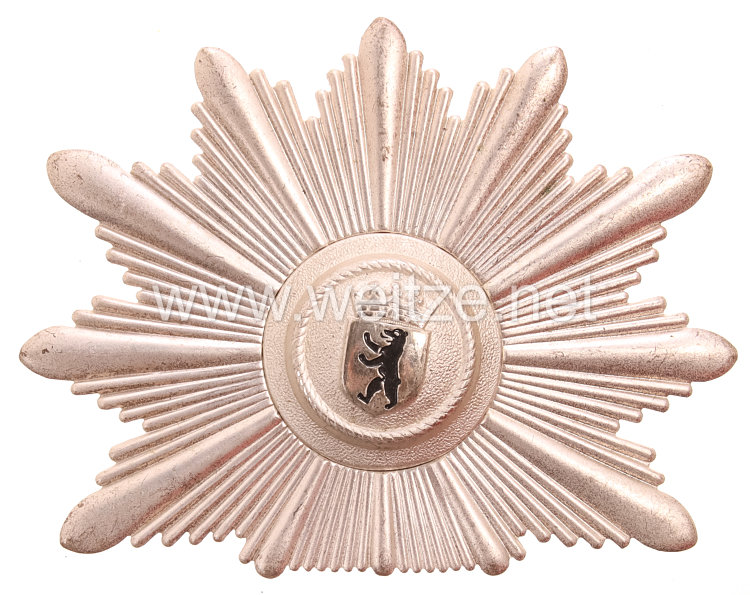
Federal Republic of Germany (FRG) City of Berlin Police Shako - Enlisted Men's Emblem
The Police Shako Emblem for Enlisted Personnel of the City of Berlin from around 1957 represents a significant phase in German police history during the early Federal Republic of Germany. This badge, manufactured from non-ferrous metal, was part of the traditional police uniform and demonstrates the continuity of certain uniform traditions in the post-war period.
After World War II and the division of Berlin in 1945, West Berlin found itself in a unique political situation. The city was formally under Allied control but gradually developed its own administrative structures. The West Berlin Police was rebuilt under the supervision of the Western Allies, with democratic principles and strict separation from military structures at the forefront.
The shako, a cylindrical headgear of military origin, had a long history in German police tradition. As early as the 19th century, this headgear was worn by Prussian military and police units. During the Weimar Republic and partially into the 1930s, the shako remained part of the ceremonial police uniform. After 1945, several German police organizations drew upon this tradition to establish a connection to democratic police traditions predating the Nazi era.
The emblem described here was manufactured around 1957, a time when the Federal Republic of Germany was consolidating its state structures. The Berlin Police received its characteristic uniforms during this period, which differed from other federal states as Berlin held a special status. The use of non-ferrous metal was typical for such emblems – an alloy usually consisting of copper, zinc, and other metals well-suited for badge manufacturing.
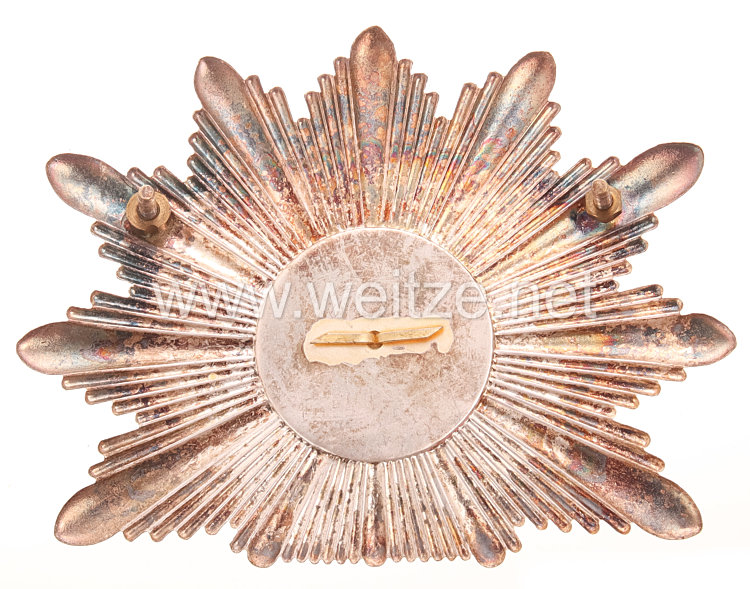
The reverse side with screw discs was the standard fastening system of this era. Unlike soldered or riveted connections, screw discs enabled secure yet removable attachment to the shako. This was practical for maintenance and replacement of uniform parts.
The designation "for enlisted personnel" is significant as it indicates the hierarchical structure of the police organization. Enlisted personnel formed the largest part of the police force and differed in their uniforms from non-commissioned officers and higher ranks. Officers often wore more elaborate or differently designed emblems, sometimes made from more valuable materials or with additional decorations.
During the 1950s, the West German police underwent a professionalization drive. Training was standardized, modern police methods were introduced, and uniforms were unified. Simultaneously, efforts were made to establish connections to positive aspects of German police history through traditional elements like the shako, while clearly distancing themselves from the Nazi past.
The Berlin police emblem typically displayed symbols of the city of Berlin, often the Berlin Bear, the city's coat of arms, or other local insignia. This local symbolism emphasized the federal structure of the Federal Republic and Berlin's special role as a divided city on the border between East and West.
However, the use of the shako in the Berlin Police was temporally limited. Throughout the 1960s and 1970s, traditional shakos were increasingly replaced by more modern, practical headgear. Ceremonial uniforms gave way to more functional designs better suited to the requirements of modern police service.
Today, such police shako emblems are sought-after collectibles that document an important chapter of German police history. They bear witness to the transitional period between traditional and modern policing and to the efforts of the young Federal Republic to build democratic institutions that embodied both authority and accessibility to citizens.