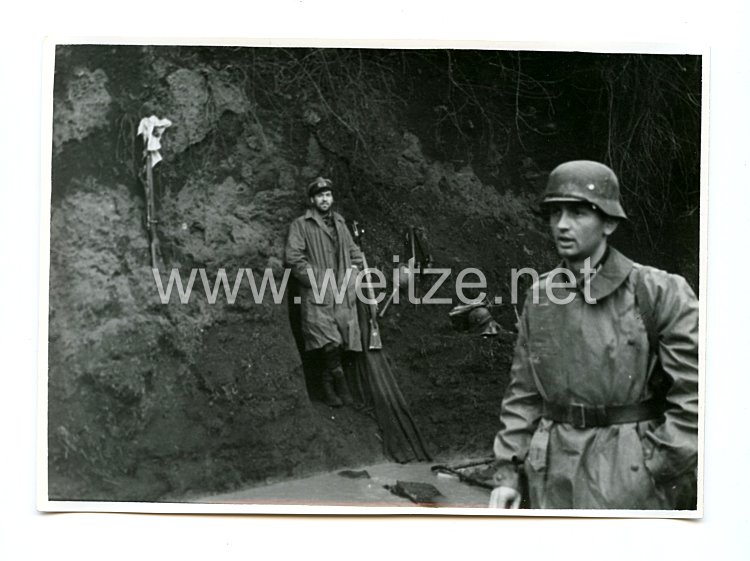
Wehrmacht Press Photo: Soldiers During a Rest Break
This Wehrmacht press photograph depicting soldiers during a rest break represents an important aspect of the National Socialist propaganda machinery during World War II (1939-1945). Such photographs were an essential component of the systematic information control and public relations efforts of the Third Reich.
The Wehrmacht Propaganda Companies (Propagandakompanien or PK) were established as early as 1938 and played a central role in the photographic documentation of war events. These units consisted of specially trained soldiers who simultaneously functioned as journalists, photographers, and cameramen. Their task was to provide material for the press, newsreels, and other media that portrayed military operations in a positive light.
Photographs like this one, showing soldiers in moments of rest, served several propaganda purposes. They were intended to convey a humanized image of the soldiers to the home front while emphasizing camaraderie and cohesion within the troops. Such images stood in contrast to dramatic combat scenes and were meant to show that soldiers remained human and approachable despite wartime circumstances.
The Supreme Command of the Wehrmacht (Oberkommando der Wehrmacht or OKW) strictly controlled the distribution of these images through the Wehrmacht Propaganda Department. Every photograph released for publication had to receive an approval stamp. The images were then distributed to newspapers and magazines domestically and abroad through the Presse-Hoffmann archive, the official photo agency of the NSDAP, or other authorized channels.
The reverse side of such press photos typically contained information such as captions, censorship numbers, photographer names, and sometimes dates. The absence of markings on the back of this specimen could have various reasons: it might be an archive copy, a duplicate, or a photograph that never reached publication.
The technical specifications of the photograph, measuring approximately 13 x 16 cm, correspond to the standard formats commonly used for press images at the time. This size allowed for easy handling in editorial offices and archives and was compatible with the reproduction techniques used for newspapers and illustrated magazines of that era.
In the context of war reporting, such “soft” images also served to obscure the brutality of war and suggest a normality that often had little in common with the reality at the front. The propaganda companies were instructed not to photograph certain aspects of the war, including fallen German soldiers, war crimes, or scenes that might undermine morale.
After the war, many of these press photographs became part of various archives, including the Federal Archives (Bundesarchiv) in Koblenz, which houses an extensive collection of Wehrmacht photographs. Today, these images are important historical sources for researching Nazi propaganda, the everyday history of the war, and the visual representation of military operations.
For collectors and historians, such press photographs provide insights into the mechanisms of image production and distribution during World War II. They document not only historical events but also the manner in which these events were to be presented to the public. The used condition of this specimen suggests that it was actually employed in an editorial office or archive.
Scholarly engagement with such materials always requires a critical perspective that considers the propagandistic intention behind the images. These photographs are not neutral documents but deliberately composed and censored representations intended to convey specific ideological messages.