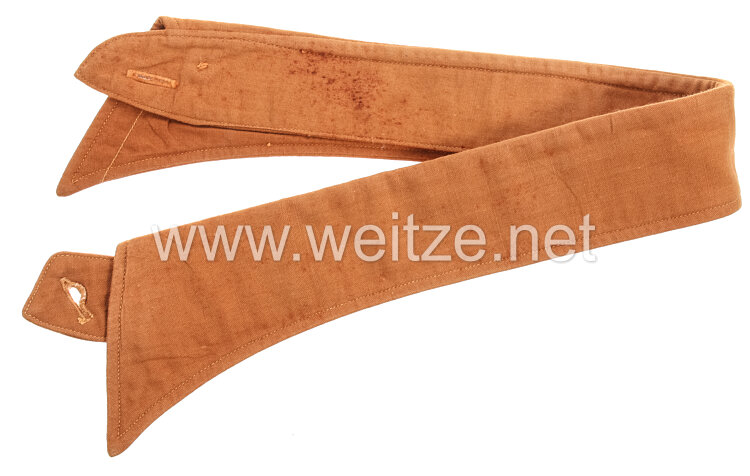
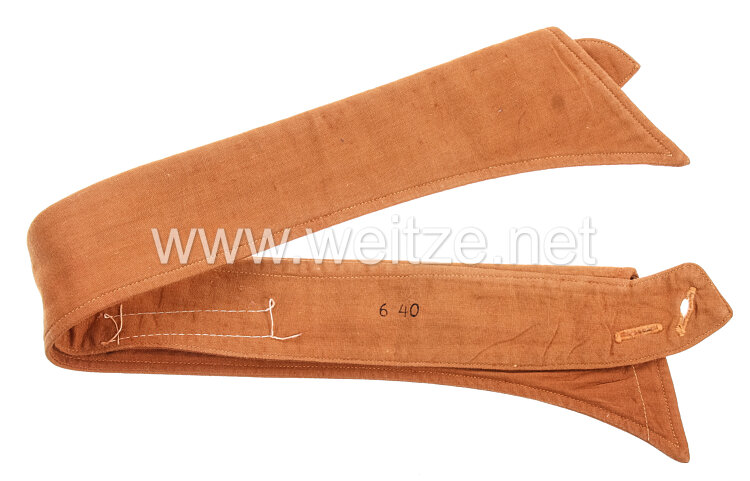
Third Reich Detachable Collar for Brown Shirt for Party Organizations
The detachable collar for the brown shirt represents a characteristic equipment element of NSDAP party organizations during the Third Reich period. These practical textile pieces served to complement and maintain the brown party uniform, which held central importance as a political symbol.
The brown shirt developed from the early 1920s as a recognizable feature of the National Socialist movement. The brown color presumably originated from an inexpensive purchase of tropical uniform stocks and later became an ideologically charged symbol of the party. From 1925 onward, after the re-founding of the NSDAP, the brown shirt established itself as standard clothing for party members of various organizations, including the SA, the NSKK, the NSFK, and other formations.
The detachable collars described here, made from brown cotton with a length of approximately 43.5 centimeters, were attached to the shirt using buttons. These removable collars fulfilled several practical functions: they enabled more frequent cleaning of the heavily used collar area without having to wash the entire shirt. This was particularly important in a time when textiles were valuable and the durability of uniforms was of economic significance.
The use of detachable collars corresponded to a long tradition in European clothing history. Already in the 19th century and during the Weimar Republic, removable collars and cuffs were common, as they extended the lifespan of shirts and reduced cleaning costs. The NSDAP adopted this practical solution for their party uniforms.
The Reichszeugmeisterei of the NSDAP, founded in 1929 and led by Jakob Werlin and later other functionaries, was responsible for standardization and quality control of party equipment. It issued detailed regulations regarding cut, color, and material of uniform parts. The detachable collars had to comply with official guidelines, with the brown cotton required to be in a specific shade matching the brown shirt.
The various party formations distinguished themselves through specific badges, rank insignia, and sometimes through colors on collar patches and shoulder straps. However, the basic cut of the brown shirt and its components remained largely uniform. Wearers were not only SA men but also members of the National Socialist Motor Corps (NSKK), the National Socialist Flying Corps (NSFK), the Hitler Youth in certain contexts, and other organizations.
With the increasing militarization of German society in the 1930s, uniform appearance in party dress gained importance. At parades, rallies, and political events, a well-groomed appearance was mandatory. Detachable collars helped ensure that uniform wearers could appear clean and orderly even with frequent use.
The production of such uniform parts was carried out by various private manufacturers licensed by the Reichszeugmeisterei. Quality could vary, although official pieces typically bore an RZM label. The economic dimension was considerable: the uniform industry employed thousands of workers and was a significant economic factor.
After the outbreak of war in 1939, the availability of textiles became increasingly restricted. However, party uniforms remained in use, particularly domestically and among functionaries not conscripted for military service. The practical detachable collars retained their significance during this period of rationing.
Today, such objects serve as testimony to a dark epoch of German history. They serve in museums and collections for historical documentation and education about the National Socialist regime and its organizational structures. Objective engagement with such artifacts is important for historical understanding of the mechanisms of totalitarian rule, which included the visual uniformization of society.